
As I write this, the United States of America, with the most powerful military in the history of the world, stands a very good chance of losing this current war with Iran, started in 2026. The US military has done far more damage to Iran’s government structure, military personnel and military equipment than Iran has done to the US’s.
Yet the level of damage done to the enemy military or country is not what determines who wins and who loses a war. It is the side that gives up its stated objectives and leaves the fight, in the face of determined opposition by the other side, that loses the war.
At the start of the war, Donald Trump stated that he wanted to 1) end the ballistic missile threat of Iran, 2) end Iran’s nuclear weapons program, and 3) end Iran’s support for proxies that threaten US interests and personnel. More recently, he has also stated 4) that the Strait of Hormuz needs to be reopened without any Iranian tolls or fees.
So, if the US ends the war and blockade without a substantial nuclear deal or the seizure of all of Iran’s enriched uranium, without securing Iranian compliance on ballistic missiles, while the Houthi proxies of Iran are threatening shipping in the Bab al-Mandab Strait, and in the process, leaves Iran with the ability to control traffic in the Strait of Hormuz and charge tolls on ships, then this counts as a complete US capitulation and loss of the war.
Unfortunately, Trump’s handling of the Iran war has led to a heavy buildup of pressure on him to stop the war like this, without achieving any of his stated objectives, and while handing at least partial control of the Strait of Hormuz over to Iran. (This control violates all international norms of the seas and amounts to a special privilege granted to the Islamic Republic of Iran that no other nation gets.)
This Iran war has led to major disruptions in the supply of oil and other goods from the Persian Gulf, generating serious shortages and price spikes. Also, as Donald Trump has justified and pursued it, this war is not very popular in America. A July 2026 poll by the University of Maryland found that 52% of Americans think that the US should end the Iran war now, and only 21% thought the US should use military force as necessary to prevent Iran from acquiring nuclear weapons. (The other 79% either favored diplomacy, or didn’t know what they thought.)
But, Donald Trump’s particular justifications and methods of fighting the Iran war aside, I think that a United States war against the Islamic Republic of Iran is completely justified. In fact, I would say that it is among the most justified military actions in the history of the United States: far more so than Vietnam, Korea, World War I, and Iraq, and perhaps even surpassing World War II and the War of 1812.
Why is such a war against Iran so justified? Because of Iran’s very long history of attacking the US by proxy, every chance it gets, and because of the nature of the Islamic Republic regime.
Summary
- To win a war means to make the other side capitulate and allow you to achieve your objectives, without further forcible opposition.
- The US war in Iran is unpopular in America and there is mounting pressure on Donald Trump to stop.
- America is in danger of losing the Iran war of 2026 because, even though it has inflicted massively disproportionate damage to Iran’s government and military, it looks to be the side that will back down from the fight, without achieving its objectives.
- A war against Iran is fully justified by Iran’s long history of proxy and direct attacks on US facilities and personnel, resulting in hundreds of American deaths. The Islamic Republic is basically the world leader of Islamist terrorism against America, Israel and the West.
- So the war against Iran should be continued and won. How can this be accomplished? Let’s look at what we know:
- The Islamic regime of Iran are all religious zealots who will never make a good-faith deal and will never give up their attempts to establish totalitarian Islam as the ruling ideology of the world. The supremacy of Islam and the duty to spread it abroad by revolutionary struggle is in the Islamic Republic’s constitution. These fanatics have shown they don’t care about oil or the Iranian economy, unless they can use them to help the triumph of Shia Islam in the world. The only way to end the ballistic missile and nuclear threat from the Iranian regime is to overthrow that regime.
- But the Iranian people are different than the Islamic regime, and the large majority, (about 90%) do not support the regime. Their mass protests have been brutally put down by the Islamic regime in a huge massacre. They want freedom, but they need to be trained, armed and organized to be effective in fighting the Islamic Revolutionary Guard Corps (IRGC).
- The Iranian people are different than the people of Iraq and Afghanistan. They are not tribal, like most Iraqis and Afghanis, and they are much more educated and individualistic than Afghanis. Iranians have already experienced something close to a modern, Western society and lifestyle. Unlike these other two national populations, most Iranians are ready for a transition to a modern, unified, stable, republican government, with democratic elections.
- Given these facts about the Iranian regime and the Iranian people, I propose a US strategy that frees the Iranian people and effectively leverages them against the regime:
- The US should employ a few Marine Expeditionary Units (MEUs) to establish a heavily defended base on the southern coast of Iran, in a rural area, (after preparing the area with airstrikes against any IRGC nearby.)
- With the base established, the US would put out the message to a nearby town that those who wish to be free of the Islamic republic, and do their part to fight it, should come to the base, bringing food, water, and any weapons they have. After depositing their weapons at the entrance to the outer perimeter and undergoing a long-distance strip-search, they would be allowed into the base to take an oath against the regime, be trained and organized. On leaving the base, they would be armed for the fight with the IRGC.
- When the people of the first town are nearly finished with their training, the call would go out to the next town, and the process would repeat. The process would work its way through nearby towns and cities, until you have an army capable of building itself, taking IRGC weapons, and gradually eliminating the IRGC throughout the entire country.
- This would all be done, initially, under heavy air defense and under air cover by the US Navy and Air Force.
- Donald Trump’s negotiations with–and his moody, whiplashing pronouncements on–the Iranian regime have given them hope that they can either get him to compromise away his objectives, or outlast his resolve to defeat them.
- What you need to win a war is a constant message to the enemy: “You will capitulate, or you will be destroyed; there is no hope of victory for you.” Trump’s negotiations and capricious statements in this war have completely undercut and subverted that message to the Iranian regime. It’s time they heard it loud and clear.
End of Summary
Iran’s Long Proxy War Against America
It started 47 years ago, even before the founding of the Islamic Republic: The rebel students, workers, intellectuals and clerics, who would later be the backbone of the Islamic Republic, took dozens of Americans in the US embassy in Tehran hostage for well over a year. This was an act of war against America, yet the US did not respond with war, at the time. The US would have been justified in attacking Tehran and occupying it, but it did not.
A little over three years later, in April of 1983, Islamic Jihad–an Iranian-backed proxy later known as Hezbollah–bombed the US embassy in Beirut, killing 63 people, including 17 Americans.
In October of the same year, Hezbollah bombed the US marine barracks in Beirut, killing 220 U.S. Marines and 21 other service personnel.
Several attacks later, in 1996, Hezbollah Al Hijaz in Saudi Arabia bombs the Khobar Towers, a U.S. Air Force housing complex in Saudi Arabia, killing 19 Americans.
In 1998, Hezbollah helped Al-Qaeda to bomb the U.S. Embassies in Kenya and Tanzania, killing 224 people, including 12 Americans.
During the US war in Iraq, Iran supported Shiite militias that, according to the Pentagon, killed over 600 US troops. Instrumental to this support was Iran’s Quds Force, a branch of the Islamic Revolutionary Guard Corps (IRGC) that specializes in asymmetric warfare, (terrorism and the arming and training of proxies) outside of Iran’s borders. When the US later killed the leader of the Quds Force, Qasem Soleimani, in Iraq, Iran directly retaliated with ballistic missiles against US bases in the Middle East, injuring American soldiers. (See: FDD Article.)
The Nature of the Iranian Regime: The Leaders of Jihad
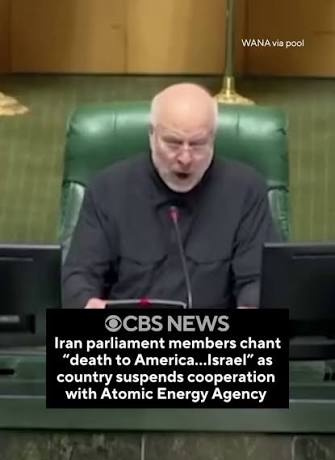
The leadership of the Islamic Republic of Iran have, for many years, regularly chanted “Death to America!” and “Death to Israel!” Since the Islamic Republic’s founding, they have called America the “Great Satan” and Israel the “Little Satan.” They have never been subtle about how they view the United States, Israel and the Western world, for anyone who has cared to listen to the domestic preaching of their leadership.
The Islamic Republic has been an open, explicit theocracy, ruled by a supreme religious leader, with a bunch of clerics under him as the body of the real government that rules the more secular officials, like the president. It has an explicitly religious, fanatical, elite military–the IRGC–that is superior to Iran’s regular military, the Artesh.
The preamble to the Constitution of the Islamic Republic of Iran states:
Our nation, in the course of its revolutionary developments, has cleansed itself of the dust and impurities that accumulated during the past and purged itself of foreign ideological influences, returning to authentic intellectual standpoints and world-view of Islam. It now intends to establish an ideal and model society on the basis of Islamic norms. The mission of the Constitution is to realize the ideological objectives of the movement and to create conditions conducive to the development of man in accordance with the noble and universal values of Islam.
With due attention to the Islamic content of the Iranian Revolution, the Constitution provides the necessary basis for ensuring the continuation of the Revolution at home and abroad. In particular, in the development of international relations, the Constitution will strive with other Islamic and popular movements to prepare the way for the formation of a single world community (in accordance with the Koranic verse “This your community is a single community, and I am your Lord, so worship Me” [21:92]), and to assure the continuation of the struggle for the liberation of all deprived and oppressed peoples in the world.
True to the mission outlined in its constitution, the Iranian regime has taken every opportunity to “strive with other Islamic and popular movements…and to assure the continuation of the struggle” for one “world community” under the rule of Sharia Law and a totalitarian form of Islam. It has become the world’s premier sponsor of Islamist terrorism and supporter of numerous Islamic proxy forces, like Hezbollah in Lebanon, the Houthis in Yemen, Shiite militias in Iraq, and Hamas in Gaza.
And, even beyond its direct efforts at funding and support for Islamist terrorism around the world, Iran serves as the major inspiration for jihadis of all sorts and all sects. Iran adheres to the Shia sect of Islam, whereas most Muslims in the world are Sunni. Many of the Islamist terrorist organizations around the world are Sunni, such as Al-Qaeda, ISIS, Hamas, and the Muslim Brotherhood. Yet Iran has helped support Hamas, because of its key position next to Israel, and Sunni Islamists can still look at Iran to see a fellow traveler and an inspirational model for what they want to achieve: a whole country run as an Islamic theocracy. They are given hope for the triumph of a Sunni caliphate by the fact that Iran continues to exist as a Shiite theocracy.
Thus, it is not too much to say that the Islamic regime of Iran is the functional leader of Islamist, jihadi terrorism in the world today. It is the only large Islamic regime that openly crusades, (heh…or “jihads”) against the United States and the Western world. Saudi Arabia, Jordan, Qatar, Oman, Syria, UAE, Kuwait and Yemen have all made friendly gestures toward the US and the West. Only Iran stays openly and resolutely opposed to everything the West stands for, in the name of Islamic theocracy.
So, to boil it down to essentials: The Iranian regime is NOT a group of corrupt thugs enjoying power for the sake of earthly wealth and crony favors, like the regime of Venezuela or Russia. Practically the whole regime is composed of ideologically committed, religiously motivated zealots, who are willing to die for the cause they believe in. They will not capitulate in the face of overwhelming US military power. They will hide in a bunker while the bombs drop, then come back to strike whenever and wherever they can. They don’t care about the Iranian economy or oil profits, except insofar as those can further the Islamic Revolution, ten or a hundred or a thousand years from now. They will do everything in their power, to their dying breath, to work toward the survival and triumph of Islamist totalitarianism in the world. They will endure anything–including a painful death–so that their great, great, great, grandchildren can live in a worldwide, totalitarian Islamic society built on the crushed and buried ruins of the Western world.
In short, these are not the sort of people Donald Trump can make any sort of genuine deal with. Any “deal” they make with the US will not be in good faith and will simply be a way for them to buy time, deceive and humiliate “the Great Satan”. This has been abundantly demonstrated in the US-Israel-Iran war of 2026. The only way to end the ballistic missile and nuclear threat from the Iranian regime is to overthrow that regime.
Fortunately, however, the nation of Iran is not only the Islamic regime and the IRGC.
Most Iranians Don’t Support the Islamic Republic
A June 2024 survey by the Group for Analyzing and Measuring Attitudes in Iran (GAMAAN) found that only 11% of Iranians supported the principles of the 1979 Islamic revolution and the Supreme Leader. The same poll found that about 80% of Iranians want the Islamic Republic regime out of power.
As economic conditions in Iran have worsened, with very high inflation, banking problems, blackouts, and even fuel rationing, it is reasonable to expect that an even higher percentage of Iranians are ready for regime change today, than were in 2024.
Countless videos coming out of Iran support the idea of general discontent with the current regime. Videos of people protesting against the regime, chanting “Death to Mojtaba Khamenei” in the middle of the night, celebrating US and Israeli attacks on the regime and thanking President Trump are all over social media.
Even after tens of thousands of unarmed Iranian protestors were murdered in the streets of Iran by the IRGC, the defiance of the Islamic regime continues. Iran has a population that, overall, is ready and eager for a revolution.
Iran is Not Afghanistan or Iraq
Before the Islamic Revolution of 1979, Iran was a fairly advanced, well-educated, Western-style society. Women went to college and wore Western skirts and bikinis, men wore bellbottoms.
To be sure, the Iranian government was not a democratic republic with the same degree of freedom as a nation like the United States, or the UK. It was an authoritarian, nationalist government. But Iranian society and culture–outside the elite in the Islamic regime of the past 47 years–has been developing in a much more individualist direction than Afghanistan or Iraq.
Today, almost 90% of adult Iranians can read and write, while only 37% of Afghanis are literate. Very few Iranians have strong loyalties to particular tribes above the nation of Iran, while very large numbers of Iraqis have strong tribal loyalties. Overall, the population of Iran bears a much stronger resemblance to the populations of stable nations like Turkey, Romania and Greece, than the populations of Afghanistan and Iraq do.
So, unlike Afghanistan and Iraq, we should not expect insurgency against the Islamic Republic to devolve into decades of lawless, tribal chaos. In fact, a decent portion of that lawless, tribal chaos was perpetuated by the interference of the Islamic Republic’s Quds Force supporting Shiite militias and helping them attack US soldiers. So a civil war in Iran that eliminates the IRGC, actually eliminates the single biggest force for lawless, tribal chaos in the Middle East.
The Basic Strategy for Total Victory Against the Islamic Republic of Iran
Given these facts about Iran, continued campaigns of airstrikes by the US and/or Israel won’t end the threat of the Islamic Republic, in any sort of reasonable time frame. The fanatics of the IRGC can keep up this game of hide-and-seek for many years. But neither is a full US invasion of hundreds of thousands of ground troops necessary.
What is needed is a strategy for the US to enable and encourage the Iranian people to rise up and eliminate the IRGC on the ground.
Thus, the basic strategy I propose is for the US to initiate a limited incursion into mainland Iran with marine expeditionary units and special forces to establish a US military compound on the southern coast. This compound would serve as a refuge and a training and staging area for Iranians who are willing to fight against the IRGC.
After establishing the base, the US would notify Iranians in one nearby town that they have a limited period of time–say, 7 days–to reach the base, before the US initiates a massive wave of strikes on the electrical power grid, water facilities and other infrastructure of that town, in order to cripple the IRGC there.
These local Iranians who are trained, organized and armed in the US compound could then be tasked with taking over that town as a pro-freedom army. When the training of the first batch of Iranians is almost complete, the US would notify a second town or city that they have a short time to get to the US base, train them, organize them and assign them the task of taking over their town or city. Eventually, this pro-freedom army would build up its numbers, seize IRGC weapons, train recruits and grow on its own. They could secure the southern coast of Iran, providing a buffer between the IRGC and the Strait of Hormuz so as to reduce the danger to shipping in the Strait. They could gather steam and root out the IRGC from its many hiding places inside Iran, eventually taking Tehran and the seats of government power.
I think this is the basic method by which the US could secure complete victory against the Islamic Republic of Iran and the only way for the US to achieve its objectives in Iran, while keeping the Strait of Hormuz as a free, international waterway.
Caveats and Details of the Strategy
I am not a trained military expert, nor do I have any inside information about the capabilities or readiness state of the various parts of the US military. But I have spent a significant amount of time learning and thinking about military tactics, capabilities and technology. So, in the following discussion of strategy, tactics and military reasoning, I am speaking as a reasonably well-informed and thoughtful layman. Any of my statements could potentially be inaccurate, and my tactics could require substantial adjustment to fit the actual state of US military capabilities or readiness, or the actual facts on the ground in Iran.
I think that the southern coast of mainland Iran is a good place for the US to establish a base, because 1) it needs to be reachable for ordinary Iranians who want to fight the IRGC, 2) its being on the coast means that it doesn’t have to worry about land-based ballistic missile attack from all directions and 3) it can receive air cover from US carrier-based aircraft relatively quickly and easily.
Before the base is established, a targeted campaign of airstrikes to eliminate as many IRGC in the area as possible would obviously be called for.
The base will obviously need to be designed to deal with lots of incoming drones and missiles, in addition to being defended against infantry assault. So the first layer of the base should consist of prefabricated or quickly assembled bunker segments, buried underground. On top of these should be built a few hardened shelter buildings. Peripheral buildings can perhaps be expendable, temporary, prefab shelters. The inner perimeter of the base could consist of Hesco bastions and a trench.
The outer perimeter of the base would be razor wire, with a minefield between the razor wire and the inner perimeter trench. One heavily guarded entry corridor would be left for Iranians to pass through as they arrive, with signs around the outer perimeter letting them know which way to go to find the entry corridor.
On being called to the US base, Iranians would be told to bring any weapons they own, as well as all the water and food that they can carry with them.
All arriving Iranians would be required to leave any weapons they’ve brought at a designated collection point near the outer perimeter entry, then strip and show they have no weapons or bombs, before proceeding to the inner perimeter gate. All adult, able-bodied Iranians would be required to be willing to perform some role in the pro-freedom army, whether in direct combat, or logistical support, or medical treatment. They would each take an oath that they are hostile to the Islamic Republic and will do everything in their power to overthrow it. Iranians would be trained to use small surveillance, FPV and top-attack drones against the IRGC. Iranians would only be given live ammunition for their supplied or brought weapons, once they are trained and organized and are outside the US base.
The base would require an extensive, layered air defense, consisting of fighter aircraft, Patriot missile systems, infantry with MANPADS, anti-drone systems, and a couple of Phalanx CIWS.
The fighter aircraft would obviously patrol the area surrounding the outer perimeter to not only knock down incoming drones and cruise missiles, but also to suppress any hostile infantry or vehicle-based assaults.
A couple of US Army brigades may be helpful or required to build, maintain and secure the base.
Time is Running Out for Trump to Do the Right Thing
The only way to end the threat to the world from the Islamic Republic of Iran is to dismantle the Islamic Republic of Iran.
Unfortunately, Donald Trump has spent a lot of time acting as though he could achieve his objectives, while leaving the Islamic regime in place. He has spent too much time spinning his wheels with rounds of airstrikes that achieve little progress in destroying the IRGC. He has spent too much time in diplomacy that only gives the Iranian regime hope that they can either get Trump to compromise away his objectives, or that they can outlast his resolve to defeat them.
Trump’s constant switching between mutually contradictory messages, like “unconditional surrender” and “hit them like they’ve never been hit,” versus “they’re very rational and we’re making good progress on a deal,” while the IRGC is continually attacking everyone around them, gives the Iranian regime hope that they can get Trump’s mood to shift to, “I don’t care, we’re done, let the rest of the world deal with the Strait of Hormuz.”
Through these five months of the Iran war, civilian ships have been disabled and sunk, the world’s oil reserves have dwindled, the necessary flow of goods out of the Persian Gulf has been stifled, and the world economy suffers more and more as time goes on. Now, it appears that the US may be running low on certain munitions that would be very helpful to have, if they were to undertake my strategy for the total defeat of the Islamic Republic.
What you want, in order to defeat an enemy in a war, is not a capricious succession of Tumpian moods, but a constant, consistent message: “You cannot win this; it is hopeless; if you continue, you will be destroyed and there is no path out but your destruction; no deal or compromise will be offered; we will be unrelenting in our actions until you capitulate; give up!” This needs to be a constant drumbeat in the enemy’s ear, projected more and more forcefully with every passing day, every airstrike, every ground assault. That is how you break the enemy’s will to fight.
That is how you win a war.
[2026-08-09 Note: Substantial edit to paragraphs 4-5 of the section, The Basic Strategy for Total Victory Against the Islamic Republic of Iran]


As your own evidence and arguments show, the enemy will not give up – no matter how hopeless the situation seems, because they believe they will go to Paradise if they are killed by infidels.
So the 40 day thing is pointless – and there is no time for it anyway. The Islamic Republic of Iran (IRI) regime must be destroyed now – time is running out before the midterms.
Without clear victory the midterms will be lost. The last six months of messing about has been a disaster with “J.D. Vance – the puppet of Tucker Carlson” written all over it.
Paul Marks. ________________________________
Please note that I have made a substantial edit to a relevant section of the essay, since you made this comment.
But, if your concern is the midterms, there is literally no way to fully win–destroy the IRGC–before the midterms, unless you’re willing to literally nuke the entirety of Iran into oblivion. But that massive breaking of the nuclear taboo and killing of millions of civilians will be even less popular in the US than what Trump is doing now. Trump will be seen as a crazy man and extremely dangerous.
What can be done is for Trump to outline a new, better strategy that actually has a good chance of working, and show that he is not stuck and all out of ideas in the Iran war. That would be the most popular move he could make, before the election.