Why “Anarcho-Capitalism” is Wrongheaded

Anti-Anarchy-symbol

Objectivism rejects anarchism for very good reason.

In the following link, Dr. Harry Binswanger explains why an officially established (“monopolistic”) government is necessary for a free society, and why the “anarcho-capitalists'” objections to it are baseless:

Anarchism vs. Objectivism

—–

Related Posts:

How to Show That Taxation is Robbery

An Objectivist Refutation of Anarcho-Capitalism (Market Anarchy)

QuickPoint 2: Altruism Supports Coercion…

The Nature of the Morality of Rational Egoism: Short Notes

Why a Proper Ethics is Not a Set of Social Rules, But a Complete Way of Life

The REAL Fiscal Cliff

While politicians and the mainstream media in the US have been busy talking about the tax laws that expire at the end of 2012, we are approaching the real “fiscal cliff” very rapidly. This cliff is further in the future and no one knows exactly when we will fall over it, but the US will fall over it if it doesn’t change direction immediately and drastically.

The US Federal debt currently stands at over $16.3 trillion and is rising by about $1 million every 40 seconds. The CBO projects massive annual deficits for the next 10 years.

The economist, Peter Schiff, spells out the harsh reality of the situation the US is getting itself into in the following set of videos:

QE stands for “Quantitative Easing,” where the the Federal Reserve creates new money and uses it to buy financial assets directly from banks. QE generates an increase in the money supply.

To paraphrase Ayn Rand: The majority of people in the US can ignore reality, but they can’t escape the consequences of ignoring reality.

The Federal Reserve is setting the US economy up for another huge crash and a round of hyperinflation. Yet, given our history, it is not hard to predict that when the big crash happens, “scheming businessmen” and/or “unscrupulous financial traders” will take the blame from the mainstream media and dominant public opinion.

This Objective Standard article describes the deeper philosophical problem: The Moral Cliff

—–

Related Posts:

What Caused the Financial Crisis: It Wasn’t Capitalism or Deregulation

QuickPoint 2: Altruism Supports Coercion…

…or “A Problem With Libertarianism”

Under altruism, (the morality of self-sacrifice,) an act of self-sacrifice can be good, even if the person sacrificing doesn’t choose to do it.

If someone’s interests are sacrificed by government force, the person committing an unwilling sacrifice doesn’t get moral credit for the act, because it was unchosen. But the act itself can still be considered “good”, apart from the choices of the “self” being sacrificed. A sacrifice is a sacrifice, regardless of whether it was freely chosen or imposed by a legal authority. Thus, under altruism, any sacrifice can be good, so long as it “benefits those in need.”

In practice, the forced imposition of sacrifice is justified on dual grounds: it will benefit those in need, while simultaneously punishing those who violate morality by being selfish. Since everyone, according to the altruist morality, really should be self-sacrificial anyway, who can object to the overall project of forced charity? We can quibble about the practical details, say the altruists, but if we want a moral society, how can we leave the needy at the mercy of other individuals’ choices?

Under the morality of altruism, the advocates of government coercion are right: A moral society requires forced charity, because without it, those who don’t sacrifice for the welfare of others will be rewarded and encouraged, and those “noble altruists” who are in need will be “left at the mercy of the selfish.”

The only way to fight this thinking is to fight for the morality of rational egoism, as established and advocated by Ayn Rand. For rational egoism, an act can only be good if it is freely chosen by the acting individual.

I highly recommend this book on how to fight for a free market: Free Market Revolution: How Ayn Rand’s Ideas Can End Big Government.

—–

Related Posts:

Atlas Shrugged, Altruism and Egoism

The Morality of Rational Egoism: Short Notes

Link Highlight: Introduction to Objectivism Playlist

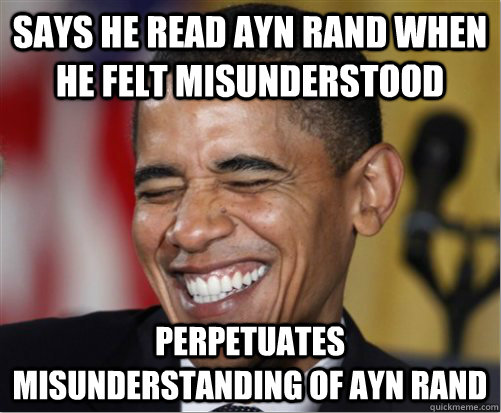
Obama “Read Ayn Rand” and Gets Her Views Wrong

In a Rolling Stone interview published today, Barack Obama distorted and misrepresented Ayn Rand’s views. Ari Armstrong of The Objective Standard responded to the president’s statements here:

Obama, Unsurprisingly, Gets Ayn Rand Wrong

The Ayn Rand Center’s blog also responded with analysis of Ayn Rand’s actual views and context that should help people understand those views:

Obama on Ayn Rand: The Annotated Version

Don Watkins has also responded to the issue Obama raised, of being an individualist and caring for other people, on the Ayn Rand Institute’s Laissez-Faire blog:

Obama’s Straw Man Attack on Ayn Rand

—–

Related Posts:

Bernie Madoff: Not Rationally Selfish, But Self-Destructive

The Morality of Rational Egoism: Short Notes

QuickPoint 1: Thinking is Individual

Atlas Shrugged, Altruism and Egoism

What Caused the Financial Crisis: It Wasn’t Capitalism or Deregulation

How to Show That Taxation is Robbery

The following article is not a general proof of the Objectivist principle that the initiation of physical force is destructive to human life; but it will show that taxation is equivalent to robbery and, when carried out for wealth redistribution, is actually more harmful to more people than the robberies committed by criminals in First-World countries. (A general proof of the destructiveness of initiated force does exist, and I may go through it at some point in the future.)

The Hypothetical Showing the Connection

If I have earned, say, $1,000 this week through my own labor, and another man comes up to me, points a gun at me, and tells me to give him the money, so he can pay his rent, is this robbery? Is it legal for him to do it? What if he tells me it’s for his friend’s rent? Is that robbery/legal? What if he gets 9 of his friends and they all tell me I need to give him my money? Is that robbery/legal? What if the 10 men write up a document that says I have to give him my money, and they include me in a vote to affirm or reject the “law” that says I should give him my money? They all vote “yes” on the “law” and I vote ”no.” “Now,” they tell me, “we as a society of 11 have drafted a law that says that you have an obligation to give us the money. We have taken a vote and you have been outvoted. As a part of our society, you now owe us this money. If you don’t give it to us, we will imprison you at gunpoint. If you don’t like what we are doing, you can leave our territory.” Is THIS robbery? Yes, the same forcible imposition of the wills of others upon me has been made. Is it legal? Yes, actually; it is now “legal,” because a law has been voted on and passed. It is legal robbery. So, the question is: How many people does it take before this practice ceases to be robbery? A hundred? A thousand? Ten million?
Continue reading