Yaron Brook: Shrugging the Stigma of Success

In this recent talk at the University of Texas-Austin, Dr. Yaron Brook, president of the Ayn Rand Institute, discusses the general American attitude toward success in business and how it is influenced by traditional moral ideas. But does traditional morality really make sense? Is it reasonable? Dr. Brook argues that it doesn’t and it isn’t.

Part 1:

Part 2:

Part 3:

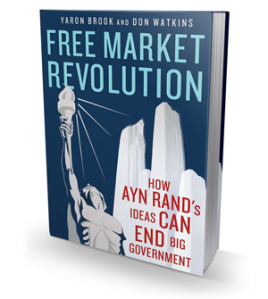
For anyone who found this talk interesting, I highly recommend reading the book, Free Market Revolution, which Dr. Brook co-authored with Don Watkins.

—–

Related Posts:

How Business Executives and Investors Create Wealth and Earn Large Incomes

Wealth is Created by Action Based on Rational Thought

What Caused the Financial Crisis: It Wasn’t Capitalism or Deregulation

Wealth is Not Money — Monetary Wages vs. Real Wages

The Nature of the Morality of Rational Egoism: Short Notes

Wealth is Created by Action Based on Rational Thought

One little bit of high-tech wealth brought to you by a lot of human thought.

One little bit of high-tech wealth brought to you by a lot of human thought.

Wealth consists of the life-promoting goods and services that people have access to. Wealth, (beyond fruit) does not grow on trees. Luxury homes do not spring up from the earth by themselves. Seasoned pork roasts do not fall from the sky. Wealth must be created by human activity.

But what kind of human activity generates wealth? Is it desiring? Does simply wanting a new car make it appear? Despite what most Keynesians will tell you, I’m afraid that it will not. (1) People have to act to create wealth. But what kind of action? If you flail your arms about mindlessly, will that create wealth? Obviously not. What is needed is action based on rational thought: That is, taking stock of one’s surroundings and the actual needs of oneself and/or others, then figuring out how to use one’s surroundings to create what is needed for the promotion of such human life, (i.e. wealth.)

To provide food, people need to think about how to plant and harvest, how to hunt, how to maintain livestock, how to store crop yields without spoilage, how to keep and prepare meat safely, etc. If no one thinks at all, everyone starves. But is all that’s required to reach today’s level of wealth, minimal, routine, low-level thought? Continue reading

Wealth is Not Money — Monetary Wages vs. Real Wages

MoneyStack-small

Not wealth.

There are many confusions that many people hold about economics today. One fairly common one that I’d like to address is the confusion of wealth with money.

Wealth consists of the actual goods and services that are available to a person. Food, medicine, clothing, houses, televisions, computers, jewelry, the services of a doctor–all of this is wealth.

Money, on the other hand, is the medium of exchange used to indirectly barter wealth. Unlike wealth, having money does you no good by yourself on an island. If the money supply in an economy is doubled, this does not increase the amount of wealth in that economy. What increases wealth in an economy is the production of material goods and the offering of valuable services.

The confusion between money and wealth tends to arise because, on an individual level with a given money supply, the way one gets access to more wealth is to get more money. But the way money translates into wealth is not a simple “more nominal money equals more wealth,” but “having a greater percentage of the money in the economy entitles one to a greater percentage of the wealth in that economy that one doesn’t already own.” Money is a claim to the wealth produced by others, (who are willing to sell) relative to the total money supply and the total wealth.

Money--Wealth Ratio

When people create wealth by producing valuable goods from raw materials or using skills to offer services, then trade these for money, they give value to the money in circulation. If they are able to produce wealth (of a type that’s needed/desired) faster than it’s consumed, they increase the value of the money in circulation. Since there are more goods and services chasing the same amount of money (assuming no more money is printed/created) the prices of the goods and services decrease. Continue reading

America Before The Entitlement State

This article by Yaron Brook and Don Watkins should be seen by all Americans, and indeed, everyone else. It describes how people dealt with sudden injuries, deaths and the various disasters that can befall people, before government welfare programs and Social Security:

America Before The Entitlement State

Here’s a video reading of a part of an essay from Capitalism: The Unknown Ideal by Ayn Rand:

—–

Related Posts:

19th-Century Capitalism Didn’t Create Poverty, But Reduced It

How to Show That Taxation is Robbery

QuickPoint 2: Altruism Supports Coercion…

The Nature of the Morality of Rational Egoism: Short Notes

19th-Century Capitalism Didn’t Create Poverty, But Reduced It

Here’s an article by Yaron Brook and Don Watkins on the near-laissez-faire capitalism of the 19th Century:

Capitalism In No Way Created Poverty, It Inherited It

—–

Related Posts:

How to Show That Taxation is Robbery

QuickPoint 2: Altruism Supports Coercion…

Why “Anarcho-Capitalism” is Wrongheaded

The Nature of the Morality of Rational Egoism: Short Notes

The False Freedom of “Equality of Opportunity”

In mainstream discourse in the US, “equality of opportunity” is taken as an uncontroversial rallying cry for both “conservatives” and “modern liberals.” It’s typically seen as a more reasonable alternative to the openly socialist “equality of results.”

Don Watkins, of the blog, LaissezFaire, has written two posts exposing the fact that “equality of opportunity,” taken literally, is just as irrational and unjust a notion as “equality of results.” (If it’s not taken literally, then it’s an extremely vague term and shouldn’t be used.)

What matters for the justice of a society is not “equality of opportunity” but the absence of initiated coercion.

Just Say “No” to Equality of Opportunity

Who Needs Opportunity?

—–

Related Posts:

On Fairness and Justice: Their Meanings, Scopes, and How They Are Not the Same

How to Show That Taxation is Robbery

QuickPoint 2: Altruism Supports Coercion…

QuickPoint 2: Altruism Supports Coercion…

…or “A Problem With Libertarianism”

Under altruism, (the morality of self-sacrifice,) an act of self-sacrifice can be good, even if the person sacrificing doesn’t choose to do it.

If someone’s interests are sacrificed by government force, the person committing an unwilling sacrifice doesn’t get moral credit for the act, because it was unchosen. But the act itself can still be considered “good”, apart from the choices of the “self” being sacrificed. A sacrifice is a sacrifice, regardless of whether it was freely chosen or imposed by a legal authority. Thus, under altruism, any sacrifice can be good, so long as it “benefits those in need.”

In practice, the forced imposition of sacrifice is justified on dual grounds: it will benefit those in need, while simultaneously punishing those who violate morality by being selfish. Since everyone, according to the altruist morality, really should be self-sacrificial anyway, who can object to the overall project of forced charity? We can quibble about the practical details, say the altruists, but if we want a moral society, how can we leave the needy at the mercy of other individuals’ choices?

Under the morality of altruism, the advocates of government coercion are right: A moral society requires forced charity, because without it, those who don’t sacrifice for the welfare of others will be rewarded and encouraged, and those “noble altruists” who are in need will be “left at the mercy of the selfish.”

The only way to fight this thinking is to fight for the morality of rational egoism, as established and advocated by Ayn Rand. For rational egoism, an act can only be good if it is freely chosen by the acting individual.

I highly recommend this book on how to fight for a free market: Free Market Revolution: How Ayn Rand’s Ideas Can End Big Government.

—–

Related Posts:

Atlas Shrugged, Altruism and Egoism

The Morality of Rational Egoism: Short Notes

Link Highlight: Introduction to Objectivism Playlist

Bernie Madoff: Not Rationally Selfish, But Self-Destructive

Bernie Madoff is sometimes held up by critics of Ayn Rand’s ethics as a poster boy for the evil of self-interest. But far from being an example of Ayn Rand’s ethics, Madoff is a type of person that Ayn Rand explicitly condemned, because he undertook an irrational–and therefore self-destructive–scheme.

Self-interest, for Ayn Rand, does not equate to simple monetary gain, or the pleasures of any given moment. Self-interest is defined by achievement of a deeply happy life over as many years as possible. Ayn Rand recognized that it is impossible to build long-term happiness by theft or fraud. One’s long-term happiness can only be based on the production of life-sustaining/enhancing values, along with honest dealings with oneself and others.

Do you think Bernie Madoff is happy now, in prison? What about while he was running his scheme? This interview should give you a sense of how much he enjoyed himself while defrauding other people:

Does this sound like a man determined to pursue his own happiness and live his life to the fullest? What must it mean for Madoff to be happier in prison, when he has no freedom and no control over his own life, than during his con? His primary emotion while in the middle of the con scheme was fear, which indicates that he sensed his life was out of control. His lies were constantly threatening to catch up with him, and it was just a matter of time before something slipped and he was caught. Continue reading

Free Market Revolution by Yaron Brook and Don Watkins

Free Market Revolution: How Ayn Rand’s Ideas Can End Big Government is now available at Amazon.

From the description:

A look at how our current crises are caused by too much government, and how Ayn Rand’s bold defense of free markets can help us change course.

The rise of the Tea Party and the 2010 election results revealed that tens of millions of Americans are alarmed by Big Government, but skeptical that anything can or will be done to stop the growth of the state. In Free Market Revolution, the keepers of Ayn Rand’s legacy argue that the answer lies in her pioneering philosophy of capitalism and self-interest -a philosophy that more and more people are turning to for answers. In the past few years, Rand’s works have surged to new peaks of popularity, as politicians like Paul Ryan, media figures like John Stossel, and businessmen like John Mackey routinely name her as one of their chief influences. Here, Brook and Watkins explain how her ideas can solve a host of political and economic ills, including the debt crisis, inflation, overregulation, and the swelling welfare state. And most important, they show how Rand’s philosophy can enable defenders of the free market to seize the moral high ground in the fight to limit government. This is a fresh and urgent look at the ideas of one of the most controversial figures in modern history – ideas that may prove the only hope for the future.

To anyone who is relatively unfamiliar with Ayn Rand’s ideas, but interested in solving our current economic and cultural problems, I encourage you to read this book. I encourage anyone who is very familiar with Rand’s ideas to tell friends about this book, loan your copy to them, or give it to them as a gift.

To purchase, click here:
Free Market Revolution: How Ayn Rand’s Ideas Can End Big Government

EDIT: Here’s a really good video from the CATO Institute with the authors of Free Market Revolution: Free Market Revolution at CATO