The following article is not a general proof of the Objectivist principle that the initiation of physical force is destructive to human life; but it will show that taxation is equivalent to robbery and, when carried out for wealth redistribution, is actually more harmful to more people than the robberies committed by criminals in First-World countries. (A general proof of the destructiveness of initiated force does exist, and I may go through it at some point in the future.)
The Hypothetical Showing the Connection
If I have earned, say, $1,000 this week through my own labor, and another man comes up to me, points a gun at me, and tells me to give him the money, so he can pay his rent, is this robbery? Is it legal for him to do it? What if he tells me it’s for his friend’s rent? Is that robbery/legal? What if he gets 9 of his friends and they all tell me I need to give him my money? Is that robbery/legal? What if the 10 men write up a document that says I have to give him my money, and they include me in a vote to affirm or reject the “law” that says I should give him my money? They all vote “yes” on the “law” and I vote ”no.” “Now,” they tell me, “we as a society of 11 have drafted a law that says that you have an obligation to give us the money. We have taken a vote and you have been outvoted. As a part of our society, you now owe us this money. If you don’t give it to us, we will imprison you at gunpoint. If you don’t like what we are doing, you can leave our territory.” Is THIS robbery? Yes, the same forcible imposition of the wills of others upon me has been made. Is it legal? Yes, actually; it is now “legal,” because a law has been voted on and passed. It is legal robbery. So, the question is: How many people does it take before this practice ceases to be robbery? A hundred? A thousand? Ten million? Continue reading →
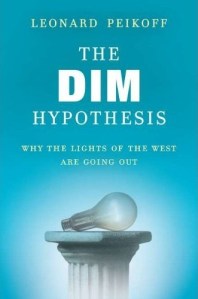
Dr. Peikoff’s last work of philosophy/historical analysis,The DIM Hypothesis was released today.
From the Amazon description:
With his groundbreaking and controversial DIM hypothesis, Dr. Leonard Peikoff casts a penetrating new light on the process of human thought, and thereby on Western culture and history.
In this far-reaching study, Peikoff identifies the three methods people use to integrate concrete data into a whole, as when connecting diverse experiments by a scientific theory, or separate laws into a Constitution, or single events into a story. The first method, in which data is integrated through rational means, he calls Integration. The second, which employs non-rational means, he calls Misintegration. The third is Disintegration—which is nihilism, the desire to tear things apart.
In The DIM Hypothesis Peikoff demonstrates the power of these three methods in shaping the West, by using the categories to examine the culturally representative fields of literature, physics, education, and politics. His analysis illustrates how the historical trends in each field have been dominated by one of these three categories, not only today but during the whole progression of Western culture from its beginning in Ancient Greece.
Extrapolating from the historical pattern he identifies, Peikoff concludes by explaining why the lights of the West are going out—and predicts the most likely future for the United States.
After a brief introduction to Atlas Shrugged, this essay provides a very good overview of the alternative between altruism and egoism. While not a work of technical philosophy, it is substantial: it quotes philosophers and textbooks that explain the meaning of altruism and clearly differentiates what rational egoism means for one’s life, versus what altruism means. It also generally outlines Ayn Rand’s argument for life as the standard of value and for rational egoism.
Well, it’s finally happened: The impoverished reasoning methods employed by academic philosophy have infected YouTube comments….Shocking, I know….
But, all kidding aside, when most academic philosophers (who aren’t deeply acquainted with Objectivist literature and lecture courses) read about Ayn Rand’s axioms, they tend to deride them as tautologies. They can’t possibly imagine how you could deduce a whole philosophical system from such tautologies. Well, they have something in common with my interlocutor (mirabileamavi) in the comments of a YouTube video. Hopefully, my concise answers to him (her?) should be clarifying:
Interlocutor: …How do you derive causation from tautologies?
Me: The “tautologies” you speak of are axioms. If something is truly an axiom, it is too fundamental to be conceptually analyzed, but is perceptually self-evident. You need only observe reality to see that it is true.
Int: i still dont understand how you can derive causation from tautologies.
‘john’, from that i can infer ‘john’ is ‘john’ but i can’t infer that ‘john is a fireman’ can i? the predicate ‘is a fireman’ is not contained in ‘john’. while ‘john’ is ‘john’ is necessarily true and tautological, ‘john is a fireman’ certainly is not. from a=a we cannot infer that a=b.
heres an example: ‘frank ramsey’, who is his father, what is his occupation? obvious all you can infer is that F.R. is F.R., nothing else.
Me: At the level of bare axioms, all we can say is that, because John is John, John must act as John. That’s it: causality is a corollary of identity. But to identify John as a fireman, we cannot simply deduce from the axiom. We must specifically observe firemen in order to form the concept “fireman.” We must then observe John and see that he fits the concept. (Intro. to Objectivist Epistemology) Once we have observed he is a fireman, causality tells us he can’t swim and lay eggs as a female squid.
Int: ‘is’ is not equivalent to ‘act’.
okie, look at this from another angle. since identity is universally necessary, 2 is 2 is also an identity statement. but what does it mean to say that 2 act as 2? or for that matter, john act as john? if not just ‘john is john’.
from john is john nothing else follows. not causality, not anything. let me ask you again, what casual anything can you deduce from ‘frank ramsey’. thats right, nothing.
Me: An entity’s identity includes its qualities and capacities for action/reaction. We can isolate and focus on them in our thinking, by abstraction, but they cannot be separated in concrete reality. Causality is a corollary of identity, not a separately deduced fact. As a corollary, it is simply another way of looking at the same fundamental fact: an entity is itself. It’s self-evident: look at reality.
2 is a quantitative abstraction. Whatever 2 entities you are focusing on will act as themselves.
Int: take our friend ‘fr’ as an example, obviously we can infer ‘fr’ is ‘fr’ via any standard of formal logic. but we can’t infer ‘fr’ is also p. why? because additional information is needed to establish the new inference.
to say something is corollary is to say that something follows from another. but how do you infer from ‘fr’ without the additional info. that ‘fr’ is also p? can i seriously validly infer that A, therefore B, C, D, X…?
i.e. how am i justified in seeing arsenic for the first time to infer that it can or cannot kill? surely none of its properties follows from my visual perception of it or the mere knowing of its name. yes we can know its effects/properties through observation, but thats an additional step, not something that merely follows from our acquaintance with it.
Me: For the last time, Objectivism doesn’t say you can infer any specific properties/actions of entities from “A=A.” To see that arsenic is deadly, you make specific observations of its effects. Once you have induced that arsenic is deadly, you know that once you have identified a specific sample as arsenic, it will be deadly when taken. Without causality, arsenic wouldn’t have to behave as arsenic, and there’s no way to know what will happen if you ingest it; it could make you live 1000 years.
So the basic point here is that, in Objectivism, proceeding from the axioms does not mean deduction, but induction. The truth of the axioms (including the validity of the senses) makes induction from observationpossible (that is, generalization; including concept formation as a certain type of induction.)
The major model of system building in modern Western philosophy has been that of the rationalists, who deduce consequences from “a priori postulates,” “intuitive” starting points, or mathematical axioms. Thus, when confronted with a philosophic system like Objectivism that claims axioms, most contemporary philosophers simply assume that the axioms are intended as a deductive starting point. They then rightly observe that nothing can be deduced from the axioms alone, and claim that Objectivism is a failure, or is not “serious” philosophy.
This is what I was referring to by “the impoverished reasoning methods employed by academic philosophy”: Real induction, which is a method of generating principles, has been largely supplanted by probabilistic reasoning, which most contemporary philosophers call “induction.”
The details of how induction works in various fields of knowledge is an active area of research among Objectivist philosophers. But we have cases of induction and general guidelines for how to form valid inductions left by Ayn Rand, and explicated by Leonard Peikoff. I recommend Understanding Objectivism: A Guide to Learning Ayn Rand’s Philosophy and Objectivism Through Induction by Leonard Peikoff.
The video below is not directly relevant to the above, but is an excerpt from one of Rand’s essays that makes general points about philosophy, reason and emotions.
At the link below, Don Watkins of the blog, Laissez-Faire, describes Rachel Maddow’s misrepresentation of Ayn Rand’s philosophy. Anyone who actually reads Atlas Shrugged should be able to tell that Maddow’s statement is a misrepresentation. Yet this seems to be a rather common falsehood passed around by Rand’s detractors.
Below are links to Yaron Brook’s explanation of how the US housing bubble and financial crisis happened. Yaron Brook has an MBA, a Ph.D. in Finance, and was a professor of finance at a university.
Here is a short video on what caused the crisis:
Here is an audio course that goes through the details of what happened and why:

 Objectivism In Depth