By the nature of the following refutation of determinism, it can also be considered a proof (1) of (libertarian-type) volition. It is a refutation of any theory that would deny the existence of non-necessitated events–in the form of fundamental, agent-controlled choices–located in a conceptual consciousness, including incompatibilist determinism and compatibilism.
Here is a short video (by someone else) explaining the general outlines of the argument:
(1) The argument shows that volition is a prerequisite of all knowledge and that the denial of volitional choice implies self-contradiction, thus establishing volitional choice as an axiom of epistemology. Strictly speaking, I think, by Leonard Peikoff’s definitions, this is not a proof, but an axiomatic validation. It establishes the axiom as absolutely and unquestionably true, but does not involve the specific process of logical proof of the positive proposition. The positive proposition is self-evident in each individual’s experience of existence.
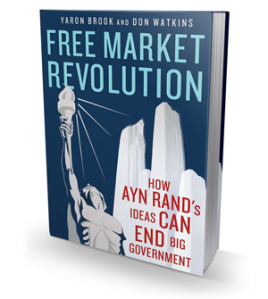
A look at how our current crises are caused by too much government, and how Ayn Rand’s bold defense of free markets can help us change course.
The rise of the Tea Party and the 2010 election results revealed that tens of millions of Americans are alarmed by Big Government, but skeptical that anything can or will be done to stop the growth of the state. In Free Market Revolution, the keepers of Ayn Rand’s legacyargue that the answer lies in her pioneering philosophy of capitalism and self-interest -a philosophy that more and more people are turning to for answers. In the past few years, Rand’s works have surged to new peaks of popularity, as politicians like Paul Ryan, media figures like John Stossel, and businessmen like John Mackey routinely name her as one of their chief influences. Here, Brook and Watkins explain how her ideas can solve a host of political and economic ills, including the debt crisis, inflation, overregulation, and the swelling welfare state. And most important, they show how Rand’s philosophy can enable defenders of the free market to seize the moral high ground in the fight to limit government. This is a fresh and urgent look at the ideas of one of the most controversial figures in modern history – ideas that may prove the only hope for the future.
To anyone who is relatively unfamiliar with Ayn Rand’s ideas, but interested in solving our current economic and cultural problems, I encourage you to read this book. I encourage anyone who is very familiar with Rand’s ideas to tell friends about this book, loan your copy to them, or give it to them as a gift.
The following article is not a general proof of the Objectivist principle that the initiation of physical force is destructive to human life; but it will show that taxation is equivalent to robbery and, when carried out for wealth redistribution, is actually more harmful to more people than the robberies committed by criminals in First-World countries. (A general proof of the destructiveness of initiated force does exist, and I may go through it at some point in the future.)
The Hypothetical Showing the Connection
If I have earned, say, $1,000 this week through my own labor, and another man comes up to me, points a gun at me, and tells me to give him the money, so he can pay his rent, is this robbery? Is it legal for him to do it? What if he tells me it’s for his friend’s rent? Is that robbery/legal? What if he gets 9 of his friends and they all tell me I need to give him my money? Is that robbery/legal? What if the 10 men write up a document that says I have to give him my money, and they include me in a vote to affirm or reject the “law” that says I should give him my money? They all vote “yes” on the “law” and I vote ”no.” “Now,” they tell me, “we as a society of 11 have drafted a law that says that you have an obligation to give us the money. We have taken a vote and you have been outvoted. As a part of our society, you now owe us this money. If you don’t give it to us, we will imprison you at gunpoint. If you don’t like what we are doing, you can leave our territory.” Is THIS robbery? Yes, the same forcible imposition of the wills of others upon me has been made. Is it legal? Yes, actually; it is now “legal,” because a law has been voted on and passed. It is legal robbery. So, the question is: How many people does it take before this practice ceases to be robbery? A hundred? A thousand? Ten million? Continue reading →
Well, it’s finally happened: The impoverished reasoning methods employed by academic philosophy have infected YouTube comments….Shocking, I know….
But, all kidding aside, when most academic philosophers (who aren’t deeply acquainted with Objectivist literature and lecture courses) read about Ayn Rand’s axioms, they tend to deride them as tautologies. They can’t possibly imagine how you could deduce a whole philosophical system from such tautologies. Well, they have something in common with my interlocutor (mirabileamavi) in the comments of a YouTube video. Hopefully, my concise answers to him (her?) should be clarifying:
Interlocutor: …How do you derive causation from tautologies?
Me: The “tautologies” you speak of are axioms. If something is truly an axiom, it is too fundamental to be conceptually analyzed, but is perceptually self-evident. You need only observe reality to see that it is true.
Int: i still dont understand how you can derive causation from tautologies.
‘john’, from that i can infer ‘john’ is ‘john’ but i can’t infer that ‘john is a fireman’ can i? the predicate ‘is a fireman’ is not contained in ‘john’. while ‘john’ is ‘john’ is necessarily true and tautological, ‘john is a fireman’ certainly is not. from a=a we cannot infer that a=b.
heres an example: ‘frank ramsey’, who is his father, what is his occupation? obvious all you can infer is that F.R. is F.R., nothing else.
Me: At the level of bare axioms, all we can say is that, because John is John, John must act as John. That’s it: causality is a corollary of identity. But to identify John as a fireman, we cannot simply deduce from the axiom. We must specifically observe firemen in order to form the concept “fireman.” We must then observe John and see that he fits the concept. (Intro. to Objectivist Epistemology) Once we have observed he is a fireman, causality tells us he can’t swim and lay eggs as a female squid.
Int: ‘is’ is not equivalent to ‘act’.
okie, look at this from another angle. since identity is universally necessary, 2 is 2 is also an identity statement. but what does it mean to say that 2 act as 2? or for that matter, john act as john? if not just ‘john is john’.
from john is john nothing else follows. not causality, not anything. let me ask you again, what casual anything can you deduce from ‘frank ramsey’. thats right, nothing.
Me: An entity’s identity includes its qualities and capacities for action/reaction. We can isolate and focus on them in our thinking, by abstraction, but they cannot be separated in concrete reality. Causality is a corollary of identity, not a separately deduced fact. As a corollary, it is simply another way of looking at the same fundamental fact: an entity is itself. It’s self-evident: look at reality.
2 is a quantitative abstraction. Whatever 2 entities you are focusing on will act as themselves.
Int: take our friend ‘fr’ as an example, obviously we can infer ‘fr’ is ‘fr’ via any standard of formal logic. but we can’t infer ‘fr’ is also p. why? because additional information is needed to establish the new inference.
to say something is corollary is to say that something follows from another. but how do you infer from ‘fr’ without the additional info. that ‘fr’ is also p? can i seriously validly infer that A, therefore B, C, D, X…?
i.e. how am i justified in seeing arsenic for the first time to infer that it can or cannot kill? surely none of its properties follows from my visual perception of it or the mere knowing of its name. yes we can know its effects/properties through observation, but thats an additional step, not something that merely follows from our acquaintance with it.
Me: For the last time, Objectivism doesn’t say you can infer any specific properties/actions of entities from “A=A.” To see that arsenic is deadly, you make specific observations of its effects. Once you have induced that arsenic is deadly, you know that once you have identified a specific sample as arsenic, it will be deadly when taken. Without causality, arsenic wouldn’t have to behave as arsenic, and there’s no way to know what will happen if you ingest it; it could make you live 1000 years.
So the basic point here is that, in Objectivism, proceeding from the axioms does not mean deduction, but induction. The truth of the axioms (including the validity of the senses) makes induction from observationpossible (that is, generalization; including concept formation as a certain type of induction.)
The major model of system building in modern Western philosophy has been that of the rationalists, who deduce consequences from “a priori postulates,” “intuitive” starting points, or mathematical axioms. Thus, when confronted with a philosophic system like Objectivism that claims axioms, most contemporary philosophers simply assume that the axioms are intended as a deductive starting point. They then rightly observe that nothing can be deduced from the axioms alone, and claim that Objectivism is a failure, or is not “serious” philosophy.
This is what I was referring to by “the impoverished reasoning methods employed by academic philosophy”: Real induction, which is a method of generating principles, has been largely supplanted by probabilistic reasoning, which most contemporary philosophers call “induction.”
The details of how induction works in various fields of knowledge is an active area of research among Objectivist philosophers. But we have cases of induction and general guidelines for how to form valid inductions left by Ayn Rand, and explicated by Leonard Peikoff. I recommend Understanding Objectivism: A Guide to Learning Ayn Rand’s Philosophy and Objectivism Through Induction by Leonard Peikoff.
The video below is not directly relevant to the above, but is an excerpt from one of Rand’s essays that makes general points about philosophy, reason and emotions.

 Objectivism In Depth