Linktoberfest: Self-Interest, Healthcare and the Environmental Benefits of Fossil Fuels

I had an enjoyable and productive discussion with a lovely young woman on her blog. Theresa Fross just turned 18, and I can tell that she’s open to new ideas. She’s clearly intelligent and thoughtful, and we discussed Ayn Rand’s novels, the nature of life, values, self-interest, Christianity, and Buddhism. The discussion starts midway down the comments section, then, at one point, continues above my first post:

My discussion with Theresa Fross

Yaron Brook, president of the Ayn Rand Institute, discusses the immorality of the government forcing people to pay for the health care of others:

You Are Not Your Neighbor’s Health Care Provider

Alex Epstein, president of the Center for Industrial Progress, gives a lecture at Vassar College on how Fossil Fuels Improve the Planet. Right now, it is only fossil fuels that make the current human population of the earth sustainable. His talk was momentarily disrupted by environmentalist protesters:

Everyone who agrees that liberty is a good thing should read this book:

Free Market Revolution: How Ayn Rand’s Ideas Can End Big Government by Yaron Brook and Don Watkins

I especially recommend it for those who are sympathetic to the Tea Party Patriots.

—–

Related Posts:

The Nature of the Morality of Rational Egoism: Short Notes

Why Healthcare in the US is So Expensive, and What Can Be Done About It

Atlas Shrugged, Altruism and Egoism

What Caused the Financial Crisis: It Wasn’t Capitalism or Deregulation

Fossil Fuels and Environment: McKibben vs. Epstein, Full Debate

QuickPoint 4: It Is Not Racist to Judge One Culture Superior to Another

A culture is a set of ideas and practices that constitute a general way of thinking about the world and a typical way of life. Ideas can be correct or incorrect. Practices based on those ideas can be conducive to human life, or destructive of it. In short, ideas and practices can be objectively good or bad for people.

The judgment of certain cultures (ideas and practices) as better than other cultures is entirely separate from the phenomenon of racism. Racism, broadly, is the idea that one’s race, genetics, or ancestry is a determining factor in the content of his or her consciousness. Consequently, it is the idea that one can determine something about what someone believes by studying his genetic or ancestral lineage. This often takes the form of moral value judgments based on race or ethnicity.

There are some cultures that have historically been associated with large numbers of people in certain genetic groups, such as “Jewish culture” and “American Black culture.” But there is no necessary connection between genetics and culture. Anyone can be a part of any culture, according to his education and personal choices. Thus, a judgment of “American Black culture” as inferior to “Chinese-American culture” is not a judgment of an African lineage as inferior to a Chinese lineage. It is simply an acknowledgment of the fact that the cultural ideas and practices that have traditionally been accepted by large numbers of African-Americans are less conducive to human well-being than those that have traditionally been accepted by large numbers of Chinese-Americans. (It is this difference that is reflected in vastly different crime rates between the two groups.)

The irony here is that it is actually racist to consider a person’s culture to be determined by his genetics. Thus, it is actually racist to consider the evaluative ranking of cultures “racist.”

—–

Related Posts:

The Nature of the Morality of Rational Egoism: Short Notes

Values Are Relational But Not Subjective

Why Morality is Not “Evolved,” But Defined and Chosen

Why a Proper Ethics is Not a Set of Social Rules, But a Complete Way of Life

Atlas Shrugged, Altruism and Egoism

A Facebook Debate on the Right to Abortion

The following exchange is taken from the comments on a post on the Objectivism for Intellectuals Facebook page. Rather than using the name of my interlocutor here, I will refer to her as “Her.” Irrelevant portions of the debate have been omitted.

Her:  So, being against abortion is irrational? I had no idea murder was a faith-only immorality.

Me:  It’s not murder if an embryo or fetus doesn’t have rights as an actual, independent human being. The religious “basis” for considering embryos to have rights is that they have already received a “soul.” This “soul” is a mystical construct with no basis in reality. There is no rational basis for a soul that can be separated from a developed and functioning brain. The mother is an actual, independent human with rights. The embryo is not.  Continue reading

QuickPoint 3: The Basis of Ayn Rand’s Ethics in a Nutshell

The Virtue of SelfishnessI observe long-term survival that I may objectively define human flourishing,* and the means to it. I aim at my objective flourishing that I may achieve happiness.

*Flourishing” is fulfilling one’s natural goal as well as possible. For living organisms, this means fulfilling an ideal pattern or mode of life as the type of organism each is. For man, this means choosing to make maximal use of his basic, distinctive means of survival–his conceptual faculty. Rand identifies this as the “survival of man qua man.”]

This is, in my understanding, the most basic summary of Rand’s program in “The Objectivist Ethics,” an essay within The Virtue of Selfishness. I think that keeping these two sentences in mind while reading the essay will help many people understand Rand’s points more fully.

—–

Related Posts:

The Nature of the Morality of Rational Egoism: Short Notes

Values Are Relational But Not Subjective

Why Each Person Can Have Only One Ultimate Value

Why a Proper Ethics is Not a Set of Social Rules, But a Complete Way of Life

Atlas Shrugged, Altruism and Egoism

The Wages of Altruism: Domestic Abuse

“If anyone would come after me, let him deny himself and take up his cross and follow me.

“If anyone would come after me, let him deny himself and take up his cross and follow me.”    — Jesus of Nazareth

Altruism is not the equivalent of helping friends, or general benevolence to strangers. Altruism is putting the interests of others first, before your own. It is harming yourself and your life so that others may be better off (allegedly.) It is giving of yourself to others when it is against your long-term interests (mental and physical) to do so.

Christianity manifestly preaches this self-sacrifice for others–this altruism–with respect to one’s own interests in the real world:

“But I tell you, do not resist an evil person. If anyone slaps you on the right cheek, turn to them the other cheek also. And if anyone wants to sue you and take your shirt, hand over your coat as well. If anyone forces you to go one mile, go with them two miles. Give to the one who asks you, and do not turn away from the one who wants to borrow from you.

“You have heard that it was said, ‘You shall love your neighbor and hate your enemy.’ But I say to you, Love your enemies and pray for those who persecute you…” –Jesus (Matthew 5:39-44)

Continue reading

Why Morality is Not “Evolved,” But Defined and Chosen

Star-Wars-Evolution-Evolution-Funny-485x728Note: I recommend reading the entire article, but if you really need just a summary, scroll down to the bottom of the post and see the “Summary” section.

I often hear people say that morality is evolved, especially those who are in the naturalist-humanist camp. But what would it mean for morality to be “evolved,” and is it true? Physical evolution by natural selection is a well established fact, but is the view of human moral theories and practices as products of evolution, in the same category?

To start to answer this, we need to clarify what we mean when we say that “morality is evolved.”

The first part of this statement is “morality.” What is morality? Ayn Rand defined morality as “a code of values to guide man’s choices and actions—the choices and actions that determine the purpose and the course of his life.” (1) So morality is a code or set of fundamental values accepted by choice, in order to guide particular choices toward some ultimate goal. Along with the basic, primary values in morality, come the basic types or modes of action by which the basic values are to be achieved. These basic modes of action are called “virtues.” Continue reading

Why a Proper Ethics is Not a Set of Social Rules, But a Complete Way of Life

ayn_rands_normative_ethics_the_virtuous_egoist_300Note: I recommend reading the entire article, but if you really need just a summary, scroll down to the bottom of the post and see the “Summary” section. Also, the image on the right is not meant to imply that this article is from Dr. Smith’s book. This is my essay.

Many people today–especially in the atheist/skeptic/naturalist subculture–think of ethics as a set of rules that applies only to interactions with other people. They don’t think that primarily personal decisions can be considered immoral, but only actions that harm (or don’t help) others.

One will find, however, that a great many historical philosophers considered ethics to encompass a complete way of life; both the personal and the social aspects. Aristotle, Epicurus, the Stoics, Thomas Aquinas, Immanuel Kant and Ayn Rand all regarded ethics as defining the proper way to live. Indeed, the dictionary definition of ethics as “the branch of philosophy dealing with values relating to human conduct, with respect to the rightness and wrongness of actions and the goodness and badness of motives and ends,” does not specify that “goodness and badness” must be “social.”

Were all these philosophers wrong in their idea of the basic place of ethics in human life? Were they fundamentally misguided in their whole approach to ethical questions? Is the dictionary definition of ethics wrong? Here I will examine the facts of the case for morality as a set of principles that provide guidance for a complete way of life, versus morality as a set of rules for promoting “proper” social interaction. Continue reading

Why Each Person Can Have Only One Ultimate Value

A value is, in Ayn Rand’s words, “that which one acts to gain and/or keep.” It is a goal of a set of actions. Most values are pursued for the sake of gaining other values. For example, a new hammer may be pursued in order for someone to build a scaffold. The scaffold is itself pursued in order to allow the construction of a house. The house is pursued in order that the builder may live there and thus have a richer, more comfortable life. The hammer is valuable in order to get the scaffold, the scaffold is valuable in order to get the house, the house is valuable in order to improve one’s quality of life. This progression can be termed a “value chain.”

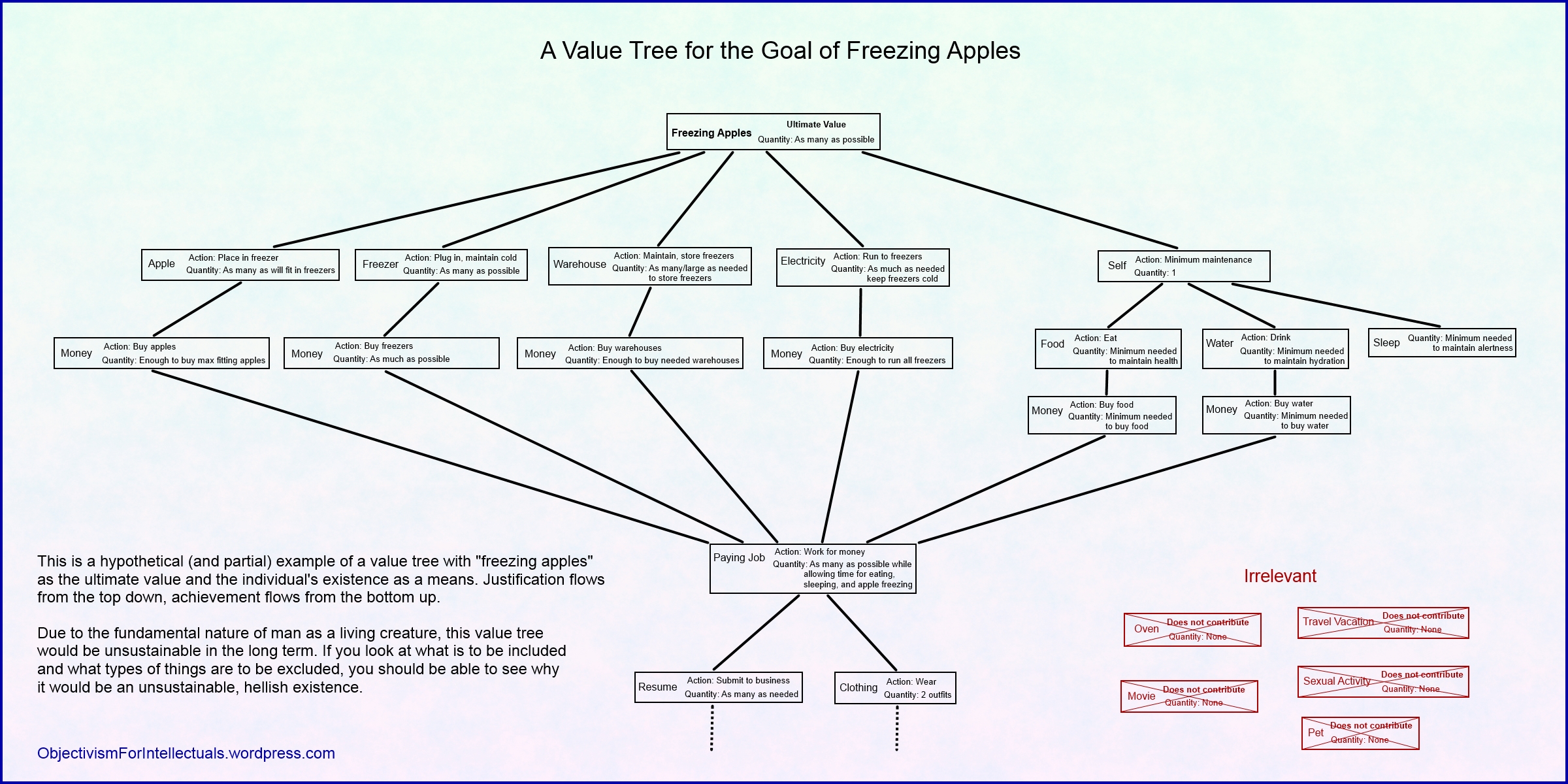
A value chain cannot go on infinitely. A person must have some ultimate value that serves to justify and motivate the others. A set of value chains that converge on a single ultimate value may be termed a “value tree.”  The ultimate value is an end-in-itself that is never pursued primarily as a means to something else.

An example of a hypothetical value tree. This tree would be possible for someone to attempt, but would be unsustainable. Click to enlarge.

An example of a hypothetical value tree. This tree would be possible for someone to attempt, but would be unsustainable. Click to enlarge.

So the question I will answer is: Can a person be committed to more than one separate value tree, each leading to a separate ultimate value?

Having two different value trees means that two different sets of actions are required to achieve each ultimate value. The actions required to achieve one will continually conflict with the actions required to achieve the other. Thus, a choice will be required to select only one of the two appropriate actions at a given time. As one obvious example, consider a man who has Ultimate Value 1 (UV1) as “freeze apples” and Ultimate Value 2 (UV2) as “bake cakes.” He has just obtained eight hundred dollars. He owns neither a freezer nor an oven. If he wants to pursue UV1, he should buy a freezer. If he wants to pursue UV2, he should buy an oven. How is he to decide where to spend his money? The way one decides with a single ultimate value is by determining which option better promotes that ultimate value in the current situation. But with two distinct ultimate values, there is no way to decide rationally. The man making the choice might as well flip a coin. There is no rational way to decide which ultimate value to pursue at any given time.

Having an ultimate value means that every decision should be weighed by how much it contributes to that ultimate value. It means that the person should plan in advance for how best to achieve as much of the value as possible. It means ruthlessly cutting out any value that is not a part of that particular value tree, because only values that serve the ultimate value are justified. In the case of UV1, this means freezing as many apples as possible while one is alive. For UV2, this means baking as many cakes as possible. But if a man holds these two “ultimate” values, then he cannot plan in advance how to achieve either one to the best of his ability. There are necessarily many situations where he does not act to gain and/or keep each of the purported ultimate values. The very fact that there are two “ultimate” values means that they violate and contradict each other. So, in a very real sense, he does not actually value either of the “ultimate values” as ultimate values.

Therefore, having two ultimate values is, in a strict sense, self-contradictory and impossible.

More realistic examples of attempts to posit more than one ultimate value will be discussed in upcoming articles. One article will deal with one’s own life versus socialization as ultimate values (Link) and another will discuss an example of life vs. flute playing.

I also recommend Viable Values: A Study of Life as the Root and Reward of Morality and Ayn Rand’s Normative Ethics: The Virtuous Egoist by Tara Smith.

—–

Related Posts:

Values Are Relational But Not Subjective

The Nature of the Morality of Rational Egoism: Short Notes

Atlas Shrugged, Altruism and Egoism

On Fairness and Justice: Their Meanings, Scopes, and How They Are Not the Same

A Philosophy Professor Discusses Ayn Rand in his Ethics Class

Dr. Gregory Sadler of Marist College recently discussed Ayn Rand’s The Virtue of Selfishness in his Spring 2013 Ethics class and posted the video to YouTube:

Dr. Sadler is not an Objectivist, but he gives what is, in my view, a good introductory presentation on Rand’s ethics. I encourage anyone interested in the broader study of Rand in academia, to watch this video (at least in part) and leave polite comments on the YouTube video page.

My main critiques of Dr. Sadler’s presentation have already been voiced in the page comments. They are the following:

Overall, this is a very good presentation of Rand’s ethics. Thank you, Dr. Sadler.

Just a few points: Contrary to 52:48, Rand wouldn’t say the choice of friends is arbitrary, but ought to depend on their objective virtues/values. Vicious people harm one’s own life when you’re involved with them; virtuous people typically benefit one’s own life.

Also worth emphasizing: Man *creates* wealth/values (material and spiritual) by acting on proper reasoning. There isn’t a fixed “pie.”

Also, Rand regards virtues as eminently practical. A breach of integrity has very real, self-destructive consequences in the long-term. There is no gap between morally principled action and practical action. (Practical for achieving long-term flourishing.)

Finally, “Ayn” rhymes with “mine.” : )

—–

Related Posts:

The Nature of the Morality of Rational Egoism: Short Notes

Atlas Shrugged, Altruism and Egoism

Values Are Relational But Not Subjective

Values Are Relational, But Not Subjective

There are many people in the world who will say that values are subjective. You may or may not be one of them. For many, the reasoning behind this stance is that they see that different people value different things, and they think that if values were objective, then everyone would value the same things. So they conclude that all values are the opposite of objective, which is subjective.

This article will give evidence and argument that this view is mistaken; that this reasoning is based on a confusion about what it means for values to be objective.

First, let’s consider a simple physical situation: Two men are standing on opposite sides of a pole, as shown in Case 1 of the figure below. We are looking down on them, and they are both facing upward. For Person A, the pole is on the right. For Person B, the pole is on the left. Does this mean that the position of the pole is subjective? No. Both men can look objectively at the relationship of the pole to each one. If they specify whose relationship to the pole they are talking about, they can both agree on the fact of the relationship.

Relational and Objective Values Diagram

When Person A observes that the pole is on his right, Person B can observe that Person A is correct: relative to Person A, the pole is objectively on the right. They can also both agree that, relative to Person B, the pole is objectively on the left. The position of the pole is objective, but its physical relationship with Person A is different than with Person B. Continue reading