Human Emotions are the Products of Beliefs and Subconscious Value Judgments

The Virtue of SelfishnessIn The Virtue of Selfishness, Ayn Rand wrote,

Just as the pleasure-pain mechanism of man’s body is an automatic indicator of his body’s welfare or injury, a barometer of its basic alternative, life or death—so the emotional mechanism of man’s consciousness is geared to perform the same function, as a barometer that registers the same alternative by means of two basic emotions: joy or suffering. Emotions are the automatic results of man’s value judgments integrated by his subconscious; emotions are estimates of that which furthers man’s values or threatens them, that which is for him or against him—lightning calculators giving him the sum of his profit or loss.

But while the standard of value operating the physical pleasure-pain mechanism of man’s body is automatic and innate, determined by the nature of his body—the standard of value operating his emotional mechanism, is not. Since man has no automatic knowledge, he can have no automatic values; since he has no innate ideas, he can have no innate value judgments.

Man is born with an emotional mechanism, just as he is born with a cognitive mechanism; but, at birth, both are “tabula rasa.” [“blank slate”] It is man’s cognitive faculty, his mind, that determines the content of both. Man’s emotional mechanism is like an electronic computer, which his mind has to program—and the programming consists of the values his mind chooses.

But since the work of man’s mind is not automatic, his values, like all his premises, are the product either of his thinking or of his evasions: man chooses his values by a conscious process of thought—or accepts them by default, by subconscious associations, on faith, on someone’s authority, by some form of social osmosis or blind imitation. Emotions are produced by man’s premises, held consciously or subconsciously, explicitly or implicitly.

Man has no choice about his capacity to feel that something is good for him or evil, but what he will consider good or evil, what will give him joy or pain, what he will love or hate, desire or fear, depends on his standard of value. If he chooses irrational values, he switches his emotional mechanism from the role of his guardian to the role of his destroyer. The irrational is the impossible; it is that which contradicts the facts of reality; facts cannot be altered by a wish, but they can destroy the wisher.

Here Miss Rand is referring to the specifically human form of emotion. But let’s start with the most basic form in which emotions manifest: in non-human animals.
Continue reading

QuickPoint 4: It Is Not Racist to Judge One Culture Superior to Another

A culture is a set of ideas and practices that constitute a general way of thinking about the world and a typical way of life. Ideas can be correct or incorrect. Practices based on those ideas can be conducive to human life, or destructive of it. In short, ideas and practices can be objectively good or bad for people.

The judgment of certain cultures (ideas and practices) as better than other cultures is entirely separate from the phenomenon of racism. Racism, broadly, is the idea that one’s race, genetics, or ancestry is a determining factor in the content of his or her consciousness. Consequently, it is the idea that one can determine something about what someone believes by studying his genetic or ancestral lineage. This often takes the form of moral value judgments based on race or ethnicity.

There are some cultures that have historically been associated with large numbers of people in certain genetic groups, such as “Jewish culture” and “American Black culture.” But there is no necessary connection between genetics and culture. Anyone can be a part of any culture, according to his education and personal choices. Thus, a judgment of “American Black culture” as inferior to “Chinese-American culture” is not a judgment of an African lineage as inferior to a Chinese lineage. It is simply an acknowledgment of the fact that the cultural ideas and practices that have traditionally been accepted by large numbers of African-Americans are less conducive to human well-being than those that have traditionally been accepted by large numbers of Chinese-Americans. (It is this difference that is reflected in vastly different crime rates between the two groups.)

The irony here is that it is actually racist to consider a person’s culture to be determined by his genetics. Thus, it is actually racist to consider the evaluative ranking of cultures “racist.”

—–

Related Posts:

The Nature of the Morality of Rational Egoism: Short Notes

Values Are Relational But Not Subjective

Why Morality is Not “Evolved,” But Defined and Chosen

Why a Proper Ethics is Not a Set of Social Rules, But a Complete Way of Life

Atlas Shrugged, Altruism and Egoism

QuickPoint 3: The Basis of Ayn Rand’s Ethics in a Nutshell

The Virtue of SelfishnessI observe long-term survival that I may objectively define human flourishing,* and the means to it. I aim at my objective flourishing that I may achieve happiness.

*Flourishing” is fulfilling one’s natural goal as well as possible. For living organisms, this means fulfilling an ideal pattern or mode of life as the type of organism each is. For man, this means choosing to make maximal use of his basic, distinctive means of survival–his conceptual faculty. Rand identifies this as the “survival of man qua man.”]

This is, in my understanding, the most basic summary of Rand’s program in “The Objectivist Ethics,” an essay within The Virtue of Selfishness. I think that keeping these two sentences in mind while reading the essay will help many people understand Rand’s points more fully.

—–

Related Posts:

The Nature of the Morality of Rational Egoism: Short Notes

Values Are Relational But Not Subjective

Why Each Person Can Have Only One Ultimate Value

Why a Proper Ethics is Not a Set of Social Rules, But a Complete Way of Life

Atlas Shrugged, Altruism and Egoism

Why Each Person Can Have Only One Ultimate Value

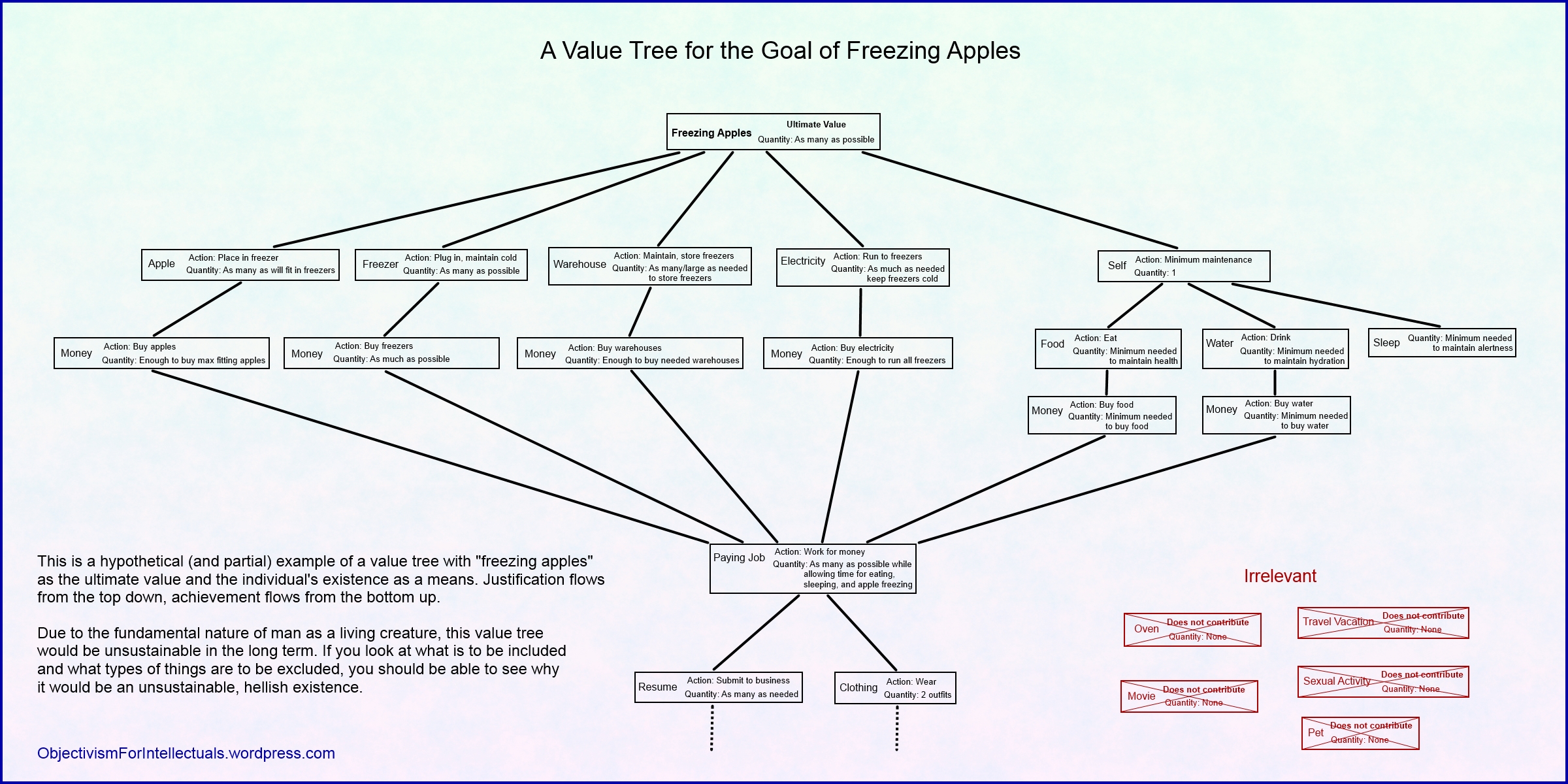
A value is, in Ayn Rand’s words, “that which one acts to gain and/or keep.” It is a goal of a set of actions. Most values are pursued for the sake of gaining other values. For example, a new hammer may be pursued in order for someone to build a scaffold. The scaffold is itself pursued in order to allow the construction of a house. The house is pursued in order that the builder may live there and thus have a richer, more comfortable life. The hammer is valuable in order to get the scaffold, the scaffold is valuable in order to get the house, the house is valuable in order to improve one’s quality of life. This progression can be termed a “value chain.”

A value chain cannot go on infinitely. A person must have some ultimate value that serves to justify and motivate the others. A set of value chains that converge on a single ultimate value may be termed a “value tree.”  The ultimate value is an end-in-itself that is never pursued primarily as a means to something else.

An example of a hypothetical value tree. This tree would be possible for someone to attempt, but would be unsustainable. Click to enlarge.

An example of a hypothetical value tree. This tree would be possible for someone to attempt, but would be unsustainable. Click to enlarge.

So the question I will answer is: Can a person be committed to more than one separate value tree, each leading to a separate ultimate value?

Having two different value trees means that two different sets of actions are required to achieve each ultimate value. The actions required to achieve one will continually conflict with the actions required to achieve the other. Thus, a choice will be required to select only one of the two appropriate actions at a given time. As one obvious example, consider a man who has Ultimate Value 1 (UV1) as “freeze apples” and Ultimate Value 2 (UV2) as “bake cakes.” He has just obtained eight hundred dollars. He owns neither a freezer nor an oven. If he wants to pursue UV1, he should buy a freezer. If he wants to pursue UV2, he should buy an oven. How is he to decide where to spend his money? The way one decides with a single ultimate value is by determining which option better promotes that ultimate value in the current situation. But with two distinct ultimate values, there is no way to decide rationally. The man making the choice might as well flip a coin. There is no rational way to decide which ultimate value to pursue at any given time.

Having an ultimate value means that every decision should be weighed by how much it contributes to that ultimate value. It means that the person should plan in advance for how best to achieve as much of the value as possible. It means ruthlessly cutting out any value that is not a part of that particular value tree, because only values that serve the ultimate value are justified. In the case of UV1, this means freezing as many apples as possible while one is alive. For UV2, this means baking as many cakes as possible. But if a man holds these two “ultimate” values, then he cannot plan in advance how to achieve either one to the best of his ability. There are necessarily many situations where he does not act to gain and/or keep each of the purported ultimate values. The very fact that there are two “ultimate” values means that they violate and contradict each other. So, in a very real sense, he does not actually value either of the “ultimate values” as ultimate values.

Therefore, having two ultimate values is, in a strict sense, self-contradictory and impossible.

More realistic examples of attempts to posit more than one ultimate value will be discussed in upcoming articles. One article will deal with one’s own life versus socialization as ultimate values (Link) and another will discuss an example of life vs. flute playing.

I also recommend Viable Values: A Study of Life as the Root and Reward of Morality and Ayn Rand’s Normative Ethics: The Virtuous Egoist by Tara Smith.

—–

Related Posts:

Values Are Relational But Not Subjective

The Nature of the Morality of Rational Egoism: Short Notes

Atlas Shrugged, Altruism and Egoism

On Fairness and Justice: Their Meanings, Scopes, and How They Are Not the Same

What Interdependence Means and Why Society Isn’t Interdependent

Morpheus on Society-WatermarkInterdependence is a state of a group in which removal or destruction of one portion (subset) of the group necessarily results in the destruction of all members of the group. (1)

One example of interdependence is the set of critical organs in a human body. Taken as units in themselves, the brain, heart and lungs are interdependent: removal or destruction of one of them necessitates the destruction of the others. Another example of interdependence is the caste system in eusocial insects like bees, ants and termites. The reproductive caste and worker caste are each needed to keep the hive (and thus the other) productive and alive.

A division-of-labor society of human beings takes on a superficial appearance of interdependence. Different people do different jobs and rely on those in other specialties for raw materials and general trade. But unlike real interdependent systems, individuals in a society can exercise independent judgment and change occupations. An individual’s job is not set for life in his genetics, but chosen by the individual. People can and do get promoted, change jobs, change career types, etc. Companies in a free market can and do expand into new fields of business.

If, in a hypothetical, laissez-faire capitalist society, all those who performed one sort of productive job were suddenly removed, then it is still possible for those in other professions to take over the job and maintain a similar division of labor. There might be great hardship for a while from such a sudden displacement, but since most other individuals would be able to adapt and survive, the society fails the test for interdependence. (This is to say nothing of the more realistic, gradual removal of people from an occupation, which a capitalist society can undergo with most people hardly noticing. In contrast, if lung tissue were gradually removed from your body, it would become harder and harder for your other organs to function, and your heart would not transform to replace the missing lung tissue.)

Moreover, not all activities undertaken by all other individuals in a society are valuable to a given individual. In fact, some are positively harmful, such as dishonest schemes, irresponsible investment plans, and theft. Since each individual has free will–the choice to think or not, to judge or not, and the capacity to behave destructively toward self and others–it is up to the independent judgment of each individual to determine friend from foe. Other people can’t be dissolved into an undifferentiated mass of beneficence, let alone all be considered critical to one’s own survival. (Easily observable facts refute this collectivist notion.)

If one individual is physically injured to the point of mental damage or paralysis, then that person can become genuinely dependent on other individuals who provide his care and sustenance. But this metaphysical dependence goes only one way: the injured is dependent on the uninjured, not vice versa. There is no “interdependence” here.

Ordinary, healthy, adult human beings are fundamentally independent creatures, and assertions to the contrary are spurious. I have only ever heard vague assertions of “interdependence” from people. I have never heard “interdependence” defined, even though such a definition is a prerequisite to any rational argument about whether or not a society of human beings is “interdependent.” (2)

—–

(1) This is existential interdependence–i.e. interdependence for continued existence as entities of a certain class. The common definitions of “interdependence” and “dependence” are philosophically vacuous.

(2) Dictionary definitions are unhelpful: interdependent – mutually dependent; depending on each other.”

dependent – relying on someone or something else for aid, support, etc.” [Webster’s College Dictionary, 1996]

Relying, in what way? Aid from whom? What happens if the support doesn’t come from whomever? This definition is useless philosophically, since it can encompass everything from an appointment with one doctor out of many to have a wart removed, to being fed through a tube because you’re paralyzed for life. The required definition is one of metaphysical (inter-)dependence, which is philosophically significant, and is the definition I gave at the start of this article.

—–

Related Posts:

America Before The Entitlement State

The Nature of the Morality of Rational Egoism: Short Notes

Atlas Shrugged, Altruism and Egoism

On Fairness and Justice: Their Meanings, Scopes, and How They Are Not the Same

Values Are Relational But Not Subjective

Values Are Relational, But Not Subjective

There are many people in the world who will say that values are subjective. You may or may not be one of them. For many, the reasoning behind this stance is that they see that different people value different things, and they think that if values were objective, then everyone would value the same things. So they conclude that all values are the opposite of objective, which is subjective.

This article will give evidence and argument that this view is mistaken; that this reasoning is based on a confusion about what it means for values to be objective.

First, let’s consider a simple physical situation: Two men are standing on opposite sides of a pole, as shown in Case 1 of the figure below. We are looking down on them, and they are both facing upward. For Person A, the pole is on the right. For Person B, the pole is on the left. Does this mean that the position of the pole is subjective? No. Both men can look objectively at the relationship of the pole to each one. If they specify whose relationship to the pole they are talking about, they can both agree on the fact of the relationship.

Relational and Objective Values Diagram

When Person A observes that the pole is on his right, Person B can observe that Person A is correct: relative to Person A, the pole is objectively on the right. They can also both agree that, relative to Person B, the pole is objectively on the left. The position of the pole is objective, but its physical relationship with Person A is different than with Person B. Continue reading

QuickPoint 1: Thinking is Individual

There are some people who say that ideas are products of a culture as a whole–that no one stands apart from the collective.

But where do ideas come from originally? Before an idea could be in many minds, it had to be in one mind. Thus, ideas come from individual thought. People can and do learn a great deal from others through their experience, but the process of thinking is a fundamentally, inescapably individual process. Learning from others does not mean parroting word sounds, but thinking about the material you are given. Before an idea can be taught, it must be thought of by an individual. Innovative individuals are those who use their own minds to think of new ideas, and thus move the “knowledge of the culture” (i.e. the sum of the knowledge of the network of communicating individuals) forward.

When people work to solve problems as a team, any individual who isn’t thinking on his own, with his physically separate brain, will not contribute to the discussion and will not make any breakthroughs.

—–

Note: At some point, I will likely write a longer article on this issue.