QuickPoint 3: The Basis of Ayn Rand’s Ethics in a Nutshell

The Virtue of SelfishnessI observe long-term survival that I may objectively define human flourishing,* and the means to it. I aim at my objective flourishing that I may achieve happiness.

*Flourishing” is fulfilling one’s natural goal as well as possible. For living organisms, this means fulfilling an ideal pattern or mode of life as the type of organism each is. For man, this means choosing to make maximal use of his basic, distinctive means of survival–his conceptual faculty. Rand identifies this as the “survival of man qua man.”]

This is, in my understanding, the most basic summary of Rand’s program in “The Objectivist Ethics,” an essay within The Virtue of Selfishness. I think that keeping these two sentences in mind while reading the essay will help many people understand Rand’s points more fully.

—–

Related Posts:

The Nature of the Morality of Rational Egoism: Short Notes

Values Are Relational But Not Subjective

Why Each Person Can Have Only One Ultimate Value

Why a Proper Ethics is Not a Set of Social Rules, But a Complete Way of Life

Atlas Shrugged, Altruism and Egoism

The Wages of Altruism: Domestic Abuse

“If anyone would come after me, let him deny himself and take up his cross and follow me.

“If anyone would come after me, let him deny himself and take up his cross and follow me.”    — Jesus of Nazareth

Altruism is not the equivalent of helping friends, or general benevolence to strangers. Altruism is putting the interests of others first, before your own. It is harming yourself and your life so that others may be better off (allegedly.) It is giving of yourself to others when it is against your long-term interests (mental and physical) to do so.

Christianity manifestly preaches this self-sacrifice for others–this altruism–with respect to one’s own interests in the real world:

“But I tell you, do not resist an evil person. If anyone slaps you on the right cheek, turn to them the other cheek also. And if anyone wants to sue you and take your shirt, hand over your coat as well. If anyone forces you to go one mile, go with them two miles. Give to the one who asks you, and do not turn away from the one who wants to borrow from you.

“You have heard that it was said, ‘You shall love your neighbor and hate your enemy.’ But I say to you, Love your enemies and pray for those who persecute you…” –Jesus (Matthew 5:39-44)

Continue reading

Dr. Burzynski and Hank Rearden: Real Life Mimicks Atlas Shrugged…Again

atlasshruggedIn the novel, Atlas Shrugged, the great steel tycoon, Henry “Hank” Rearden and his assistants create a metal alloy that’s stronger, lighter and cheaper to produce than steel. For this great achievement, the government subjects Rearden to every form of business obstruction it can muster. This includes a propaganda campaign, new laws and attempts to badger Rearden into selling the rights to the metal to a government institution.

In the real world, Dr. Stanislaw Burzynski and his team developed a cancer treatment that’s more effective (for some cancers), safer to administer and that produces much milder side-effects than radiation and traditional chemotherapy. For this great achievement, Dr. Burzynski was subjected to a harrowing, multi-year ordeal of interference by the FDA and state government.

This incredible, real-world progression of events is meticulously and compellingly documented in the 2010 film, “Burzynski,” currently available on Netflix streaming.

While the documentary is a searing indictment of the FDA, it is less compelling in its attempt to implicate the competitive drive of big pharmaceutical companies as the motive power behind the persecution of Burzynski. The evidence for this connection is relatively scanty. But it is certainly possible that there is some influence there, and it is definitely true that the FDA’s persecution of Burzynski served to insulate “big pharma” from competition. This would be another real-world parallel to Atlas Shrugged. There the politically connected steel baron, Orren Boyle, is involved in the government persecution of Hank Rearden, in order to eliminate his more able, productive and efficient competition.

But the lesson to draw from “Burzynski” is not that the pharmaceutical industry needs to be more heavily regulated, or that the FDA needs more “oversight.” The lesson is that the FDA needs to be abolished. Companies of all kinds will always want to remove obstacles and competition from their paths, but without the FDA regulatory machinery, they would have no way to do this by legalized force. They would only be able to overcome competition through superior efficiency and customer service. (Any coercive methods would be criminal.)

Moreover, the regulatory institutions of the state give politicians and bureaucrats the power to violate the decisions of individuals and private companies in the name of “the public interest.” This distorts economic decision-making, cripples market efficiency, and leads to pressure group warfare as described by Ayn Rand in Capitalism: The Unknown Ideal:

‘So long as a concept such as “the public interest” (or the “social” or “national” or “international” interest) is regarded as a valid principle to guide legislation—lobbies and pressure groups will necessarily continue to exist. Since there is no such entity as “the public,” since the public is merely a number of individuals, the idea that “the public interest” supersedes private interests and rights, can have but one meaning: that the interests and rights of some individuals take precedence over the interests and rights of others.

‘If so, then all men and all private groups have to fight to the death for the privilege of being regarded as “the public.” The government’s policy has to swing like an erratic pendulum from group to group, hitting some and favoring others, at the whim of any given moment—and so grotesque a profession as lobbying (selling “influence”) becomes a full-time job. If parasitism, favoritism, corruption, and greed for the unearned did not exist, a mixed economy would bring them into existence.

‘Since there is no rational justification for the sacrifice of some men to others, there is no objective criterion by which such a sacrifice can be guided in practice. All “public interest” legislation (and any distribution of money taken by force from some men for the unearned benefit of others) comes down ultimately to the grant of an undefined, undefinable, non-objective, arbitrary power to some government officials.

‘The worst aspect of it is not that such a power can be used dishonestly, but that it cannot be used honestly. The wisest man in the world, with the purest integrity, cannot find a criterion for the just, equitable, rational application of an unjust, inequitable, irrational principle.’

In this case, the “public interest” coincides with the short-range “protection” of the major pharmaceutical companies, since their “partnership” with the FDA represents the “established system” of “ensuring the safety and efficacy of drugs.”

If the US were to institute a system of government that only protects the individual rights of citizens from the coercion and fraud of others, its people would be much better off than with the FDA.

—–

Related Posts:

America Before The Entitlement State

19th-Century Capitalism Didn’t Create Poverty, But Reduced It

How to Show That Taxation is Robbery

QuickPoint 2: Altruism Supports Coercion…

What Caused the Financial Crisis: It Wasn’t Capitalism or Deregulation

Dr. Burzynski and Hank Rearden: Real Life Mimicks Atlas Shrugged…Again

atlasshruggedIn the novel, Atlas Shrugged, the great steel tycoon, Henry “Hank” Rearden and his assistants create a metal alloy that’s stronger, lighter and cheaper to produce than steel. For this great achievement, the government subjects Rearden to every form of business obstruction it can muster. This includes a propaganda campaign, new laws and attempts to badger Rearden into selling the rights to the metal to a government institution.

In the real world, Dr. Stanislaw Burzynski and his team developed a cancer treatment that’s more effective (for some cancers), safer to administer and that produces much milder side-effects than radiation and traditional chemotherapy. For this great achievement, Dr. Burzynski was subjected to a harrowing, multi-year ordeal of interference by the FDA and state government.

This incredible, real-world progression of events is meticulously and compellingly documented in the 2010 film, “Burzynski,” currently available on Netflix streaming.

While the documentary is a searing indictment of the FDA, it is less compelling in its attempt to implicate the competitive drive of big pharmaceutical companies as the motive power behind the persecution of Burzynski. The evidence for this connection is relatively scanty. But it is certainly possible that there is some influence there, and it is definitely true that the FDA’s persecution of Burzynski served to insulate “big pharma” from competition. This would be another real-world parallel to Atlas Shrugged. There the politically connected steel baron, Orren Boyle, is involved in the government persecution of Hank Rearden, in order to eliminate his more able, productive and efficient competition.

But the lesson to draw from “Burzynski” is not that the pharmaceutical industry needs to be more heavily regulated, or that the FDA needs more “oversight.” The lesson is that the FDA needs to be abolished. Companies of all kinds will always want to remove obstacles and competition from their paths, but without the FDA regulatory machinery, they would have no way to do this by legalized force. They would only be able to overcome competition through superior efficiency and customer service. (Any coercive methods would be criminal.)

Moreover, the regulatory institutions of the state give politicians and bureaucrats the power to violate the decisions of individuals and private companies in the name of “the public interest.” This distorts economic decision-making, cripples market efficiency, and leads to pressure group warfare as described by Ayn Rand in Capitalism: The Unknown Ideal:

‘So long as a concept such as “the public interest” (or the “social” or “national” or “international” interest) is regarded as a valid principle to guide legislation—lobbies and pressure groups will necessarily continue to exist. Since there is no such entity as “the public,” since the public is merely a number of individuals, the idea that “the public interest” supersedes private interests and rights, can have but one meaning: that the interests and rights of some individuals take precedence over the interests and rights of others.

‘If so, then all men and all private groups have to fight to the death for the privilege of being regarded as “the public.” The government’s policy has to swing like an erratic pendulum from group to group, hitting some and favoring others, at the whim of any given moment—and so grotesque a profession as lobbying (selling “influence”) becomes a full-time job. If parasitism, favoritism, corruption, and greed for the unearned did not exist, a mixed economy would bring them into existence.

‘Since there is no rational justification for the sacrifice of some men to others, there is no objective criterion by which such a sacrifice can be guided in practice. All “public interest” legislation (and any distribution of money taken by force from some men for the unearned benefit of others) comes down ultimately to the grant of an undefined, undefinable, non-objective, arbitrary power to some government officials.

‘The worst aspect of it is not that such a power can be used dishonestly, but that it cannot be used honestly. The wisest man in the world, with the purest integrity, cannot find a criterion for the just, equitable, rational application of an unjust, inequitable, irrational principle.’

In this case, the “public interest” coincides with the short-range “protection” of the major pharmaceutical companies, since their “partnership” with the FDA represents the “established system” of “ensuring the safety and efficacy of drugs.”

If the US were to institute a system of government that only protects the individual rights of citizens from the coercion and fraud of others, its people would be much better off than with the FDA.

—–

Related Posts:

America Before The Entitlement State

19th-Century Capitalism Didn’t Create Poverty, But Reduced It

How to Show That Taxation is Robbery

QuickPoint 2: Altruism Supports Coercion…

What Caused the Financial Crisis: It Wasn’t Capitalism or Deregulation

Why Morality is Not “Evolved,” But Defined and Chosen

Star-Wars-Evolution-Evolution-Funny-485x728Note: I recommend reading the entire article, but if you really need just a summary, scroll down to the bottom of the post and see the “Summary” section.

I often hear people say that morality is evolved, especially those who are in the naturalist-humanist camp. But what would it mean for morality to be “evolved,” and is it true? Physical evolution by natural selection is a well established fact, but is the view of human moral theories and practices as products of evolution, in the same category?

To start to answer this, we need to clarify what we mean when we say that “morality is evolved.”

The first part of this statement is “morality.” What is morality? Ayn Rand defined morality as “a code of values to guide man’s choices and actions—the choices and actions that determine the purpose and the course of his life.” (1) So morality is a code or set of fundamental values accepted by choice, in order to guide particular choices toward some ultimate goal. Along with the basic, primary values in morality, come the basic types or modes of action by which the basic values are to be achieved. These basic modes of action are called “virtues.” Continue reading

The Arbitrary (from The Objectivism Seminar)

The Objectivism Seminar is a podcast series that features informal discussions of the works of Ayn Rand, Leonard Peikoff, and others, (mostly Objectivist intellectuals.) It takes the form of a conference call between a number of Objectivists/Students of Objectivism, where they summarize, discuss and mull over the ideas presented.

This episode features a nice discussion of the section of Leonard Peikoff’s Objectivism (OPAR), titled “The Arbitrary as Neither True Nor False.”

The Objectivism Seminar: The Arbitrary

Here’s the TalkShoe page for the podcast.

Here’s the Ayn Rand Lexicon page on the Arbitrary.

—–

Related Posts:

Objectivism vs. Intrinsicism vs. Subjectivism: A Short Summary

The Bible (New Testament) as Evidence

A Refutation of the Argument from Design

The Nature of the Morality of Rational Egoism: Short Notes

Why a Proper Ethics is Not a Set of Social Rules, But a Complete Way of Life

ayn_rands_normative_ethics_the_virtuous_egoist_300Note: I recommend reading the entire article, but if you really need just a summary, scroll down to the bottom of the post and see the “Summary” section. Also, the image on the right is not meant to imply that this article is from Dr. Smith’s book. This is my essay.

Many people today–especially in the atheist/skeptic/naturalist subculture–think of ethics as a set of rules that applies only to interactions with other people. They don’t think that primarily personal decisions can be considered immoral, but only actions that harm (or don’t help) others.

One will find, however, that a great many historical philosophers considered ethics to encompass a complete way of life; both the personal and the social aspects. Aristotle, Epicurus, the Stoics, Thomas Aquinas, Immanuel Kant and Ayn Rand all regarded ethics as defining the proper way to live. Indeed, the dictionary definition of ethics as “the branch of philosophy dealing with values relating to human conduct, with respect to the rightness and wrongness of actions and the goodness and badness of motives and ends,” does not specify that “goodness and badness” must be “social.”

Were all these philosophers wrong in their idea of the basic place of ethics in human life? Were they fundamentally misguided in their whole approach to ethical questions? Is the dictionary definition of ethics wrong? Here I will examine the facts of the case for morality as a set of principles that provide guidance for a complete way of life, versus morality as a set of rules for promoting “proper” social interaction. Continue reading

The Theme

A musical theme for this blog. I choose it not because it’s my favorite piece of music ever, (though it is fairly high on the list) but because it fits how I feel about the blog. I only wish it were longer. This theme music for the blog has been added to the About page, and may change from time to time.

Why Each Person Can Have Only One Ultimate Value

A value is, in Ayn Rand’s words, “that which one acts to gain and/or keep.” It is a goal of a set of actions. Most values are pursued for the sake of gaining other values. For example, a new hammer may be pursued in order for someone to build a scaffold. The scaffold is itself pursued in order to allow the construction of a house. The house is pursued in order that the builder may live there and thus have a richer, more comfortable life. The hammer is valuable in order to get the scaffold, the scaffold is valuable in order to get the house, the house is valuable in order to improve one’s quality of life. This progression can be termed a “value chain.”

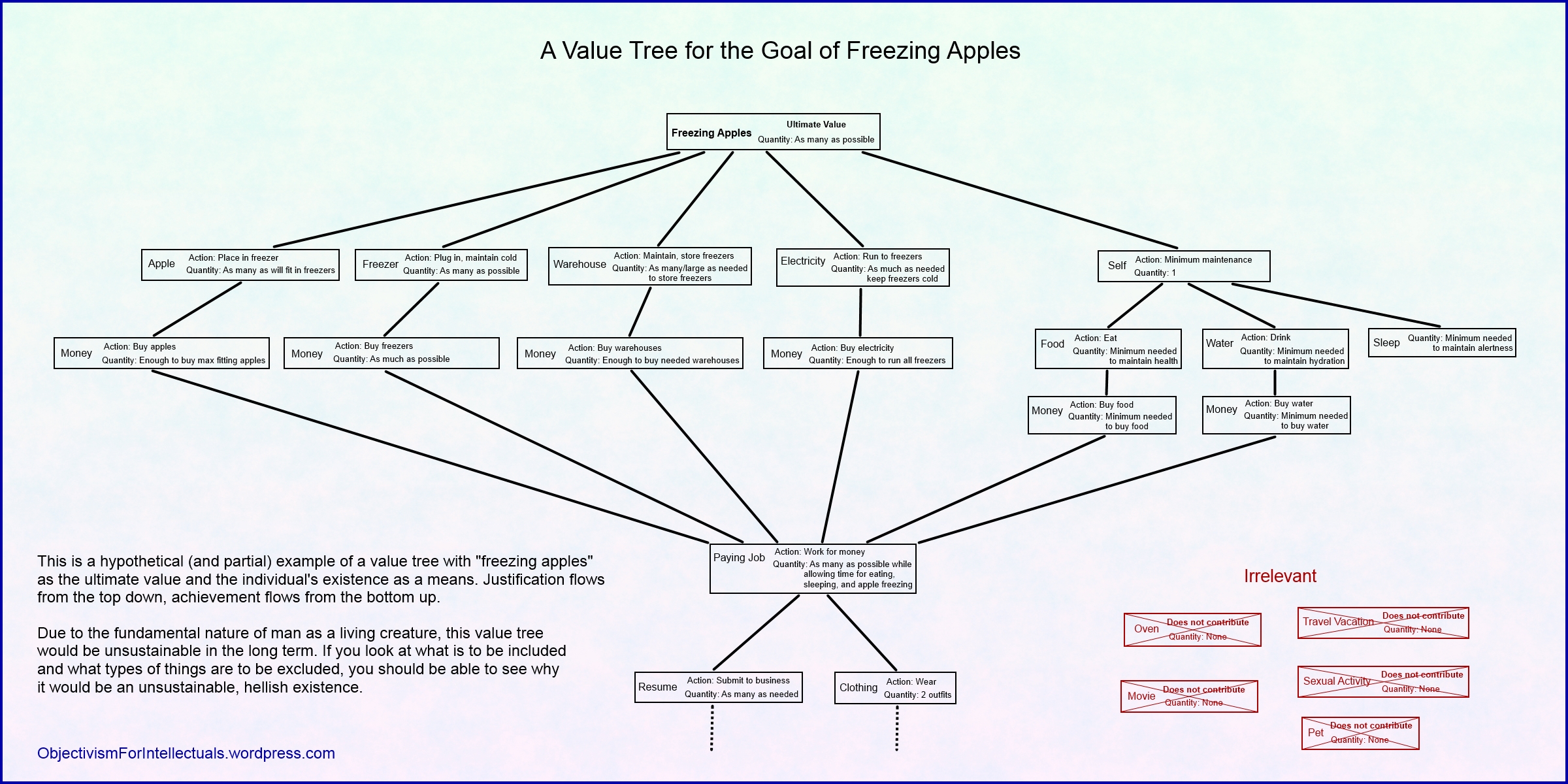
A value chain cannot go on infinitely. A person must have some ultimate value that serves to justify and motivate the others. A set of value chains that converge on a single ultimate value may be termed a “value tree.”  The ultimate value is an end-in-itself that is never pursued primarily as a means to something else.

An example of a hypothetical value tree. This tree would be possible for someone to attempt, but would be unsustainable. Click to enlarge.

An example of a hypothetical value tree. This tree would be possible for someone to attempt, but would be unsustainable. Click to enlarge.

So the question I will answer is: Can a person be committed to more than one separate value tree, each leading to a separate ultimate value?

Having two different value trees means that two different sets of actions are required to achieve each ultimate value. The actions required to achieve one will continually conflict with the actions required to achieve the other. Thus, a choice will be required to select only one of the two appropriate actions at a given time. As one obvious example, consider a man who has Ultimate Value 1 (UV1) as “freeze apples” and Ultimate Value 2 (UV2) as “bake cakes.” He has just obtained eight hundred dollars. He owns neither a freezer nor an oven. If he wants to pursue UV1, he should buy a freezer. If he wants to pursue UV2, he should buy an oven. How is he to decide where to spend his money? The way one decides with a single ultimate value is by determining which option better promotes that ultimate value in the current situation. But with two distinct ultimate values, there is no way to decide rationally. The man making the choice might as well flip a coin. There is no rational way to decide which ultimate value to pursue at any given time.

Having an ultimate value means that every decision should be weighed by how much it contributes to that ultimate value. It means that the person should plan in advance for how best to achieve as much of the value as possible. It means ruthlessly cutting out any value that is not a part of that particular value tree, because only values that serve the ultimate value are justified. In the case of UV1, this means freezing as many apples as possible while one is alive. For UV2, this means baking as many cakes as possible. But if a man holds these two “ultimate” values, then he cannot plan in advance how to achieve either one to the best of his ability. There are necessarily many situations where he does not act to gain and/or keep each of the purported ultimate values. The very fact that there are two “ultimate” values means that they violate and contradict each other. So, in a very real sense, he does not actually value either of the “ultimate values” as ultimate values.

Therefore, having two ultimate values is, in a strict sense, self-contradictory and impossible.

More realistic examples of attempts to posit more than one ultimate value will be discussed in upcoming articles. One article will deal with one’s own life versus socialization as ultimate values (Link) and another will discuss an example of life vs. flute playing.

I also recommend Viable Values: A Study of Life as the Root and Reward of Morality and Ayn Rand’s Normative Ethics: The Virtuous Egoist by Tara Smith.

—–

Related Posts:

Values Are Relational But Not Subjective

The Nature of the Morality of Rational Egoism: Short Notes

Atlas Shrugged, Altruism and Egoism

On Fairness and Justice: Their Meanings, Scopes, and How They Are Not the Same

What Interdependence Means and Why Society Isn’t Interdependent

Morpheus on Society-WatermarkInterdependence is a state of a group in which removal or destruction of one portion (subset) of the group necessarily results in the destruction of all members of the group. (1)

One example of interdependence is the set of critical organs in a human body. Taken as units in themselves, the brain, heart and lungs are interdependent: removal or destruction of one of them necessitates the destruction of the others. Another example of interdependence is the caste system in eusocial insects like bees, ants and termites. The reproductive caste and worker caste are each needed to keep the hive (and thus the other) productive and alive.

A division-of-labor society of human beings takes on a superficial appearance of interdependence. Different people do different jobs and rely on those in other specialties for raw materials and general trade. But unlike real interdependent systems, individuals in a society can exercise independent judgment and change occupations. An individual’s job is not set for life in his genetics, but chosen by the individual. People can and do get promoted, change jobs, change career types, etc. Companies in a free market can and do expand into new fields of business.

If, in a hypothetical, laissez-faire capitalist society, all those who performed one sort of productive job were suddenly removed, then it is still possible for those in other professions to take over the job and maintain a similar division of labor. There might be great hardship for a while from such a sudden displacement, but since most other individuals would be able to adapt and survive, the society fails the test for interdependence. (This is to say nothing of the more realistic, gradual removal of people from an occupation, which a capitalist society can undergo with most people hardly noticing. In contrast, if lung tissue were gradually removed from your body, it would become harder and harder for your other organs to function, and your heart would not transform to replace the missing lung tissue.)

Moreover, not all activities undertaken by all other individuals in a society are valuable to a given individual. In fact, some are positively harmful, such as dishonest schemes, irresponsible investment plans, and theft. Since each individual has free will–the choice to think or not, to judge or not, and the capacity to behave destructively toward self and others–it is up to the independent judgment of each individual to determine friend from foe. Other people can’t be dissolved into an undifferentiated mass of beneficence, let alone all be considered critical to one’s own survival. (Easily observable facts refute this collectivist notion.)

If one individual is physically injured to the point of mental damage or paralysis, then that person can become genuinely dependent on other individuals who provide his care and sustenance. But this metaphysical dependence goes only one way: the injured is dependent on the uninjured, not vice versa. There is no “interdependence” here.

Ordinary, healthy, adult human beings are fundamentally independent creatures, and assertions to the contrary are spurious. I have only ever heard vague assertions of “interdependence” from people. I have never heard “interdependence” defined, even though such a definition is a prerequisite to any rational argument about whether or not a society of human beings is “interdependent.” (2)

—–

(1) This is existential interdependence–i.e. interdependence for continued existence as entities of a certain class. The common definitions of “interdependence” and “dependence” are philosophically vacuous.

(2) Dictionary definitions are unhelpful: interdependent – mutually dependent; depending on each other.”

dependent – relying on someone or something else for aid, support, etc.” [Webster’s College Dictionary, 1996]

Relying, in what way? Aid from whom? What happens if the support doesn’t come from whomever? This definition is useless philosophically, since it can encompass everything from an appointment with one doctor out of many to have a wart removed, to being fed through a tube because you’re paralyzed for life. The required definition is one of metaphysical (inter-)dependence, which is philosophically significant, and is the definition I gave at the start of this article.

—–

Related Posts:

America Before The Entitlement State

The Nature of the Morality of Rational Egoism: Short Notes

Atlas Shrugged, Altruism and Egoism

On Fairness and Justice: Their Meanings, Scopes, and How They Are Not the Same

Values Are Relational But Not Subjective