Dr. Burzynski and Hank Rearden: Real Life Mimicks Atlas Shrugged…Again

atlasshruggedIn the novel, Atlas Shrugged, the great steel tycoon, Henry “Hank” Rearden and his assistants create a metal alloy that’s stronger, lighter and cheaper to produce than steel. For this great achievement, the government subjects Rearden to every form of business obstruction it can muster. This includes a propaganda campaign, new laws and attempts to badger Rearden into selling the rights to the metal to a government institution.

In the real world, Dr. Stanislaw Burzynski and his team developed a cancer treatment that’s more effective (for some cancers), safer to administer and that produces much milder side-effects than radiation and traditional chemotherapy. For this great achievement, Dr. Burzynski was subjected to a harrowing, multi-year ordeal of interference by the FDA and state government.

This incredible, real-world progression of events is meticulously and compellingly documented in the 2010 film, “Burzynski,” currently available on Netflix streaming.

While the documentary is a searing indictment of the FDA, it is less compelling in its attempt to implicate the competitive drive of big pharmaceutical companies as the motive power behind the persecution of Burzynski. The evidence for this connection is relatively scanty. But it is certainly possible that there is some influence there, and it is definitely true that the FDA’s persecution of Burzynski served to insulate “big pharma” from competition. This would be another real-world parallel to Atlas Shrugged. There the politically connected steel baron, Orren Boyle, is involved in the government persecution of Hank Rearden, in order to eliminate his more able, productive and efficient competition.

But the lesson to draw from “Burzynski” is not that the pharmaceutical industry needs to be more heavily regulated, or that the FDA needs more “oversight.” The lesson is that the FDA needs to be abolished. Companies of all kinds will always want to remove obstacles and competition from their paths, but without the FDA regulatory machinery, they would have no way to do this by legalized force. They would only be able to overcome competition through superior efficiency and customer service. (Any coercive methods would be criminal.)

Moreover, the regulatory institutions of the state give politicians and bureaucrats the power to violate the decisions of individuals and private companies in the name of “the public interest.” This distorts economic decision-making, cripples market efficiency, and leads to pressure group warfare as described by Ayn Rand in Capitalism: The Unknown Ideal:

‘So long as a concept such as “the public interest” (or the “social” or “national” or “international” interest) is regarded as a valid principle to guide legislation—lobbies and pressure groups will necessarily continue to exist. Since there is no such entity as “the public,” since the public is merely a number of individuals, the idea that “the public interest” supersedes private interests and rights, can have but one meaning: that the interests and rights of some individuals take precedence over the interests and rights of others.

‘If so, then all men and all private groups have to fight to the death for the privilege of being regarded as “the public.” The government’s policy has to swing like an erratic pendulum from group to group, hitting some and favoring others, at the whim of any given moment—and so grotesque a profession as lobbying (selling “influence”) becomes a full-time job. If parasitism, favoritism, corruption, and greed for the unearned did not exist, a mixed economy would bring them into existence.

‘Since there is no rational justification for the sacrifice of some men to others, there is no objective criterion by which such a sacrifice can be guided in practice. All “public interest” legislation (and any distribution of money taken by force from some men for the unearned benefit of others) comes down ultimately to the grant of an undefined, undefinable, non-objective, arbitrary power to some government officials.

‘The worst aspect of it is not that such a power can be used dishonestly, but that it cannot be used honestly. The wisest man in the world, with the purest integrity, cannot find a criterion for the just, equitable, rational application of an unjust, inequitable, irrational principle.’

In this case, the “public interest” coincides with the short-range “protection” of the major pharmaceutical companies, since their “partnership” with the FDA represents the “established system” of “ensuring the safety and efficacy of drugs.”

If the US were to institute a system of government that only protects the individual rights of citizens from the coercion and fraud of others, its people would be much better off than with the FDA.

—–

Related Posts:

America Before The Entitlement State

19th-Century Capitalism Didn’t Create Poverty, But Reduced It

How to Show That Taxation is Robbery

QuickPoint 2: Altruism Supports Coercion…

What Caused the Financial Crisis: It Wasn’t Capitalism or Deregulation
The Theme

A musical theme for this blog. I choose it not because it’s my favorite piece of music ever, (though it is fairly high on the list) but because it fits how I feel about the blog. I only wish it were longer. This theme music for the blog has been added to the About page, and may change from time to time.

Why Each Person Can Have Only One Ultimate Value

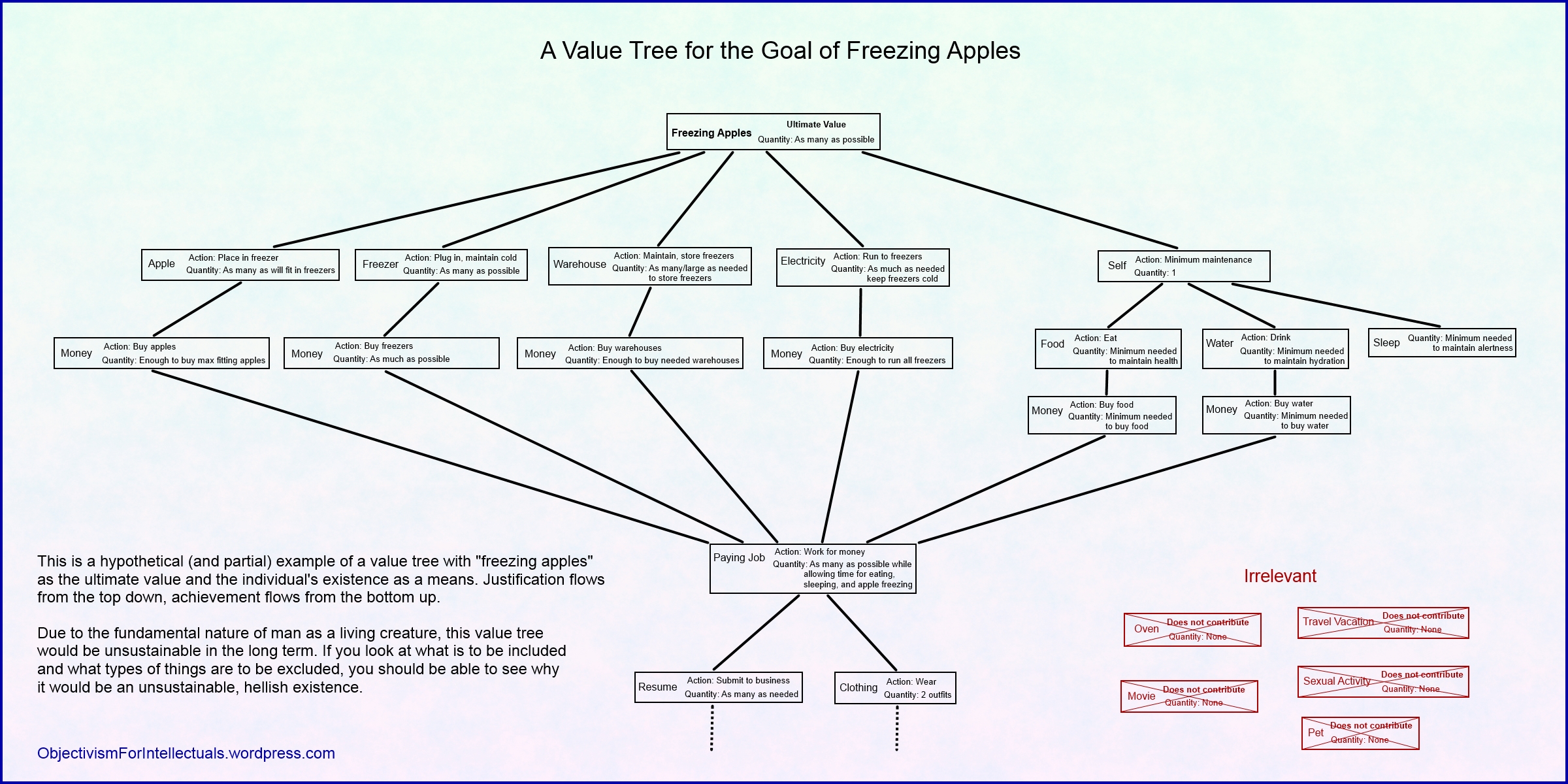
A value is, in Ayn Rand’s words, “that which one acts to gain and/or keep.” It is a goal of a set of actions. Most values are pursued for the sake of gaining other values. For example, a new hammer may be pursued in order for someone to build a scaffold. The scaffold is itself pursued in order to allow the construction of a house. The house is pursued in order that the builder may live there and thus have a richer, more comfortable life. The hammer is valuable in order to get the scaffold, the scaffold is valuable in order to get the house, the house is valuable in order to improve one’s quality of life. This progression can be termed a “value chain.”

A value chain cannot go on infinitely. A person must have some ultimate value that serves to justify and motivate the others. A set of value chains that converge on a single ultimate value may be termed a “value tree.”  The ultimate value is an end-in-itself that is never pursued primarily as a means to something else.

An example of a hypothetical value tree. This tree would be possible for someone to attempt, but would be unsustainable. Click to enlarge.

An example of a hypothetical value tree. This tree would be possible for someone to attempt, but would be unsustainable. Click to enlarge.

So the question I will answer is: Can a person be committed to more than one separate value tree, each leading to a separate ultimate value?

Having two different value trees means that two different sets of actions are required to achieve each ultimate value. The actions required to achieve one will continually conflict with the actions required to achieve the other. Thus, a choice will be required to select only one of the two appropriate actions at a given time. As one obvious example, consider a man who has Ultimate Value 1 (UV1) as “freeze apples” and Ultimate Value 2 (UV2) as “bake cakes.” He has just obtained eight hundred dollars. He owns neither a freezer nor an oven. If he wants to pursue UV1, he should buy a freezer. If he wants to pursue UV2, he should buy an oven. How is he to decide where to spend his money? The way one decides with a single ultimate value is by determining which option better promotes that ultimate value in the current situation. But with two distinct ultimate values, there is no way to decide rationally. The man making the choice might as well flip a coin. There is no rational way to decide which ultimate value to pursue at any given time.

Having an ultimate value means that every decision should be weighed by how much it contributes to that ultimate value. It means that the person should plan in advance for how best to achieve as much of the value as possible. It means ruthlessly cutting out any value that is not a part of that particular value tree, because only values that serve the ultimate value are justified. In the case of UV1, this means freezing as many apples as possible while one is alive. For UV2, this means baking as many cakes as possible. But if a man holds these two “ultimate” values, then he cannot plan in advance how to achieve either one to the best of his ability. There are necessarily many situations where he does not act to gain and/or keep each of the purported ultimate values. The very fact that there are two “ultimate” values means that they violate and contradict each other. So, in a very real sense, he does not actually value either of the “ultimate values” as ultimate values.

Therefore, having two ultimate values is, in a strict sense, self-contradictory and impossible.

More realistic examples of attempts to posit more than one ultimate value will be discussed in upcoming articles. One article will deal with one’s own life versus socialization as ultimate values (Link) and another will discuss an example of life vs. flute playing.

I also recommend Viable Values: A Study of Life as the Root and Reward of Morality and Ayn Rand’s Normative Ethics: The Virtuous Egoist by Tara Smith.

—–

Related Posts:

Values Are Relational But Not Subjective

The Nature of the Morality of Rational Egoism: Short Notes

Atlas Shrugged, Altruism and Egoism

On Fairness and Justice: Their Meanings, Scopes, and How They Are Not the Same

Mainstream Radio Talks About Atlas MD

atlasIn this segment of his morning radio show, Bill Handel talks about the benefits of the concierge doctor service, Atlas MD. It’s a glimpse into the quality and efficiency of free-market healthcare. The only thing that’s missing is an unregulated, unsubsidized health insurance industry that mostly provides benefits for large/catastrophic medical expenses, rather than everyday expenses. This segment really is great to hear.

Bill Handel on Atlas MD

Objectivism vs. Intrinsicism vs. Subjectivism: A Short Summary

Objectivism-The Philosophy of Ayn RandAt root, subjectivism, intrinsicism and Objectivism are theories of the nature of concepts or “universals.” Here, I summarize them in regard to their view of the nature of truth and knowledge. Since truth is an attribute of statements composed of concepts, each school’s view of truth is a direct outgrowth of its view of concepts.

Subjectivism holds that truth, in effect, resides only in the mind. For a subjectivist, a particular statement can be true for one person and false for another, based solely on one’s mental choices, subjective processing, or emotions. (Kant (by implication), Wittgenstein, James, Sartre, etc.) “Truth” amounts to whatever one believes, and there is no such thing as “knowledge” of reality; only some sort of “experience” inside one’s own mind.

Intrinsicism holds that truth resides disembodied out in the world. Typically, intrinsicists hold that all people have to do is somehow “open their hearts to God,” or “pay attention to their intuitions,” or “open their minds to the light of truth,” and the “external truth” will infallibly push its way in. If the truth is already “out there,” then there’s no reason to think that any special processing is required to reach it; one merely has to absorb it. (Plato, Aristotle (partially, in regard to essences), Apostle Paul, Augustine, etc.) For an intrinsicist, conceptual knowledge is whatever external truths one happens to have absorbed. A particular statement is “true” for everyone, whether they have any evidence or not. (And it’s an arbitrarily answerable question whether various people can be held responsible for not grasping all the “floating truth” out there.) (1)

Objectivism holds that truth and falsehood are aspects of conceptual knowledge. Truth (and perceptual knowledge) is a relationship between a consciousness and reality. Truth is reality, as conceptually processed by a consciousness. Truths do not exist disembodied in external reality. Only physical entities (and their aspects–including other consciousnesses) exist in external reality. I can only reach a truth when I choose to conceptually process percepts by reasoning (by the method of logic.) For an Objectivist, a particular statement can be true for one person and false for another, only when there is a radical difference in the relevant perceptual evidence available to the two people. It does not depend on mental choices, subjective processing, emotions, or whims. (2) A statement can also be arbitrary for one person and either true or false for another: People can have different levels of evidence that change how the statement ranks on their “epistemological determinacy” scale. (From arbitrary, to possibly true or false, to probably true or false, to certainly true or false.)

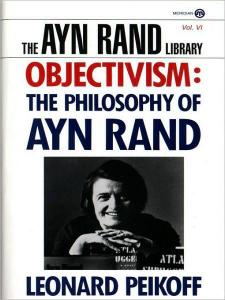
There is much more to be said about this topic, and I recommend Objectivism: The Philosophy of Ayn Rand, by Leonard Peikoff, for more.

—–

(1) To be clear, most modern, intellectual intrinsicists (and many such subjectivists) go to great pains to cloak their theory of knowledge in the appearance of reasoning from observation. They use the language of natural science and the formalism of deductive arguments. But this is all rationalization or inconsistency, because, for intrinsicists, the ultimate basis of “knowledge” is just to “feel the [allegedly external] truth.” For subjectivists, whatever their pretenses about subjectivism being necessitated by objective science, that self-contradiction wipes out objectivity on their part, and they thus imply that there’s no such thing as knowledge of reality. (What distinguishes knowledge of reality from fantasy is that knowledge is objective.)

(2) Some clarification on mental choices and truth: When I say that truth does not depend on mental choices, I am referring to what one might call “normative truth”: what the person ought to consider true. This depends solely on what parts of reality the person has observed, (i.e. what evidence he has.) What the person will actually claim as truth does depend on a mental choice: the choice to think about the evidence or not. This is why I say, “I can only reach a truth when I choose to conceptually process percepts by reasoning…” The normative truth is a potential I have, based on my current context of perceptual evidence. Reaching this truth is exercising the choice to fulfill (recognize) the normative truth.

Note also that the position of one’s body can be affected by prior mental choices. Only in this narrow sense can what one perceives–and thus one’s normative truth–be affected by mental choices. Once one has actually perceived something, mental choices are irrelevant to the normative truth.

[Substantial Edit: 2/28/15: My statement that, “For an Objectivist, a particular statement cannot be true for one person and false for another, (2) but it can be arbitrary for one person and either true or false for another,” in the fourth paragraph was altered to say that it is possible for something to be true for one person and false for another, based on evidence. I no longer agree with the old statement, and I don’t think Objectivism supports it. Footnote (2) was also altered to explain the current view.]

—–

Related Posts:

Proceeding from Axioms in Objectivism – YouTube Edition

The Proof of Free Will (Libertarian Volition)

Taking Philosophy Seriously…

A Refutation of the Argument from Design

Ayn Rand on Politicians, Ideas and Compromise

Quote

“Commentators often exhort some politician to place the interests of the country above his own (or his party’s) and to compromise with his opponents–and such exhortations are not addressed to petty grafters, but to reputable men. What does this mean? If the politician is convinced that his ideas are right, it is the country that he would betray by compromising. If he is convinced that his opponents’ ideas are wrong, it is the country that he would be harming. If he is not certain of either, then he should check his views for his own sake, not merely the country’s–because the truth or falsehood of his ideas should be of the utmost personal interest to him.”

–Ayn Rand, “Selfishness Without a Self,” Philosophy: Who Needs It

America Before The Entitlement State

This article by Yaron Brook and Don Watkins should be seen by all Americans, and indeed, everyone else. It describes how people dealt with sudden injuries, deaths and the various disasters that can befall people, before government welfare programs and Social Security:

America Before The Entitlement State

Here’s a video reading of a part of an essay from Capitalism: The Unknown Ideal by Ayn Rand:

—–

Related Posts:

19th-Century Capitalism Didn’t Create Poverty, But Reduced It

How to Show That Taxation is Robbery

QuickPoint 2: Altruism Supports Coercion…

The Nature of the Morality of Rational Egoism: Short Notes

19th-Century Capitalism Didn’t Create Poverty, But Reduced It

Here’s an article by Yaron Brook and Don Watkins on the near-laissez-faire capitalism of the 19th Century:

Capitalism In No Way Created Poverty, It Inherited It

—–

Related Posts:

How to Show That Taxation is Robbery

QuickPoint 2: Altruism Supports Coercion…

Why “Anarcho-Capitalism” is Wrongheaded

The Nature of the Morality of Rational Egoism: Short Notes

A Philosophy Professor Discusses Ayn Rand in his Ethics Class

Dr. Gregory Sadler of Marist College recently discussed Ayn Rand’s The Virtue of Selfishness in his Spring 2013 Ethics class and posted the video to YouTube:

Dr. Sadler is not an Objectivist, but he gives what is, in my view, a good introductory presentation on Rand’s ethics. I encourage anyone interested in the broader study of Rand in academia, to watch this video (at least in part) and leave polite comments on the YouTube video page.

My main critiques of Dr. Sadler’s presentation have already been voiced in the page comments. They are the following:

Overall, this is a very good presentation of Rand’s ethics. Thank you, Dr. Sadler.

Just a few points: Contrary to 52:48, Rand wouldn’t say the choice of friends is arbitrary, but ought to depend on their objective virtues/values. Vicious people harm one’s own life when you’re involved with them; virtuous people typically benefit one’s own life.

Also worth emphasizing: Man *creates* wealth/values (material and spiritual) by acting on proper reasoning. There isn’t a fixed “pie.”

Also, Rand regards virtues as eminently practical. A breach of integrity has very real, self-destructive consequences in the long-term. There is no gap between morally principled action and practical action. (Practical for achieving long-term flourishing.)

Finally, “Ayn” rhymes with “mine.” : )

—–

Related Posts:

The Nature of the Morality of Rational Egoism: Short Notes

Atlas Shrugged, Altruism and Egoism

Values Are Relational But Not Subjective

The False Freedom of “Equality of Opportunity”

In mainstream discourse in the US, “equality of opportunity” is taken as an uncontroversial rallying cry for both “conservatives” and “modern liberals.” It’s typically seen as a more reasonable alternative to the openly socialist “equality of results.”

Don Watkins, of the blog, LaissezFaire, has written two posts exposing the fact that “equality of opportunity,” taken literally, is just as irrational and unjust a notion as “equality of results.” (If it’s not taken literally, then it’s an extremely vague term and shouldn’t be used.)

What matters for the justice of a society is not “equality of opportunity” but the absence of initiated coercion.

Just Say “No” to Equality of Opportunity

Who Needs Opportunity?

—–

Related Posts:

On Fairness and Justice: Their Meanings, Scopes, and How They Are Not the Same

How to Show That Taxation is Robbery

QuickPoint 2: Altruism Supports Coercion…