
An answer at last…
Image
Reply

 The book, MiG Pilot, is the true story of a Soviet pilot who defected to the United States in 1976. As a MiG-25 pilot, Lieutenant Viktor Belenko was among the most elite officers of the Soviet military. Like all Soviet military men of the period, he was thoroughly indoctrinated in Communist ideals and fed misinformation about the West his whole life. Yet through many years of observation and logical thinking, he came to see that there was something deeply wrong with the USSR. The rampant drunkenness, dishonesty and economic stagnation he witnessed eventually drove him to fly his MiG-25 to Japan, seeking asylum in the United States–the very heart of the “Dark Forces” he had been taught to fear.
The following incident is from Lt. Belenko’s time as a MiG-25 pilot stationed at Chuguyevka in Southern Siberia. Belenko’s thoughts at the time are represented in {green braces.} Again, I stress that this book is nonfiction; as in, this actually happened:
Continue reading

Objectivism rejects anarchism for very good reason.
In the following link, Dr. Harry Binswanger explains why an officially established (“monopolistic”) government is necessary for a free society, and why the “anarcho-capitalists'” objections to it are baseless:
—–
Related Posts:
How to Show That Taxation is Robbery
An Objectivist Refutation of Anarcho-Capitalism (Market Anarchy)
QuickPoint 2: Altruism Supports Coercion…
The Nature of the Morality of Rational Egoism: Short Notes
Why a Proper Ethics is Not a Set of Social Rules, But a Complete Way of Life
Some deep discussion of causality and metaphysics. My refutation of this “First Cause” argument for God appears in the comments under “Sword of Apollo.”
—
[Note: Jacob T. Brunton is philosophically sophisticated and usually argues civilly. These characteristics led me to give him the benefit of every doubt when it came to intellectual honesty. I am not one who is quick to judge such a person an incorrigible evader or intellectually dishonest, since I think that there are many deep, yet honest errors that smart people can make in thinking about philosophy. But through argument with Mr. Brunton on multiple occasions, I have been given the evidence to conclude, beyond any doubt, that he is not honest in his philosophical viewpoints; especially in his regard for the Bible.
My past discussions with Mr. Brunton can still be informative to others, and so I will leave them as they are. But he will no longer be allowed to comment on this blog, and I will make no further comments in direct response to him on any blog. — 6-27-2013]
While politicians and the mainstream media in the US have been busy talking about the tax laws that expire at the end of 2012, we are approaching the real “fiscal cliff” very rapidly. This cliff is further in the future and no one knows exactly when we will fall over it, but the US will fall over it if it doesn’t change direction immediately and drastically.
The US Federal debt currently stands at over $16.3 trillion and is rising by about $1 million every 40 seconds. The CBO projects massive annual deficits for the next 10 years.
The economist, Peter Schiff, spells out the harsh reality of the situation the US is getting itself into in the following set of videos:
QE stands for “Quantitative Easing,” where the the Federal Reserve creates new money and uses it to buy financial assets directly from banks. QE generates an increase in the money supply.
To paraphrase Ayn Rand: The majority of people in the US can ignore reality, but they can’t escape the consequences of ignoring reality.
The Federal Reserve is setting the US economy up for another huge crash and a round of hyperinflation. Yet, given our history, it is not hard to predict that when the big crash happens, “scheming businessmen” and/or “unscrupulous financial traders” will take the blame from the mainstream media and dominant public opinion.
This Objective Standard article describes the deeper philosophical problem: The Moral Cliff
—–
Related Posts:
What Caused the Financial Crisis: It Wasn’t Capitalism or Deregulation
…or “A Problem With Libertarianism”
Under altruism, (the morality of self-sacrifice,) an act of self-sacrifice can be good, even if the person sacrificing doesn’t choose to do it.
If someone’s interests are sacrificed by government force, the person committing an unwilling sacrifice doesn’t get moral credit for the act, because it was unchosen. But the act itself can still be considered “good”, apart from the choices of the “self” being sacrificed. A sacrifice is a sacrifice, regardless of whether it was freely chosen or imposed by a legal authority. Thus, under altruism, any sacrifice can be good, so long as it “benefits those in need.”
In practice, the forced imposition of sacrifice is justified on dual grounds: it will benefit those in need, while simultaneously punishing those who violate morality by being selfish. Since everyone, according to the altruist morality, really should be self-sacrificial anyway, who can object to the overall project of forced charity? We can quibble about the practical details, say the altruists, but if we want a moral society, how can we leave the needy at the mercy of other individuals’ choices?
Under the morality of altruism, the advocates of government coercion are right: A moral society requires forced charity, because without it, those who don’t sacrifice for the welfare of others will be rewarded and encouraged, and those “noble altruists” who are in need will be “left at the mercy of the selfish.”
The only way to fight this thinking is to fight for the morality of rational egoism, as established and advocated by Ayn Rand. For rational egoism, an act can only be good if it is freely chosen by the acting individual.
I highly recommend this book on how to fight for a free market: Free Market Revolution: How Ayn Rand’s Ideas Can End Big Government.
—–
Related Posts:
Atlas Shrugged, Altruism and Egoism
Bernie Madoff is sometimes held up by critics of Ayn Rand’s ethics as a poster boy for the evil of self-interest. But far from being an example of Ayn Rand’s ethics, Madoff is a type of person that Ayn Rand explicitly condemned, because he undertook an irrational–and therefore self-destructive–scheme.
Self-interest, for Ayn Rand, does not equate to simple monetary gain, or the pleasures of any given moment. Self-interest is defined by achievement of a deeply happy life over as many years as possible. Ayn Rand recognized that it is impossible to build long-term happiness by theft or fraud. One’s long-term happiness can only be based on the production of life-sustaining/enhancing values, along with honest dealings with oneself and others.
Do you think Bernie Madoff is happy now, in prison? What about while he was running his scheme? This interview should give you a sense of how much he enjoyed himself while defrauding other people:
Does this sound like a man determined to pursue his own happiness and live his life to the fullest? What must it mean for Madoff to be happier in prison, when he has no freedom and no control over his own life, than during his con? His primary emotion while in the middle of the con scheme was fear, which indicates that he sensed his life was out of control. His lies were constantly threatening to catch up with him, and it was just a matter of time before something slipped and he was caught. Continue reading
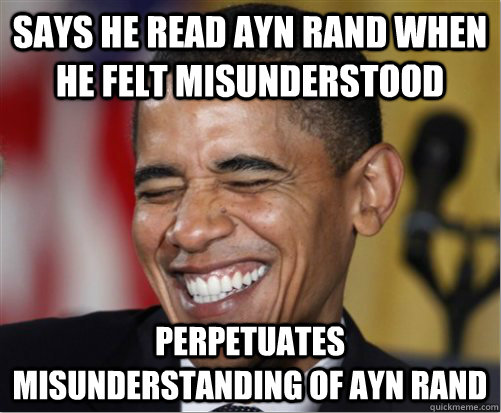
In a Rolling Stone interview published today, Barack Obama distorted and misrepresented Ayn Rand’s views. Ari Armstrong of The Objective Standard responded to the president’s statements here:
Obama, Unsurprisingly, Gets Ayn Rand Wrong
The Ayn Rand Center’s blog also responded with analysis of Ayn Rand’s actual views and context that should help people understand those views:
Obama on Ayn Rand: The Annotated Version
Don Watkins has also responded to the issue Obama raised, of being an individualist and caring for other people, on the Ayn Rand Institute’s Laissez-Faire blog:
Obama’s Straw Man Attack on Ayn Rand
—–
Related Posts:
Bernie Madoff: Not Rationally Selfish, But Self-Destructive
The Morality of Rational Egoism: Short Notes
QuickPoint 1: Thinking is Individual
Atlas Shrugged, Altruism and Egoism
What Caused the Financial Crisis: It Wasn’t Capitalism or Deregulation
Here is a playlist of YouTube videos providing an introductory overview of Ayn Rand’s philosophy of Objectivism. Please give it a like if you enjoy it:
On November 5th at Duke university, renowned environmentalist and AGW proponent, Bill McKibben will debate Alex Epstein of the Center for Industrial Progress, on the effect that fossil fuels have on the human environment.
Here is a YouTube video on the debate:
As governments enact restrictions on fossil fuel use, power plant construction, CO2 emissions, etc. it’s important to be clear on exactly what the effect of fossil fuel use is on the human environment and human life. Do they harm the planet, or do they improve it?
This debate urgently needs funds for livestreaming, recording, distribution and publicity, though. If anyone would like to donate any amount to help with this, they can go here: McKibben vs. Epstein Donations
(McKibben’s website shows he will be there: http://www.billmckibben.com/appearances.html)
Here is a video of Power Hour by Alex Epstein on the indispensable role of coal in improving the standard of living of millions of people:
 Objectivism In Depth