A Refutation of the Argument from Design

The following is my short refutation of the Argument for God, from Design:

The Argument from Design purports to show that God exists by showing that only he could have designed the universe (or some part of the universe.) So, what does “design” mean? The relevant definition here would be: “conceived in a mind [God’s mind] and intentionally implemented in reality.” So the concept of “design” requires the existence of a mind (conceptual faculty) to conceive the idea for the object(s). Further, in order to do anything, the mind must have an intention or purpose. A “purpose” is a goal of a conceptual consciousness; the value for which it acts. Take careful note of the meanings of these concepts in reality and their relationships to each other; it is these concepts on which the Argument from Design rests.

The refutation of the Argument from Design is to observe what is actually required to infer design in an object and to show that this cannot be done with “God.” To infer design from an object: a) You must already know of some type of purposeful entity (based on other evidence) whose goals could potentially be served by the object. b1) Further, you must be able to observe some sort of purposeful function for the object as a whole (the object is a means to a goal beyond itself, whether practical or artistic.) OR: b2) You must be able to find evidence of a method of purposeful manufacture that is already known as such by other evidence. c) In order to observe that (b1) or (b2) is true, you must be able to contrast the purposeful nature of the construction of the object in question with something else that was not manufactured and has not been altered for a purpose.

The argument from design is capable of producing evidence of human-like aliens from observations of human-like alien artifacts, since human goals could potentially be fulfilled by such artifacts. But because of (a), the argument from design can’t apply to an immortal and radically different creature, whose alleged goals we cannot fathom. We have no basis for thinking that living beings have any purpose beyond themselves. They grow, metabolize, reproduce, and die in an endless cycle. The forms evolve over time, but to no clear goal beyond their own continuance and survival. Of what possible value could a succession of mortal humans be to an ultra-powerful, immortal, unchanging being? There’s no basis even for speculation, because there’s no basis even to consider it possible for an immortal, unchanging being to have values. (This supposition is arbitrary.)

The only known reference we have for purposes, and the relationship of designer to designed object, is humans and their creations. Indeed, the very concepts of “purpose”, “goal” and “value” only have meaning in reference to temporal, living entities that face an alternative between life and death. Goals and values are what living entities pursue in order to keep themselves alive, growing, flourishing, as opposed to deteriorating, suffering, dying. The concept of “purpose” is the same as “goal,” except that “purpose” involves the conceptual consciousness of a living being that is intent on the goal.

Thus, to say that an immortal and unchanging being has a “purpose” is literally meaningless; it defies the actual basis of the concept. Therefore a “design” by such an entity is meaningless and impossible to hypothesize.

In other words, whenever anyone talks about “God’s design” or “God’s purposes,” they are literally not making sense. The only way such phrases can be made comprehensible at all is by anthropomorphizing this alleged God into a mortal, very powerful human.

(For more on the nature of concepts and values, I refer the reader to Introduction to Objectivist Epistemology, Exp. 2nd Ed. and The Virtue of Selfishness by Ayn Rand, and to Viable Values: A Study of Life as the Root and Reward of Morality by Tara Smith)

—–

Related Posts:

Link Highlight: Introduction to Objectivism Playlist

The Morality of Rational Egoism: Short Notes

Atlas Shrugged, Altruism and Egoism
The Quran Promotes Violence Against Non-Muslims

The Axioms of Objectivism

Proceeding from Axioms in Objectivism — YouTube Edition

Fossil Fuels and Environment: McKibben vs. Epstein, Full Debate

On November 5th at Duke university, renowned environmentalist and AGW proponent, Bill McKibben debated Alex Epstein of the Center for Industrial Progress, on the effect that fossil fuels have on the human environment. Bill McKibben took the position that fossil fuels were harmful and an immediate threat to the human environment, while Alex Epstein took the position that fossil fuels continue to improve the environment we live in.

Here is the YouTube video of the full debate:

Here is a debate highlight from the question period: What does Bill McKibben really advocate?

Another highlight: Are affordable fossil fuels a “market failure”?

Bernie Madoff: Not Rationally Selfish, But Self-Destructive

Bernie Madoff is sometimes held up by critics of Ayn Rand’s ethics as a poster boy for the evil of self-interest. But far from being an example of Ayn Rand’s ethics, Madoff is a type of person that Ayn Rand explicitly condemned, because he undertook an irrational–and therefore self-destructive–scheme.

Self-interest, for Ayn Rand, does not equate to simple monetary gain, or the pleasures of any given moment. Self-interest is defined by achievement of a deeply happy life over as many years as possible. Ayn Rand recognized that it is impossible to build long-term happiness by theft or fraud. One’s long-term happiness can only be based on the production of life-sustaining/enhancing values, along with honest dealings with oneself and others.

Do you think Bernie Madoff is happy now, in prison? What about while he was running his scheme? This interview should give you a sense of how much he enjoyed himself while defrauding other people:

Does this sound like a man determined to pursue his own happiness and live his life to the fullest? What must it mean for Madoff to be happier in prison, when he has no freedom and no control over his own life, than during his con? His primary emotion while in the middle of the con scheme was fear, which indicates that he sensed his life was out of control. His lies were constantly threatening to catch up with him, and it was just a matter of time before something slipped and he was caught. Continue reading

Obama “Read Ayn Rand” and Gets Her Views Wrong

In a Rolling Stone interview published today, Barack Obama distorted and misrepresented Ayn Rand’s views. Ari Armstrong of The Objective Standard responded to the president’s statements here:

Obama, Unsurprisingly, Gets Ayn Rand Wrong

The Ayn Rand Center’s blog also responded with analysis of Ayn Rand’s actual views and context that should help people understand those views:

Obama on Ayn Rand: The Annotated Version

Don Watkins has also responded to the issue Obama raised, of being an individualist and caring for other people, on the Ayn Rand Institute’s Laissez-Faire blog:

Obama’s Straw Man Attack on Ayn Rand

—–

Related Posts:

Bernie Madoff: Not Rationally Selfish, But Self-Destructive

The Morality of Rational Egoism: Short Notes

QuickPoint 1: Thinking is Individual

Atlas Shrugged, Altruism and Egoism

What Caused the Financial Crisis: It Wasn’t Capitalism or Deregulation

Debate on Fossil Fuels and Environment: McKibben vs. Epstein

On November 5th at Duke university, renowned environmentalist and AGW proponent, Bill McKibben will debate Alex Epstein of the Center for Industrial Progress, on the effect that fossil fuels have on the human environment.

Here is a YouTube video on the debate:

As governments enact restrictions on fossil fuel use, power plant construction, CO2 emissions, etc. it’s important to be clear on exactly what the effect of fossil fuel use is on the human environment and human life. Do they harm the planet, or do they improve it?

This debate urgently needs funds for livestreaming, recording, distribution and publicity, though. If anyone would like to donate any amount to help with this, they can go here: McKibben vs. Epstein Donations
(McKibben’s website shows he will be there: http://www.billmckibben.com/appearances.html)

Here is a video of Power Hour by Alex Epstein on the indispensable role of coal in improving the standard of living of millions of people:

QuickPoint 1: Thinking is Individual

There are some people who say that ideas are products of a culture as a whole–that no one stands apart from the collective.

But where do ideas come from originally? Before an idea could be in many minds, it had to be in one mind. Thus, ideas come from individual thought. People can and do learn a great deal from others through their experience, but the process of thinking is a fundamentally, inescapably individual process. Learning from others does not mean parroting word sounds, but thinking about the material you are given. Before an idea can be taught, it must be thought of by an individual. Innovative individuals are those who use their own minds to think of new ideas, and thus move the “knowledge of the culture” (i.e. the sum of the knowledge of the network of communicating individuals) forward.

When people work to solve problems as a team, any individual who isn’t thinking on his own, with his physically separate brain, will not contribute to the discussion and will not make any breakthroughs.

—–

Note: At some point, I will likely write a longer article on this issue.

The Proof of Free Will (Libertarian Volition)

By the nature of the following refutation of determinism, it can also be considered a proof (1) of (libertarian-type) volition. It is a refutation of any theory that would deny the existence of non-necessitated events–in the form of fundamental, agent-controlled choices–located in a conceptual consciousness, including incompatibilist determinism and compatibilism.

Here is a short video (by someone else) explaining the general outlines of the argument:

Here is a link to the paper by Harry Binswanger:

A Refutation of Determinism

——————

(1) The argument shows that volition is a prerequisite of all knowledge and that the denial of volitional choice implies self-contradiction, thus establishing volitional choice as an axiom of epistemology. Strictly speaking, I think, by Leonard Peikoff’s definitions, this is not a proof, but an axiomatic validation. It establishes the axiom as absolutely and unquestionably true, but does not involve the specific process of logical proof of the positive proposition. The positive proposition is self-evident in each individual’s experience of existence.

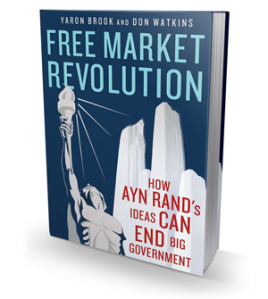
Free Market Revolution by Yaron Brook and Don Watkins

Free Market Revolution: How Ayn Rand’s Ideas Can End Big Government is now available at Amazon.

From the description:

A look at how our current crises are caused by too much government, and how Ayn Rand’s bold defense of free markets can help us change course.

The rise of the Tea Party and the 2010 election results revealed that tens of millions of Americans are alarmed by Big Government, but skeptical that anything can or will be done to stop the growth of the state. In Free Market Revolution, the keepers of Ayn Rand’s legacy argue that the answer lies in her pioneering philosophy of capitalism and self-interest -a philosophy that more and more people are turning to for answers. In the past few years, Rand’s works have surged to new peaks of popularity, as politicians like Paul Ryan, media figures like John Stossel, and businessmen like John Mackey routinely name her as one of their chief influences. Here, Brook and Watkins explain how her ideas can solve a host of political and economic ills, including the debt crisis, inflation, overregulation, and the swelling welfare state. And most important, they show how Rand’s philosophy can enable defenders of the free market to seize the moral high ground in the fight to limit government. This is a fresh and urgent look at the ideas of one of the most controversial figures in modern history – ideas that may prove the only hope for the future.

To anyone who is relatively unfamiliar with Ayn Rand’s ideas, but interested in solving our current economic and cultural problems, I encourage you to read this book. I encourage anyone who is very familiar with Rand’s ideas to tell friends about this book, loan your copy to them, or give it to them as a gift.

To purchase, click here:
Free Market Revolution: How Ayn Rand’s Ideas Can End Big Government

EDIT: Here’s a really good video from the CATO Institute with the authors of Free Market Revolution: Free Market Revolution at CATO

The Quran Promotes Violence Against Non-Muslims

In light of the events in Libya and the recent anniversary of 9-11, today’s post is off the topic of Objectivism, so that I can alert people about the real nature of Islam and the Quran, (anyone who is still in the dark, anyway. “Quran” is also sometimes spelled “Qur’an” or “Koran.”)

To be quite frank, those Muslims who believe in Western freedom and who accept other religions/philosophies as political equals, are actually the ones who compromise and don’t take the Quran seriously. It is the violent totalitarian Islamists who are really living by the teachings of the Quran, as advocated in that book.

The following video discusses the violent passages in the Quran, and the common “context defense” employed by Western Islamic advocates. It is very logical, clear and well presented.

This is another excellent video discussing the stages of jihad:

It should be noted that I do not necessarily endorse anything else the makers of the above videos advocate. I regard all religion as false or arbitrary, and fundamentally as a force for human suffering. (The reason for this is a subject for another post.)

Here is another video that corroborates some of what was said in the first two videos.

At its core, Islam is a totalitarian, militant, expansionist ideology. It is engineered to achieve irreversible growth. Jihad (striving for the triumph of Islam in the world) is a religious duty of all Muslims. (Quran 66:9, 9:41, Tafsir Ibn Kathir 216, 217) The “holy strategy” of Jihad was modeled for all Muslims by Muhammad: it starts with taqiyya (deception of unbelievers) and culminates in wars of aggression by Muslims to conquer non-Muslims. The Islamic government then imposes “divine” Sharia law on everyone under its jurisdiction, ensuring a privileged place for Islam, and treating non-Muslims as second-class citizens. (It is illegal to publicly practice religions other than Islam in Saudi Arabia: churches and synagogues are banned.)

Under Sharia, the penalty for leaving Islam (apostasy) is death.

Again, Islam is engineered to expand. The radical Islamic terrorists of the world will not stop their war if the US pulls out of the Middle East completely. The radical Muslims of the world (of which there are many millions) will just be emboldened to take over larger and larger territories, with their terrorist wings looking for opportune times to attack Western countries. They will search for any excuse to become outraged and carry out “reprisals”: excuses like cartoons mocking Muhammad, or criticism of Islam, or failure of governments to uphold Sharia legal standards/punishments for Muslims or those they interact with. (For evidence, observe the behavior, statements, and self-imposed “victimhood” of the Palestinians and Hamas in the West Bank and Gaza.)

The threat of Islamic terrorism to the West will not end until the major countries that fund the Muslim jihadists, and give them hope, are destroyed. The prime financial supporters of Islamic terrorism are Iran and Saudi Arabia. (Also on Saudi Arabia, see: The Saudi Connection: How billions in oil money spawned a global terror network, and Pentagon Briefing by the RAND Corporation Depicted Saudis as Enemies.) Once those countries are devastated, other regimes will be so intimidated that they won’t dare slip funds to Islamic terrorists.

I recommend this article: “The Iranian and Saudi Regimes Must Go” and this book: Winning the Unwinnable War: America’s Self-Crippled Response to Islamic Totalitarianism by Elan Journo.

NOTE: I request that anyone commenting to criticize, or offer another interpretation, do so only after having seen at least the entirety of the first video.

[Edited: 6-26-16: Expanded post to include significant text and links after videos.

3-14-17: Altered spelling of “Qur’an” to “Quran.”]

—–

Related Posts:

Israel and the Palestinians: Disputed Land “Belongs” to Whichever Government is Better at Protecting Individual Rights

Israel and the Palestinians: Of War, Civilization and “Refugees”

Ayn Rand’s Philosophy vs. Abortion Bans: Why a Fetus Doesn’t Have Rights

19th-Century Capitalism Didn’t Create Poverty, But Reduced It

The Nature of the Morality of Rational Egoism: Short Notes