Objectivism for Dummies?

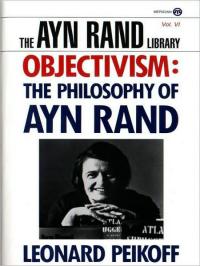
Objectivism: The Philosophy of Ayn Rand by Leonard Peikoff

A more in-depth, book-length overview of Objectivism.

I find it a bit strange that one of the top Google auto-completes I see for “Objectivism” is “Objectivism for dummies,” considering that there is no “For Dummies” book on this topic. But what it indicates is that there is significant interest in a basic, understandable introduction to Objectivism, the philosophy of the novelist and philosopher, Ayn Rand.

If this is what you want, I’d like to recommend my Introduction to Objectivism page. Not only does it have a clear and straightforward presentation of the philosophy of Objectivism, but it also has a large number of links to resources for learning more.

Introduction to Objectivism

I’d also like to recommend reading Ayn Rand’s novels, such as Atlas Shrugged and The Fountainheadif you haven’t recently–to get a fuller feel for the type of person that Objectivism praises, and the type of life that it holds out as an ideal. As I like to caution, however, Rand’s novels are romantic novels, and they feature extraordinary and dramatic situations. The principles her ideal heroes live by are the ones she advocates, but one must be careful about being too literal, (or, in Ayn Rand’s terminology, “concrete-bound” or “anti-conceptual”) in applying those principles to real life.

Happy learning! 🙂

Sword of Apollo

—–

Related Posts:

The Nature of the Morality of Rational Egoism: Short Notes

Other People as Egoistic Values Versus Other People as Objects of Self-Sacrifice in Ayn Rand’s Philosophy

Human Emotions are the Products of Beliefs and Subconscious Value Judgments

Laissez-Faire Capitalism Solves “The Tragedy of the Commons” and Deals With Negative Externalities: A Dialogue

Why Healthcare in the US is So Expensive, and What Can Be Done About It

The Meaning of “Necessary” Versus “Contingent” Truth

Billiard balls ready to be brokenThere is a long history in philosophy of distinguishing between truths that are “necessary” and truths that are “contingent.”

A necessary truth is a true statement whose negation must imply a contradiction in reality, such that the negation would be impossible.

So, if “One plus one equals two,” is a necessary truth, then the statement “One plus one does not equal two” will imply a contradiction. Given the meanings of “one” and “two,” we can immediately see that the addition of two “ones” (units) always does yield “two,” yet the statement “One plus one does not equal two,” contradicts this. It’s incomprehensible that one plus one should ever add to anything but two. So “One plus one equals two,” is commonly held to be a necessary truth, with its negation being impossible.

A contingent truth is a true statement whose negation does not imply a contradiction in reality, such that the negation could have been the case.

So, if “John married Jessica last Sunday,” is a contingent truth, then the statement “John did not marry Jessica last Sunday,” could have been true, without implying a contradiction in reality. Since John could have chosen not to marry Jessica, or to have married her on a different day, we can see that this is indeed a contingent truth.

The Objectivist View on the Necessary/Contingent Distinction

Objectivism-The Philosophy of Ayn RandCausality (the Law of Cause and Effect) is the Law of Identity applied to action. This means that an entity’s actions follow from its nature. That is, the nature of the entity (its attributes, properties, etc.) causes the action it will take in any given situation. In any given context, there is only one action open to it: the one in accordance with its nature. Any other action would contradict its nature.

Continue reading

The Basics of Ayn Rand’s Philosophy: Introducing my “Introduction to Objectivism” Page

The happiness of a man whose enlightened mind illuminates the world. Silhouette of Howard Roark with light rays emanating from his head.Hot off the digital press is my “Introduction to Objectivism” page. It conveys the basics of Ayn Rand‘s philosophy in an overview summary. It also explains some of the benefits of learning about her philosophy–called Objectivism–a little about the nature of moral and philosophical principles, and a little about how this rational philosophy fits in with modern science.

Exploring Objectivism is an intellectual adventure that really gives you a greater appreciation for your life, the world around you, and the power of abstract ideas to bring good or evil, success or failure.

So jump on in! 😀

Click here: Introduction to Objectivism

—–

Related Posts:

The Structure of Objectivism

The Nature of the Morality of Rational Egoism: Short Notes

Human Emotions are the Products of Beliefs and Subconscious Value Judgments

Laissez-Faire Capitalism Solves “The Tragedy of the Commons” and Deals With Negative Externalities: A Dialogue

Why Healthcare in the US is So Expensive, and What Can Be Done About It

Book Review — RooseveltCare: How Social Security is Sabotaging the Land of Self-Reliance

RooseveltCare: How Social Security is Sabotaging the Land of Self Reliance, by Don Watkins book coverMost American conservatives, today–however “radical” or “extremist” the political Left calls them–do not openly challenge “big government” in the form of Social Security and Medicare. While some seek a complete repeal of the recent ObamaCare legislation, at most, they want to “reform” these other two programs by a scheme of partial privatization.

Yet, in his recent book, RooseveltCare, Don Watkins demonstrates that the United States grew, prospered, and did quite well at providing for old age for 158 years, before FDR and his fellow “Progressives” pushed Americans into accepting the Social Security program. Watkins also shows that, ultimately, a complete repeal of Social Security is the only moral course of action; any lesser measure, as the ultimate goal, is morally wrong. Social Security is basically an inter-generational Ponzi scheme that is morally bankrupt and does nothing but harm.

RooseveltCare is divided into 2 parts: “The Story of Social Security” and “Social Security: A Verdict.”

The first part is a thorough survey of the history of the United States as it relates to Social Security. The account of the culture of American self-reliance prior to Social Security is inspiring and enjoyable. It includes the plethora of options ordinary people had in dealing with old age and life’s unexpected challenges, both in preparation and response. The account of the rise of Social Security and the welfare state makes clear that these government programs were not something that most Americans considered an obvious necessity, even during the government-created Great Depression. Social Security was pushed by “Progressive” intellectuals, on Americans who had no intellectual defense, (and some operative elements of the un-American morality of self-sacrifice, making them susceptible.)

The second part of RooseveltCare is an exploration of the moral status of Social Security. It takes the arguments of Social Security’s proponents seriously and persuasively shows why they are wrong, (such as that Social Security is an “earned benefit.”) It discusses how and why Social Security is destructive to Americans’ economic and moral well-being. It discusses why “reforms” of the Social Security system are not a morally acceptable endpoint: ultimately, only a complete phase out of the system over a finite number of years will do.

I highly recommend RooseveltCare: How Social Security is Sabotaging the Land of Self-Reliance, by Don Watkins. It contains fascinating history, and will help give most people a stronger appreciation for the benefits of liberty and the culture of self-reliance. Workers in 19th-Century America were not downtrodden and were not starving in the streets. Starting out poor was not considered an indignity, to be “corrected” by handouts, but an honorable condition to be improved by diligent work on one’s own behalf. (A huge number of Americans in fact did improve their lot quite significantly this way.) It was, rather, accepting unearned charity and handouts that were often considered beneath one’s stature as a self-reliant adult.

The “Progressive” movement changed these attitudes and made unnecessary dependency morally acceptable in most American’s eyes. This opened the way for government redistribution, and has led to a host of destructive effects, including the destruction of wealth and the elimination of opportunities for investment in new technologies.

If we Americans want a bright future of prosperity, technology, opportunity and self-esteem for ourselves and our children, we need the majority of the population to understand the moral and economic need to completely phase out government entitlement programs. As a first step, we need as many thoughtful people as possible to read Don Watkins’ book:

RooseveltCare: How Social Security is Sabotaging the Land of Self-Reliance

—–

Related Posts:

19th-Century Capitalism Didn’t Create Poverty, But Reduced It

Why Healthcare in the US is So Expensive, and What Can Be Done About It

Laissez-Faire Capitalism Solves “The Tragedy of the Commons” and Deals With Negative Externalities: A Dialogue

Socialism and Welfare vs. Justice: Why Inalienable Private Property Rights are Required for Justice

America Before The Entitlement State

Socialism and Welfare vs. Justice: Why Inalienable Private Property Rights are Required for Justice

A farm and a factory: examples of property that requires effort to build.In 1816, Thomas Jefferson wrote:

“To take from one, because it is thought that his own industry and that of his fathers has acquired too much, in order to spare to others, who, or whose fathers have not exercised equal industry and skill, is to violate arbitrarily the first principle of association, “the guarantee to every one of a free exercise of his industry, and the fruits acquired by it.””

Here, Jefferson is affirming the principle of individual rights, especially property rights. But don’t property rights sometimes stand in the way of justice? In any such cases, wouldn’t it be a moral imperative for government to violate property rights?

The purpose of this essay is to show that inalienable private property rights are a necessary condition of justice. That is, any violation of property rights implies injustice, to the extent of the violation. Please note that it is not the purpose of this essay to argue that property rights guarantee justice. Objectivism does not hold that property rights are a sufficient condition for justice, only a necessary condition. There is much injustice that can occur without violations of property rights. But no one, including the government, can rectify such injustices by violating property rights. Anyone attempting to do this is in the wrong, morally.

So, what is an inalienable property right? It is a principle specifying that no one else may take or otherwise use the thing a person has a right to, without that person’s permission. (All things properly called “rights” are inalienable–that is, they cannot morally be taken away; otherwise they are not “rights,” but grants of permission by someone else. Note also that one person’s rights can be waived by him, by the act of violating another person’s rights.)

A property right to a certain, distinct thing–call it “X”–is properly acquired by either 1) engaging in a productive process directly involving X, when it is not already owned by someone else, or 2) consensually trading things or services with another person for X, when that person owns X, or 3) receiving X as a gift from another person, when that person owns X. A “productive process” might be farming to produce food, building a home, building a factory, making shoes, writing software, providing services, like air conditioning repair, radio, television, movies, etc.

Continue reading

Why Definitions Must Be Justified by Evidence

An amazing Earth with rising sun and water. Philosophy tells us what we can know by reasoning about the origin of water.Are definitions a matter of arbitrary social convention?

Well let’s find out if it makes sense to say that they are. Let’s imagine that Adam’s culture defines “space pixie” as “one of the living creatures that has wings, and whose species is solely responsible for bringing water to Earth.”

If definitions are arbitrary matters of social convention, then Adam can reason like this:

  • Premise 1: If there is water on Earth, it was brought by space pixies.
  • Premise 2: There is water on Earth.
  • Conclusion 1: Therefore, (only) space pixies brought water to Earth.
  • Premise 3: All things that bring water must exist at the time it is brought.
  • Conclusion 2: Therefore, space pixies must have existed.

This argument is deductively valid: If the premises are true, then the conclusions must also be true.

Furthermore, this argument is sound (has true premises and is valid–irrefutably correct) given the stated definition of “space pixie.” If definitions are arbitrary cultural inventions, then Premise 1 is “analytic”–that is, it is true purely by definition: One need only examine the definition of “space pixie” to find that Premise 1 is true. Premise 2 is an empirical truth, obvious to anyone who observes Earth and holds the common definition of “water.” Premise 3 simply states an indubitable fact: that things that act in reality must also exist.

Continue reading

Laissez-Faire Capitalism Solves “The Tragedy of the Commons” and Deals With Negative Externalities: A Dialogue

Enjoy CapitalismAs the reddit user, /u/sobersymphony, I participated in a discussion on reddit on the subject of capitalism vs. socialism. Another user asked me in a private message (PM) about one of my statements in that discussion. The ensuing PM discussion is reprinted here with his permission:

Him: In that conversation, you said, “Circumstances that arise due to people’s voluntary choices are not examples of force. They are simply the law of cause and effect in action. That people have to work and be able to dispose of the product of their labor to live in the long term is a fact of reality that no one can wipe out. It is not coercive.”
The usual response to this is that we value freedom, but we value other things too, so we make tradeoffs. We obviously don’t want to be coerced, but we do want to live in what might be called a “fair” or “humane” society. Everyone (tautologically) wants to act in their self-interest, but sometimes it is in their self-interest to have some governing authority solve coordination problems in ways that leave everyone better off. The same author I linked to uses a hypothetical tragedy of the commons situation to illustrate this point. He explains how even a system of voluntary contracts would not solve this problem.
Analogously, in the “work or starve” situation: behind a veil of ignorance, everyone would prefer some form of coercion to prevent work conditions becoming too terrible.
How would you respond to this argument? Apologies if this is too basic, but I haven’t yet heard a satisfying answer to this.

Me: 

Apologies if this is too basic, but I haven’t yet heard a satisfying answer to this.

No, that’s fine. They’re understandable questions that are worth analyzing.

The usual response to this is that we value freedom, but we value other things too, so we make tradeoffs.

The first question I would ask is: Who is this “we”? Do all individual human beings in a society share a collective mind and collective values, like the Borg in Star Trek? No, I might disagree with you and value different things than you do. My judgment is my own, and yours is your own. So on what basis can you say that “we” value some coercive governmental programs more highly than freedom?

Continue reading

Israel and the Palestinians: Disputed Land “Belongs” to Whichever Government is Better at Protecting Individual Rights

A female Hamas suicide bomber poses with the Qur'an before detonating herself and killing four Israelis.

A female Hamas suicide bomber poses with the Qur’an before detonating herself and killing four Israelis.

In the wake of each flare-up in the Palestinian/Israeli conflict, people inevitably argue over the same question: “Who owns the territory that currently comprises Israel: the Arab Palestinians, or the Jews?” Then long debates ensue about the history of the two different groups in the region, who was there first, which group was the aggressor, which group has rightful title, etc.

But the Objectivist answer to the question of which ethnic group has the right to the land is: Neither. Land cannot belong to ethnic groups, social classes, or other categories of people, in any sense.

In The Virtue of Selfishness, Ayn Rand wrote:

A group, as such, has no rights. A man can neither acquire new rights by joining a group nor lose the rights which he does possess. The principle of individual rights is the only moral base of all groups or associations.

The reason that rights are individual is that the human mind is individual, the process of thought is individual, and human life is fundamentally individual. (For more on this, see: QuickPoint 1: Thinking is Individual.) Rights are the moral-political principles that protect individual human life and freedom of thought and action from the coercive depredations of other humans. (See Ayn Rand’s essays from The Virtue of Selfishness here: “Man’s Rights/The Nature of Government.”)

Land can only be owned by individuals, or by groups that are definite sets of individuals in a clear contractual arrangement, (such as a corporation.) Vague conglomerations of people have no singular identity and no collective mind, and thus cannot have rights to anything, as such.

Continue reading

Israel and the Palestinians: Of War, Civilization and “Refugees”

Here is a sampling of audio, video and articles about the history of the Israeli/Palestinian-Muslim conflict and the current war in Gaza between Hamas and Israel:

An audio interview with Dr. Efraim Karsh, professor of Middle East and Mediterranean Studies at King’s College London on “The Arab-Israel Conflict and the Palestinian Refugees”:

(The original ARI page for this interview is here: “The Arab-Israel Conflict and the Palestinian Refugees”)

A video interview with Elan Journo about the current (2014) Israel/Hamas war:

Written articles:

Hamas and The Left’s Pretense about the Deaths of Innocents in Gaza

Israel and the Front Line of Civilization

Israel Has a Moral Right To Its Life

QuickPoint 7: Good Teamwork Is Self-Interested

Kobe Bryant of the Lakers passing the ball.

There’s no “I” in “team.”

So goes the common saying that encapsulates the common idea that good teamwork is selfless. But, punchy as the saying is, (and as correct as its literal meaning is) the idea that good teamwork is selfless is entirely wrong.

When a sport is team-based, it is, by its nature and rules, a cooperative activity. A proper motivation for any individual to become a player of that sport is to enjoy playing as a member of a team and to contribute to the success of the team. To enjoy the team sport, each individual should enjoy putting his skills at the service of the team’s success. The player’s personal interests should be aligned with those of the team.

It is not a selfless sacrifice for Kobe Bryant or LeBron James to refrain from showboating and hogging the basketball, when doing so would be detrimental to their team’s chances of winning. Their personal interests are best served by playing good basketball and winning games.

Ask a football player, who lost the SuperBowl for his team by showboating with the ball, whether what he did was good for him. The answer should be clear enough without having to ask.

Let us rid ourselves of the confusion that sees so many social values, such as teamwork, friendship and love as inherently selfless; while also equating “self-interest,” “egoism” and “selfishness” with shortsightedness, foolishness, childishness, materialism, and the harm of others. Let us clearly recognize that one’s own self-interest–one’s happiness–is not bought at the expense of the interests of other people.

I highly recommend the non-fiction works of Ayn Rand, such as The Virtue of Selfishness and Philosophy: Who Needs It, along with her novels, such as The Fountainhead and Atlas Shrugged.

—–

Related Posts:

QuickPoint 6: Psychological Egoism is False — Not Everyone is Selfish

Atlas Shrugged, Altruism and Egoism

Why a Proper Ethics is Not a Set of Social Rules, But a Complete Way of Life

Values Are Relational But Not Subjective

QuickPoint 1: Thinking is Individual