QuickPoint 2: Altruism Supports Coercion…

…or “A Problem With Libertarianism”

Under altruism, (the morality of self-sacrifice,) an act of self-sacrifice can be good, even if the person sacrificing doesn’t choose to do it.

If someone’s interests are sacrificed by government force, the person committing an unwilling sacrifice doesn’t get moral credit for the act, because it was unchosen. But the act itself can still be considered “good”, apart from the choices of the “self” being sacrificed. A sacrifice is a sacrifice, regardless of whether it was freely chosen or imposed by a legal authority. Thus, under altruism, any sacrifice can be good, so long as it “benefits those in need.”

In practice, the forced imposition of sacrifice is justified on dual grounds: it will benefit those in need, while simultaneously punishing those who violate morality by being selfish. Since everyone, according to the altruist morality, really should be self-sacrificial anyway, who can object to the overall project of forced charity? We can quibble about the practical details, say the altruists, but if we want a moral society, how can we leave the needy at the mercy of other individuals’ choices?

Under the morality of altruism, the advocates of government coercion are right: A moral society requires forced charity, because without it, those who don’t sacrifice for the welfare of others will be rewarded and encouraged, and those “noble altruists” who are in need will be “left at the mercy of the selfish.”

The only way to fight this thinking is to fight for the morality of rational egoism, as established and advocated by Ayn Rand. For rational egoism, an act can only be good if it is freely chosen by the acting individual.

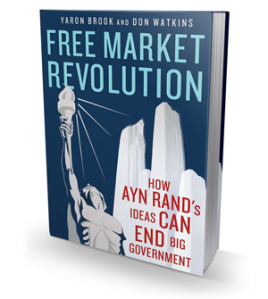
I highly recommend this book on how to fight for a free market: Free Market Revolution: How Ayn Rand’s Ideas Can End Big Government.

—–

Related Posts:

Atlas Shrugged, Altruism and Egoism

The Morality of Rational Egoism: Short Notes

Link Highlight: Introduction to Objectivism Playlist

A Refutation of the Argument from Design

The following is my short refutation of the Argument for God, from Design:

The Argument from Design purports to show that God exists by showing that only he could have designed the universe (or some part of the universe.) So, what does “design” mean? The relevant definition here would be: “conceived in a mind [God’s mind] and intentionally implemented in reality.” So the concept of “design” requires the existence of a mind (conceptual faculty) to conceive the idea for the object(s). Further, in order to do anything, the mind must have an intention or purpose. A “purpose” is a goal of a conceptual consciousness; the value for which it acts. Take careful note of the meanings of these concepts in reality and their relationships to each other; it is these concepts on which the Argument from Design rests.

The refutation of the Argument from Design is to observe what is actually required to infer design in an object and to show that this cannot be done with “God.” To infer design from an object: a) You must already know of some type of purposeful entity (based on other evidence) whose goals could potentially be served by the object. b1) Further, you must be able to observe some sort of purposeful function for the object as a whole (the object is a means to a goal beyond itself, whether practical or artistic.) OR: b2) You must be able to find evidence of a method of purposeful manufacture that is already known as such by other evidence. c) In order to observe that (b1) or (b2) is true, you must be able to contrast the purposeful nature of the construction of the object in question with something else that was not manufactured and has not been altered for a purpose.

The argument from design is capable of producing evidence of human-like aliens from observations of human-like alien artifacts, since human goals could potentially be fulfilled by such artifacts. But because of (a), the argument from design can’t apply to an immortal and radically different creature, whose alleged goals we cannot fathom. We have no basis for thinking that living beings have any purpose beyond themselves. They grow, metabolize, reproduce, and die in an endless cycle. The forms evolve over time, but to no clear goal beyond their own continuance and survival. Of what possible value could a succession of mortal humans be to an ultra-powerful, immortal, unchanging being? There’s no basis even for speculation, because there’s no basis even to consider it possible for an immortal, unchanging being to have values. (This supposition is arbitrary.)

The only known reference we have for purposes, and the relationship of designer to designed object, is humans and their creations. Indeed, the very concepts of “purpose”, “goal” and “value” only have meaning in reference to temporal, living entities that face an alternative between life and death. Goals and values are what living entities pursue in order to keep themselves alive, growing, flourishing, as opposed to deteriorating, suffering, dying. The concept of “purpose” is the same as “goal,” except that “purpose” involves the conceptual consciousness of a living being that is intent on the goal.

Thus, to say that an immortal and unchanging being has a “purpose” is literally meaningless; it defies the actual basis of the concept. Therefore a “design” by such an entity is meaningless and impossible to hypothesize.

In other words, whenever anyone talks about “God’s design” or “God’s purposes,” they are literally not making sense. The only way such phrases can be made comprehensible at all is by anthropomorphizing this alleged God into a mortal, very powerful human.

(For more on the nature of concepts and values, I refer the reader to Introduction to Objectivist Epistemology, Exp. 2nd Ed. and The Virtue of Selfishness by Ayn Rand, and to Viable Values: A Study of Life as the Root and Reward of Morality by Tara Smith)

—–

Related Posts:

Link Highlight: Introduction to Objectivism Playlist

The Morality of Rational Egoism: Short Notes

Atlas Shrugged, Altruism and Egoism

The Quran Promotes Violence Against Non-Muslims

The Axioms of Objectivism

Proceeding from Axioms in Objectivism — YouTube Edition

Bernie Madoff: Not Rationally Selfish, But Self-Destructive

Bernie Madoff is sometimes held up by critics of Ayn Rand’s ethics as a poster boy for the evil of self-interest. But far from being an example of Ayn Rand’s ethics, Madoff is a type of person that Ayn Rand explicitly condemned, because he undertook an irrational–and therefore self-destructive–scheme.

Self-interest, for Ayn Rand, does not equate to simple monetary gain, or the pleasures of any given moment. Self-interest is defined by achievement of a deeply happy life over as many years as possible. Ayn Rand recognized that it is impossible to build long-term happiness by theft or fraud. One’s long-term happiness can only be based on the production of life-sustaining/enhancing values, along with honest dealings with oneself and others.

Do you think Bernie Madoff is happy now, in prison? What about while he was running his scheme? This interview should give you a sense of how much he enjoyed himself while defrauding other people:

Does this sound like a man determined to pursue his own happiness and live his life to the fullest? What must it mean for Madoff to be happier in prison, when he has no freedom and no control over his own life, than during his con? His primary emotion while in the middle of the con scheme was fear, which indicates that he sensed his life was out of control. His lies were constantly threatening to catch up with him, and it was just a matter of time before something slipped and he was caught. Continue reading

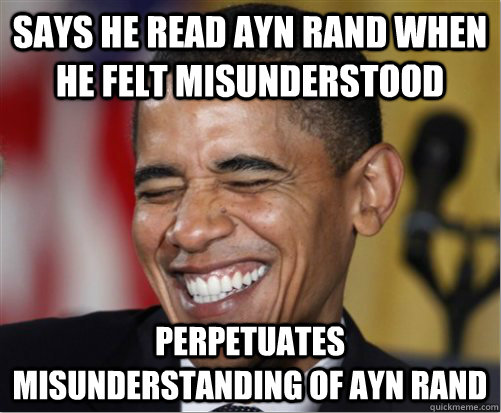
Obama “Read Ayn Rand” and Gets Her Views Wrong

In a Rolling Stone interview published today, Barack Obama distorted and misrepresented Ayn Rand’s views. Ari Armstrong of The Objective Standard responded to the president’s statements here:

Obama, Unsurprisingly, Gets Ayn Rand Wrong

The Ayn Rand Center’s blog also responded with analysis of Ayn Rand’s actual views and context that should help people understand those views:

Obama on Ayn Rand: The Annotated Version

Don Watkins has also responded to the issue Obama raised, of being an individualist and caring for other people, on the Ayn Rand Institute’s Laissez-Faire blog:

Obama’s Straw Man Attack on Ayn Rand

—–

Related Posts:

Bernie Madoff: Not Rationally Selfish, But Self-Destructive

The Morality of Rational Egoism: Short Notes

QuickPoint 1: Thinking is Individual

Atlas Shrugged, Altruism and Egoism

What Caused the Financial Crisis: It Wasn’t Capitalism or Deregulation

QuickPoint 1: Thinking is Individual

There are some people who say that ideas are products of a culture as a whole–that no one stands apart from the collective.

But where do ideas come from originally? Before an idea could be in many minds, it had to be in one mind. Thus, ideas come from individual thought. People can and do learn a great deal from others through their experience, but the process of thinking is a fundamentally, inescapably individual process. Learning from others does not mean parroting word sounds, but thinking about the material you are given. Before an idea can be taught, it must be thought of by an individual. Innovative individuals are those who use their own minds to think of new ideas, and thus move the “knowledge of the culture” (i.e. the sum of the knowledge of the network of communicating individuals) forward.

When people work to solve problems as a team, any individual who isn’t thinking on his own, with his physically separate brain, will not contribute to the discussion and will not make any breakthroughs.

—–

Note: At some point, I will likely write a longer article on this issue.

The Proof of Free Will (Libertarian Volition)

By the nature of the following refutation of determinism, it can also be considered a proof (1) of (libertarian-type) volition. It is a refutation of any theory that would deny the existence of non-necessitated events–in the form of fundamental, agent-controlled choices–located in a conceptual consciousness, including incompatibilist determinism and compatibilism.

Here is a short video (by someone else) explaining the general outlines of the argument:

Here is a link to the paper by Harry Binswanger:

A Refutation of Determinism

——————

(1) The argument shows that volition is a prerequisite of all knowledge and that the denial of volitional choice implies self-contradiction, thus establishing volitional choice as an axiom of epistemology. Strictly speaking, I think, by Leonard Peikoff’s definitions, this is not a proof, but an axiomatic validation. It establishes the axiom as absolutely and unquestionably true, but does not involve the specific process of logical proof of the positive proposition. The positive proposition is self-evident in each individual’s experience of existence.

Free Market Revolution by Yaron Brook and Don Watkins

Free Market Revolution: How Ayn Rand’s Ideas Can End Big Government is now available at Amazon.

From the description:

A look at how our current crises are caused by too much government, and how Ayn Rand’s bold defense of free markets can help us change course.

The rise of the Tea Party and the 2010 election results revealed that tens of millions of Americans are alarmed by Big Government, but skeptical that anything can or will be done to stop the growth of the state. In Free Market Revolution, the keepers of Ayn Rand’s legacy argue that the answer lies in her pioneering philosophy of capitalism and self-interest -a philosophy that more and more people are turning to for answers. In the past few years, Rand’s works have surged to new peaks of popularity, as politicians like Paul Ryan, media figures like John Stossel, and businessmen like John Mackey routinely name her as one of their chief influences. Here, Brook and Watkins explain how her ideas can solve a host of political and economic ills, including the debt crisis, inflation, overregulation, and the swelling welfare state. And most important, they show how Rand’s philosophy can enable defenders of the free market to seize the moral high ground in the fight to limit government. This is a fresh and urgent look at the ideas of one of the most controversial figures in modern history – ideas that may prove the only hope for the future.

To anyone who is relatively unfamiliar with Ayn Rand’s ideas, but interested in solving our current economic and cultural problems, I encourage you to read this book. I encourage anyone who is very familiar with Rand’s ideas to tell friends about this book, loan your copy to them, or give it to them as a gift.

To purchase, click here:
Free Market Revolution: How Ayn Rand’s Ideas Can End Big Government

EDIT: Here’s a really good video from the CATO Institute with the authors of Free Market Revolution: Free Market Revolution at CATO

How to Show That Taxation is Robbery

The following article is not a general proof of the Objectivist principle that the initiation of physical force is destructive to human life; but it will show that taxation is equivalent to robbery and, when carried out for wealth redistribution, is actually more harmful to more people than the robberies committed by criminals in First-World countries. (A general proof of the destructiveness of initiated force does exist, and I may go through it at some point in the future.)

The Hypothetical Showing the Connection

If I have earned, say, $1,000 this week through my own labor, and another man comes up to me, points a gun at me, and tells me to give him the money, so he can pay his rent, is this robbery? Is it legal for him to do it? What if he tells me it’s for his friend’s rent? Is that robbery/legal? What if he gets 9 of his friends and they all tell me I need to give him my money? Is that robbery/legal? What if the 10 men write up a document that says I have to give him my money, and they include me in a vote to affirm or reject the “law” that says I should give him my money? They all vote “yes” on the “law” and I vote ”no.” “Now,” they tell me, “we as a society of 11 have drafted a law that says that you have an obligation to give us the money. We have taken a vote and you have been outvoted. As a part of our society, you now owe us this money. If you don’t give it to us, we will imprison you at gunpoint. If you don’t like what we are doing, you can leave our territory.” Is THIS robbery? Yes, the same forcible imposition of the wills of others upon me has been made. Is it legal? Yes, actually; it is now “legal,” because a law has been voted on and passed. It is legal robbery. So, the question is: How many people does it take before this practice ceases to be robbery? A hundred? A thousand? Ten million?
Continue reading

The DIM Hypothesis by Dr. Leonard Peikoff

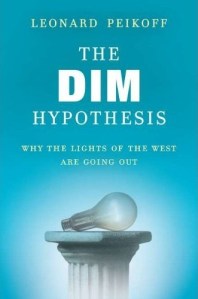
Dr. Peikoff’s last work of philosophy/historical analysis,The DIM Hypothesis was released today.

From the Amazon description:

With his groundbreaking and controversial DIM hypothesis, Dr. Leonard Peikoff casts a penetrating new light on the process of human thought, and thereby on Western culture and history.

In this far-reaching study, Peikoff identifies the three methods people use to integrate concrete data into a whole, as when connecting diverse experiments by a scientific theory, or separate laws into a Constitution, or single events into a story. The first method, in which data is integrated through rational means, he calls Integration. The second, which employs non-rational means, he calls Misintegration. The third is Disintegration—which is nihilism, the desire to tear things apart.

In The DIM Hypothesis Peikoff demonstrates the power of these three methods in shaping the West, by using the categories to examine the culturally representative fields of literature, physics, education, and politics. His analysis illustrates how the historical trends in each field have been dominated by one of these three categories, not only today but during the whole progression of Western culture from its beginning in Ancient Greece.

Extrapolating from the historical pattern he identifies, Peikoff concludes by explaining why the lights of the West are going out—and predicts the most likely future for the United States.

Available now from Amazon:

The DIM Hypothesis: Why the Lights of the West Are Going Out