Unknown's avatar

About Sword of Apollo

The dollar sign represents the creation of value, whether material or spiritual (i.e. psychological.) The creation of value by action *based on thought* is what sustains human life. Thus, the dollar sign is the proper symbol of human life. If you look closely, you'll see I have modified the dollar sign slightly for my personal Gravatar.

What is Individualism? What is Collectivism?

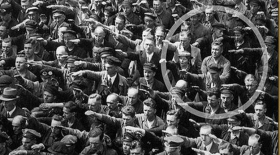
German man refusing Nazi saluteModern political debates, from the 18th Century up until today, are full of appeals to the ideas of individualism and collectivism, whether open or merely implied. People speak of “the common good” or “public goods” or “obligations to society” on one hand, and of “individual rights” or “individual freedom” on the other.

The late novelist and philosopher, Ayn Rand, is well known today for being an arch individualist who was very opposed to any form of collectivism. But what does it really mean to be an individualist or collectivist? Are the two views mutually exclusive? Is one or the other right, or is the reality a mixture of both? Here I will discuss what individualism and collectivism mean, which one or mixture represents the truth, and what the major implications of each of the views are for today’s moral and political debates.

Life is the Active Pursuit of Self-Sustaining Goals

The issue of individualism versus collectivism does not arise out of thin air. It arises out of the observation–whether explicitly stated or implicitly understood–that life consists of organisms that pursue goals that keep them alive. Lions find watering holes and hunt gazelles, eagles catch rabbits or fish, termites dig and build mounds for shelter, etc. The ultimate goal of this activity for any given organism is its continued life as the type of organism it is. (The origin of organisms in evolution has ensured that reproduction is a natural part of the life-pattern of each nonhuman species–i.e. reproductive behavior is part of an individual organism being the type of organism it is.)

The question of individualism versus collectivism is the question of what the living unit is for human beings–that is, what is the human organism that acts toward self-sustaining goals: is it the individual, or some group?


Continue reading

Ayn Rand on Christmas

Ayn Rand, novelist and philosopher of Objectivism, a philosophy for living on Earth.

Ayn Rand – novelist and philosopher

Ayn Rand, the novelist and philosopher, really enjoyed Christmas.

She was not a materialist; nor was she a mystical spiritualist. She held that there is no conflict between genuine spirituality and the enjoyment of material things. Human beings need material products to survive, and an abundance of material wealth–used under the guidance of proper moral principles–enhances human life and happiness dramatically. Wealth allows people leisure time: Instead of working about 12 hours a day from sunrise to sunset, 6 days a week, having a short supper and going to bed as most people did before capitalism and the Industrial Revolution, most Westerners can now afford to work 8 hours a day, while pursuing hobbies, recreation and friendships after work and on the weekends. People have a greater ability to balance vocational productive work with other pursuits that also contribute to happiness and spiritual contentment.

Rand also held that voluntary trade in a free market is a good, benevolent, win-win interaction: Both parties benefit from the trade, by their own judgment (or they wouldn’t pursue it, assuming they’re not acting self-destructively.) There is no need for anyone to sacrifice the interests of others for his own supposed benefit in free-market trades. (And in fact, sacrificing others cannot bring real benefits, but is self-destructive, all things considered.)

Continue reading

Biblical Inerrancy

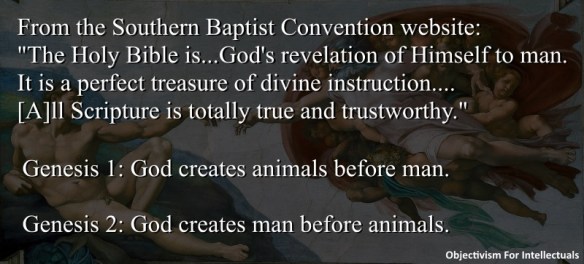
It is the official belief of the Southern Baptist Convention that the Bible is the perfect revelation of God and that it is the perfect source of moral instruction. From the SBC website:

The Holy Bible was written by men divinely inspired and is God’s revelation of Himself to man. It is a perfect treasure of divine instruction. It has God for its author, salvation for its end, and truth, without any mixture of error, for its matter. Therefore, all Scripture is totally true and trustworthy. It reveals the principles by which God judges us, and therefore is, and will remain to the end of the world the true center of Christian union, and the supreme standard by which all human conduct, creeds, and religious opinions should be tried. All Scripture is a testimony to Christ, who is Himself the focus of divine revelation.

Here is all the response that that belief needs or deserves:

“If anyone comes to me and does not hate father and mother, wife and children, brothers and sisters—yes, even their own life—such a person cannot be my disciple." -- Jesus, (Luke 14:26)

This is one of many details that varies between the four Gospels, causing them to contradict each other in their content and, to an extent, in their message. Biblical inerrancy is clearly an article of dogmatic, blind faith.

[Bible quote source]

Here’s one more from the Old Testament for good measure:

Biblical inerrancy - In the Bible, order of creation is different between Genesis 1 and Genesis 2. God creates animals before man in 1 and man before animals in 2.

—–

Related Posts:

The Bible (New Testament) as Evidence

Other People as Egoistic Values Versus Other People as Objects of Self-Sacrifice in Ayn Rand’s Philosophy

Introduction to Objectivism

The Wages of Altruism: Domestic Abuse

One Internal Contradiction in the Christian Worldview: God’s Omniscience vs. Free Will

Why the Philosophy of Objectivism is Still Relevant and Needed in the Age of Modern Science

“Equal is Unfair – The Inequality Advantage”: A Talk by Yaron Brook

Should economic inequality (inequality of wealth) in a capitalist system concern you? Is inequality of opportunity a problem that needs a governmental solution? Is it fair or just that some people make more money than others, or inherit wealth from their parents?

I found this video so powerful that I had to share it in its own post on my blog. In this video, Yaron Brook is both reasonable and passionate when he speaks about one of the central moral and political issues of our time: inequality. He also answers questions from his audience at the University of Exeter after the talk.

Stick around for the Q&A for Dr. Brook’s view of what legitimate equality is. (Hint: It’s the same type of equality meant by the Founding Fathers of the United States.)

Also, look for Yaron Brook’s upcoming book, Equal Is Unfair: America’s Misguided Fight Against Income Inequality, co-authored with Don Watkins.

—–

Related Posts:

Socialism and Welfare vs. Justice: Why Inalienable Private Property Rights are Required for Justice

On Fairness and Justice: Their Meanings, Scopes, and How They Are Not the Same

Wealth is Created by Action Based on Rational Thought

The Role of Profits in Free-Market Capitalism, and Why High Profits are Good for a Company’s Workers

How Business Executives and Investors Create Wealth and Earn Large Incomes

The Role of Profits in Free-Market Capitalism, and Why High Profits are Good for a Company’s Workers

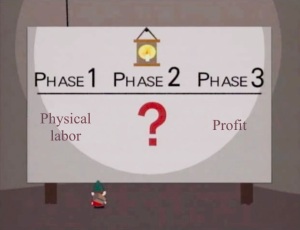
Underpants Gnomes Meme - Phase 1: Physical Labor Phase 2: ? Phase 3: ProfitWhether people like it or not, it is a fact that the production of valuable things requires more than physical labor. (I’m looking at you, Karl Marx, with your Labor Theory of Value and “profit as exploitation.”) This is especially true when it comes to industrial-scale mass production. To successfully deliver products at a reasonable price and quality, a company must be organized in certain ways that are effective; there must be communication and coordination between the various departments; there must be management to make sure things keep running smoothly together and that timetables are kept; there must be wealth invested for buildings, machinery and raw materials in the right amounts; any machinery and facilities must be continually maintained; there must be management of sales and distribution of the product; etc.
A collection of factory workers without power tools, without specific roles and without management direction will produce very little and very inefficiently. In any line of business, there is a tremendous amount of strategy, business planning, technical planning, management, and industry knowledge that goes into making a company productive and successful.

As I discussed in my essay, “How Business Executives and Investors Create Wealth and Earn Large Incomes,” a company’s chief executive officer (CEO) carries tremendous responsibility: he is crucial in making large-scale decisions for the company, implementing and coordinating major changes, planning long-term for the future market and technology the company will face, formulating and holding onto a large-scale vision of where the company should go, etc.

Continue reading

Why Fairness Does Not Mean Justice: Some Further Argument

Equal is Unfair: America's Misguided Fight Against Income Inequality, book coverOver three years ago, I wrote an essay discussing the proper meaning of the concepts of “fairness” and “justice,” as I understand them: On Fairness and Justice: Their Meanings, Scopes, and How They Are Not the Same.

My major points in this essay were 1) that the concept of “fairness” presupposes that one is talking about a zero-sum game: a situation devised by a purposeful intelligence to measure people’s attributes, where one person winning requires that another person loses; 2) that life in society and in general does not meet this criterion for “fairness” to apply: people “win” by creating valuable things, and do not need to deprive others of these things to have them; and 3) that societal justice requires the protection of individuals’ rights to life, liberty, and property, and that it consists in each individual generally being rewarded in proportion to his mental effort and virtuous actions.

In this previous essay, I explained my view of “fairness” and illustrated it with examples, but I did not argue extensively for my conception of that term–why my conception of fairness is correct. I have been prompted to provide further argument by the upcoming release of a book called “Equal is Unfair,” and one of the co-authors’ (Yaron Brook’s) reply to me regarding “fairness”:

I have great respect for Dr. Brook, and am looking forward to his latest book, but I think he’s wrong here: fairness does not mean justice. And the purpose of this post is to argue my case. I encourage those who have not read my previous essay to read it before proceeding on in this one, since it will help set the context for my arguments: On Fairness and Justice.

One of the first things that should spring to mind when someone mentions the word, “fairness,” is the realm of sports and competitions: Is it fair when women are put in competition with men? Is it fair when one team learns the other team’s plays through spying? Is a race where one athlete has artificial legs fair? Is a weightlifting competition fair when steroids are secretly taken, or openly allowed? Is it fair when the Patriots let air out of the football?

Does justice have the same intimate connection with such competitive sports? Is that one of the first things you think of when you think of justice? Probably not. This is our first clue that fairness and justice are different concepts: they seem to be associated with different realms of life.

Continue reading

It Is Not True that “97% of Scientists Agree that Climate Change is Real, Man-Made and Dangerous,” but Environmentalist Leaders Dogmatically Repeat It

In May of 2013, Barack Obama put out a tweet that said:

Ninety-seven percent of scientists agree: climate change is real, man-made and dangerous.

This claim is often repeated by environmentalists and the Left, and is most definitely false. Alex Epstein, writing for Forbes, destroyed this claim in his article, “‘97% Of Climate Scientists Agree’ Is 100% Wrong”.

From Epstein’s article:

One of the main papers behind the 97 percent claim is authored by John Cook, who runs the popular website SkepticalScience.com, a virtual encyclopedia of arguments trying to defend predictions of catastrophic climate change from all challenges.

Here is Cook’s summary of his paper: “Cook et al. (2013) found that over 97 percent [of papers he surveyed] endorsed the view that the Earth is warming up and human emissions of greenhouse gases are the main cause.”

This is a fairly clear statement—97 percent of the papers surveyed endorsed the view that man-made greenhouse gases were the main cause—main in common usage meaning more than 50 percent.

But even a quick scan of the paper reveals that this is not the case. Cook is able to demonstrate only that a relative handful endorse “the view that the Earth is warming up and human emissions of greenhouse gases are the main cause.” Cook calls this “explicit endorsement with quantification” (quantification meaning 50 percent or more). The problem is, only a small percentage of the papers fall into this category; Cook does not say what percentage, but when the study was publicly challenged by economist David Friedman, one observer calculated that only 1.6 percent explicitly stated that man-made greenhouse gases caused at least 50 percent of global warming.

Where did most of the 97 percent come from, then? Cook had created a category called “explicit endorsement without quantification”—that is, papers in which the author, by Cook’s admission, did not say whether 1 percent or 50 percent or 100 percent of the warming was caused by man. He had also created a category called “implicit endorsement,” for papers that imply (but don’t say) that there is some man-made global warming and don’t quantify it. In other words, he created two categories that he labeled as endorsing a view that they most certainly didn’t.

As Alex Epstein details, some of the scientists whose papers were mischaracterized by this paper objected to the misrepresentation. There is more to Epstein’s article that is worth reading, so I definitely recommend reading the whole thing when you have time.

Continue reading

A Refutation of G.E. Moore’s Critique of Ethical Egoism: A Dialogue

G. E. Moore He thought ethical egoism was self-contradictory.

G. E. Moore

In a post on Reddit, a user called /u/Regtik quoted the Stanford Encyclopedia of Philosophy article on Egoism, which features G.E. Moore’s criticism that ethical egoism is self-contradictory. What follows is my discussion with Regtik. (Another user, called “parolang” also makes an appearance.) My comments explore the status of “good”–including “moral good”–as inherently relational to a living creature, versus the mistaken notion of “intrinsic goods,” as well as the reason that the rational self-interests of individuals generally do not conflict.

I am “Sword_of_Apollo” in this discussion and, as usual, I am arguing from an Objectivist perspective, (which advocates a normative ethics of rational egoism):

Regtik: Ethical Egoism is an internally inconsistent morality.

From the [Stanford Encyclopedia of Philosophy]:

“G. E. Moore argued that ethical egoism is self-contradictory. If I am an egoist, I hold that I ought to maximize my good. I deny that others ought to maximize my good (they should maximize their own goods). But to say that x is “my good” is just to say that my possessing x is good. (I cannot possess the goodness.) If my possession of x is good, then I must hold that others ought to maximize my possession of it. I both deny and am committed to affirming that others ought to maximize my good. (Sometimes Moore suggests instead that “my good” be glossed as “x is good and x is mine.” This does not yield the contradiction above, since it does not claim that my possession of x is good. But it yields a different contradiction: if x is good, everyone ought to maximize it wherever it appears; egoists hold that I ought to maximize x only when it appears in me.)”

https://en.wikipedia.org/wiki/Prisoner%27s_dilemma

This is a good example of why ethical egoism fails. Ethical Egoism fails to reap the full benefits of human cooperation because it holds the stance that cooperation is only useful when it benefits yourself. …

Sword_of_Apollo: This is not a sound argument. The actual, rational basis of the concept of “good” involves a relation. Something is good for something else, (a living creature.) Plato and Kant to the contrary notwithstanding, this includes moral goods.

Moral goods are those goods that are freely chosen by humans, (potentially rational animals) that are good for all humans in all–or almost all–circumstances. (This universality means that they are very much abstract goods. Note here that when I say “good for all humans,” I mean that the goal or object of each moral act is always good for the agent acting; not that the actions of each agent are necessarily good for all humans.)

To claim that egoism is self-contradictory as G.E. Moore did is absurd. It’s like saying that the concept of “destructive” is self-contradictory, because something can be destructive to one object, but not to others: A bomb that destroys one building is destructive, because it destroyed that building; but it is also not destructive, because it left many others standing. So the bomb is both destructive and not destructive at the same time. Since we (allegedly) have a contradiction, the concept of “destructive” can only apply to things that destroy everything, and is otherwise nonsensical. That’s absurd. Something that is destructive is destructive to something else, just as something that is good is good for something else.

https://en.wikipedia.org/wiki/Prisoner%27s_dilemma

This is a good example of why ethical egoism fails. Ethical Egoism fails to reap the full benefits of human cooperation because it holds the stance that cooperation is only useful when it benefits yourself.”

I’ve said it before and I’ll say it again: Prisoner’s Dilemma is an artificially restricted situation that is not a good model for real life.

Continue reading

Ayn Rand and the Crude Materialism of the “Rich vs. Poor” Worldview

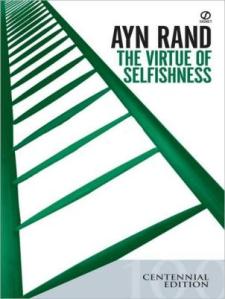
The Virtue of Selfishness by Ayn RandOne of the most common criticisms of Ayn Rand that I hear from people (especially on the Left) is that she “loved the rich and hated the poor,” or, in more recent terms, that she “was for the 1% at the expense of the 99%.”

Yet Ayn Rand herself did not really think or judge people in those terms, as should be fairly obvious to anyone who has read her writing without prejudice: Many of the heroes and protagonists of her novels were poor or roughly middle-income, including a young Howard Roark, Steven Mallory, Roark’s friend Mike, Eddie Willers, Cheryl Brooks, Jeff Allen, Gwen Ives, and even her most famous hero, John Galt. Many of Rand’s villains are wealthy businessmen, government officials and scientists, including the mature Peter Keating, Guy Francon, James Taggart, Orren Boyle, Floyd Ferris, Wesley Mouch, Kip Chalmers, and Mr. Thompson.

Rand’s nonfiction explicitly says that what is important in the moral judgment of people is not the scale of their productive ability, but how they choose to use their minds. In her essay, “The Objectivist Ethics” (VoS) Rand writes:

“Productive work is the road of man’s unlimited achievement and calls upon the highest attributes of his character: his creative ability, his ambitiousness, his self-assertiveness, his refusal to bear uncontested disasters, his dedication to the goal of reshaping the earth in the image of his values. “Productive work” does not mean the unfocused performance of the motions of some job. It means the consciously chosen pursuit of a productive career, in any line of rational endeavor, great or modest, on any level of ability. It is not the degree of a man’s ability nor the scale of his work that is ethically relevant here, but the fullest and most purposeful use of his mind.” [emphasis mine]

So Rand doesn’t accept that having more money automatically makes one more moral.

But why then the accusations that she’s in favor of the rich and against the poor? The accusations actually show us, not what Rand believed, but what many of her critics believe. The accusations actually reflect the materialistic nature of these critics’ worldview.

Continue reading

A Message on Ayn Rand, Compassion, and Individualism vs. Collectivism

Ayn Rand

Ayn Rand

A user on reddit posted a question to the subreddit, /r/askphilosophy, which I reprint below. I have also reprinted my response in a private message below that.

The question posed:

So I’ve read many of Ayn Rand’s work and have been frequently reading Libertarian articles and stuff. I’ve read Atlas Shrugged, The Fountainhead and The Virtue of Selfishness. [Links added in reprint.]

When I read Atlas Shrugged it was something quite new to me. I was a Philosophy undergraduate back then and her ideas were very different from all of the things I’ve been in contact with. Mainly her individualist ethics and capitalism.

As time went by I kept reading other books, articles, as well as debating with a few people and reflecting about all of those concepts. As for today, I really appreciate how well Rand’s ethics value the subject and how fair laissez-faire capitalism seems to be. However, I’ve seen many flaws in her ideas.

Concerning ethics, I think her ideas lack a lot of compassion and put collectivism to a zero. Individualism is great, but we are all part of social groups, aren’t we? And concerning politics I don’t see how a TRUE free market would be possible in any time soon, since it would require anarchy or minarchy to happen. (about economy, I am in favor of capitalism as an economic system, even though I disagree of how it is like right now)

So as it’s been a while since I’ve started this path, which was fairly opposite to the extreme-left I had taken when I got into Philosophy, I’d like to read some authors and books that have ideas that oppose Rand’s. I don’t want books that argue directly with her, such as “Ayn Rand Nation”. Instead, I’d like to read opposite opinions.

According to the Political Compass I’m a Right Libertarian, so I’d like to read some authors of the Left Libertarian. The Political Compass mentions Pyotr Kropotkin, Noam Chomsky and Emma Goldman in this area. (I’d like to read the Left Libertarian authors since I’m not that pro-government at the moment)

So what authors/books would you suggest me?

My response:

In your OP, you say:

Concerning ethics, I think [Rand’s] ideas lack a lot of compassion and put collectivism to a zero. Individualism is great, but we are all part of social groups, aren’t we?

First, in regard to compassion: that is an emotional response, and emotions are displayed by people, not ideas. Principles as such can neither be compassionate, nor uncompassionate. They can be true or false, justified or unjustified by evidence and argument.

Continue reading