

Ayn Rand
Ayn Rand’s idea of rationality is one of the most misunderstood concepts in her Objectivist philosophy. It seems that almost everyone just assumes they know exactly what rationality means. Then, upon learning that Rand advocates consistent rationality, tend to judge Rand’s philosophy by their preconceived notion of rationality, without realizing their understanding is deeply flawed.
Here I’ll explain what rationality means in Ayn Rand’s philosophy. I’ll quote Rand for a brief, positive explanation of her concept of rationality. Then, because misconceptions are so prevalent, my further explanation will largely take the form of a series of myths about rationality, with genuine rationality explained in contrast to the myths.
In her essay, “The Objectivist Ethics,” Ayn Rand describes rationality:
Rationality is man’s basic virtue, the source of all his other virtues. …
The virtue of Rationality means the recognition and acceptance of reason as one’s only source of knowledge, one’s only judge of values and one’s only guide to action. It means one’s total commitment to a state of full, conscious awareness, to the maintenance of a full mental focus in all issues, in all choices, in all of one’s waking hours. It means a commitment to the fullest perception of reality within one’s power and to the constant, active expansion of one’s perception, i.e., of one’s knowledge. It means a commitment to the reality of one’s own existence, i.e., to the principle that all of one’s goals, values and actions take place in reality and, therefore, that one must never place any value or consideration whatsoever above one’s perception of reality. It means a commitment to the principle that all of one’s convictions, values, goals, desires and actions must be based on, derived from, chosen and validated by a process of thought—as precise and scrupulous a process of thought, directed by as ruthlessly strict an application of logic, as one’s fullest capacity permits.
So rationality consists of two components: a mental component and a physical component. It involves both thought and action. The thinking portion can be described as the rigorous application of objectivity in one’s own life. So when I discuss the myths about rationality, you should understand that what I say about the mental aspect of it applies to Ayn Rand’s concept of objectivity, as well. (Objectivity is frequently mischaracterized, along with rationality.)
Now to the myths:
Myth: Rationality means not making errors about facts.
Truth: Rationality means judging facts to the best of your ability on the basis of observation, rather than going by faith or feelings. Doing this is not a guarantee that you won’t make mistakes. Rational thought can still result in major errors about what the facts are.
The evidence may seem to point to one conclusion, because of limitations in what evidence you have access to. But there may be other evidence you’re not aware of that would lead you to a different conclusion. So long as you’re continually thinking and following the evidence to the best of your ability, you are acting rationally in regard to the facts.


 The purpose of this article is to explain different ethical theories and compare and contrast them in a way that’s clear and easy for students to understand. There are three major categories of ethical systems that students typically learn about in philosophy classes: consequentialism, deontology and virtue ethics. I will describe all of them briefly, then describe each one of them in more detail, pointing out their defining features and major variants. I’ll then discuss the nature of Objectivist Ethical Egoism and how it compares and contrasts with each of these types of ethics.
 Here’s a list of possible ways I’ve thought of or heard to fund government, without the government
  Many Christians, especially conservatives in the US, will tell you that Christianity is compatible with liberty. Some will even say that it’s the foundation of liberty. After all, isn’t one of the Biblical Commandments, “Thou shalt not steal”? So the people in government have no business stealing through coercive taxation. And didn’t Jesus practice non-violence and admonish followers to give to the poor themselves, rather than forcibly taking money from others to donate? What business do the people in government have doing this, if they’re going by Christian morality?


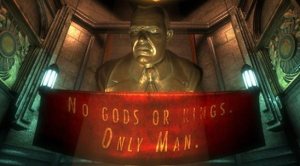 The original BioShock was a game released in 2007 by 2K Games. The main antagonist was Andrew Ryan, a “business magnate” who founded an underwater city, called Rapture. He was supposed to be guided by the same philosophy that
  What I want to see presidential candidate, Gary Johnson, say to those who supported Bernie Sanders in the Democratic primary:
 Many libertarians will tell you that moral theories have relatively little to do with their advocacy of libertarianism. They think that liberty is morally neutral. Their thinking for why this is so is basically that liberty enables people to live by all sorts of different moral ideas. It doesn’t favor any morality over others, they think, so liberty itself must be morally neutral.
 Objectivism In Depth