
 Within epistemology, which is the branch of philosophy that studies human knowledge, one of the most fundamental topics is the nature of perception. Philosophers from the Ancient Greeks to the present have offered various theories of what perception is and how it occurs. Because it is a topic so fundamental to human knowledge, specialized natural science can’t answer the basics about it. Science relies on perceptual observations of reality. Thus science itself relies on the idea that perception allows us to be aware of an external reality. If perception does not give us awareness of external reality, then scientific study of the external world is not possible: We would always, at best, be inspecting the contents of our own minds.
Thus, it is the job of philosophy to answer the most basic question: Does perception give us an awareness of reality, and if so, at the most basic level, how?
In this essay, I’ll explain three different theories of perception. To the question of whether perception gives us an awareness of reality, all three of them attempt to answer, “Yes.” Where they disagree is on the “how,” or the basic nature of perception. The three basic theories are naïve realism, representative realism, and Direct Transformative Process Realism (DTPR.) (“Representative realism” here is a synonym for representationalism. Note that these theories are all variants of “realism” in perception. Theories that answer “No” to the question of whether we can observe mind-independent reality would be variants of “idealism.”)
Philosophers sometimes use “naïve realism” as a synonym for “direct realism,” and there are many different theories that could be called “direct realist.” But here I will take “naïve realism” to be one specific sort of direct realist theory: the sort of approach to perception exemplified by the Ancient Greek philosopher, Aristotle. Representationalism too has quite a few variants, but they all share a common thread. I will focus largely on the version of representationalism associated with the English philosopher, John Locke. Direct Transformative Process Realism (DTPR) is my term for the theory of perception put forward by Ayn Rand and Objectivist intellectuals after her. It’s a form of direct realism that is very different from Aristotle’s approach. I’ll explain this term in more detail when I explain this theory later in this essay.

 The purpose of this article is to explain different ethical theories and compare and contrast them in a way that’s clear and easy for students to understand. There are three major categories of ethical systems that students typically learn about in philosophy classes: consequentialism, deontology and virtue ethics. I will describe all of them briefly, then describe each one of them in more detail, pointing out their defining features and major variants. I’ll then discuss the nature of Objectivist Ethical Egoism and how it compares and contrasts with each of these types of ethics.
 Here’s a list of possible ways I’ve thought of or heard to fund government, without the government
  Many Christians, especially conservatives in the US, will tell you that Christianity is compatible with liberty. Some will even say that it’s the foundation of liberty. After all, isn’t one of the Biblical Commandments, “Thou shalt not steal”? So the people in government have no business stealing through coercive taxation. And didn’t Jesus practice non-violence and admonish followers to give to the poor themselves, rather than forcibly taking money from others to donate? What business do the people in government have doing this, if they’re going by Christian morality?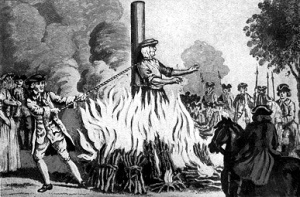

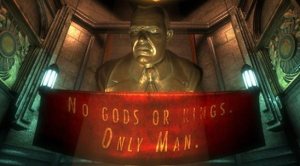 The original BioShock was a game released in 2007 by 2K Games. The main antagonist was Andrew Ryan, a “business magnate” who founded an underwater city, called Rapture. He was supposed to be guided by the same philosophy that
  What I want to see presidential candidate, Gary Johnson, say to those who supported Bernie Sanders in the Democratic primary:
 Many libertarians will tell you that moral theories have relatively little to do with their advocacy of libertarianism. They think that liberty is morally neutral. Their thinking for why this is so is basically that liberty enables people to live by all sorts of different moral ideas. It doesn’t favor any morality over others, they think, so liberty itself must be morally neutral.
 There’s a little school in California’s Orange County that not too many people know about. But this school should be the talk of the education world, because it’s an amazingly good school. This is VanDamme Academy, a small K-8 school in Aliso Viejo, California.
 Objectivism In Depth