Philosopher Greg Salmieri (of Rutgers University) Discusses Ayn Rand’s Moral Philosophy on the Elucidations Podcast

The Library Research Pavilion at the University of Chicago, whose philosophy department produces the Elucidations podcast

The Library Research Pavilion at the University of Chicago, (whose philosophy department produces the Elucidations podcast.)

The Elucidations podcast has released an interview with Professor Greg Salmieri on Ayn Rand’s moral philosophy. This is a great interview, especially for those who don’t know that Ayn Rand’s moral philosophy supports friendship, benevolence and helping other people in certain ways and under certain circumstances.

The interview also does a good job of presenting Ayn Rand’s basic approach to morality and moral thinking.

Listen here:

Elucidations, Episode 73: Greg Salmieri discusses Ayn Rand’s moral philosophy

—–

Related Posts:

Introduction to Objectivism

Why the Philosophy of Objectivism is Still Relevant and Needed in the Age of Modern Science

Why “Selfishness” Doesn’t Properly Mean Being Shortsighted and Harmful to Others

Ayn Rand’s Philosophy vs. Abortion Bans: Why a Fetus Doesn’t Have Rights

The Wages of Altruism: Domestic Abuse

The Ayn Rand Institute’s 2015 Summer Conference (OCON) Just Wrapped Up

The Ayn Rand Institute (ARI) holds a conference every summer in a different city. Objectivists, students of Objectivism, and other people interested in Ayn Rand‘s philosophy travel from around the country to meet each other and hear talks by experts in various fields. The speakers discuss the ideas of Objectivism and their applications in life, science, and the arts, and answer questions from the audience. It is a very educational event, and a way to meet new people interested in ideas. (For the veterans of OCONs past, it’s also a chance to see old friends.) I definitely recommend it.

I went to OCON 2014 in Las Vegas, but was unable to go this year. But I look forward to videos of some of the major talks being released on ARI’s YouTube channel, as they were for OCON 2014.

There’s a fee to attend OCON, but that fee is reduced quite dramatically for current students and young adults. (Students can even apply for scholarships to cover the costs of travel and lodging.) If you are a student or young adult, I especially recommend taking the opportunity to attend at least one OCON. It’s a great opportunity to take a break from mundane things, meet great people, and learn more about Ayn Rand’s deep philosophy in a benevolent, congenial and exciting atmosphere.

You can subscribe to the Ayn Rand Institute’s Facebook and Twitter pages to see announcements when registration for next year’s OCON is open.

Here is the cvent page for OCON 2015, and here’s a list of upcoming ARI events.

Here are a couple of talks from last year’s OCON:

—–

Related Posts:

Introduction to Objectivism

Why the Philosophy of Objectivism is Still Relevant and Needed in the Age of Modern Science

Ayn Rand’s Philosophy vs. Abortion Bans: Why a Fetus Doesn’t Have Rights

The Wages of Altruism: Domestic Abuse

What Caused the Financial Crisis: It Wasn’t Capitalism or Deregulation

Why the Philosophy of Objectivism is Still Relevant and Needed in the Age of Modern Science

Barred spiral galaxy in space. Represents science and philosophy.Many people distrust abstract philosophical ideas and ideals. There are a couple of related reasons for this: 1) They hold that abstract ideas “oversimplify” reality, ensuring that they always fail to properly capture it, and 2) They think that abstract ideas outside of the natural sciences are generally faith-based dogma, or “armchair” speculation. (In either case, this means they think the ideas are put forward without sufficient supporting evidence.)

In regard to Number 1, I’d like to point out that all human concepts “simplify reality” in a sense: they all ignore differences between particular objects to focus on features common to a class of objects. For example, the concept “chair” refers to every particular chair you have ever encountered or will encounter. This means that it omits the countless differences between any two particular chairs. (Even if two chairs look identical at a macroscopic level, they almost certainly have countless differences at a microscopic level.) All other concepts function in a similar way: they ignore certain differences between things, for the sake of classifying them and integrating them into a single mental unit, represented by one word (“chair,” “dog,” etc.)

Yet the similarities that proper concepts such as “chair” capture are real and important, and it is not an oversimplification to say that all things called “chairs” (without qualification or modification) are made to allow someone to sit on them. Virtually no one accuses ideas about chairs of “oversimplifying reality”: Someone who speaks of chairs typically understands that he can always give more information about a particular chair by providing a description.

Classifying and simplifying reality by means of concepts is the human way of dealing with reality in thought, and it is very powerful, when done properly. Human beings have used the simplifying concepts of the natural sciences to cure diseases, increase food production per farmhand manyfold, extend the average human lifespan by over thirty years, build skyscrapers, and land on the moon. Furthermore, there is no reason to believe that simplifying concepts stop working at any level of abstraction (breadth of generalization) or at any level of complexity. The simple principles of Einstein’s relativity are highly abstract: they apply to all physical phenomena in the known universe, (when the scale under consideration is not too small) and to all the immense complexity of gravitational interactions between visible objects and light rays in galaxies. Continue reading

Why “Selfishness” Doesn’t Properly Mean Being Shortsighted and Harmful to Others

Carpenter Working with Pencil and HammerThe definitions of the terms we use have consequences for our ability to think and communicate clearly.

Imagine for a moment that your friend told you that he defines “carpenter” as “one who shapes wood by shooting it with a gun.” You’re baffled and you ask him what word he uses for someone who shapes wood by other means, such as a saw, lathe and sander. He says that he really has no word for this. He has a couple of synonyms for “carpenter,” but they also carry the implication that the person shaping the wood used a gun.

Hopefully, you can see that the problem with this hypothetical situation is not merely that you and your friend are using terms differently: shooting wood with a gun is a terribly impractical way of shaping it into useful forms. If the only concepts you have of wood shaping mean using a gun to do it, then you can’t really talk about those who shape wood using the practical methods in their profession.

Ayn Rand held that the common concept of “selfishness” is in an exactly analogous position to your hypothetical friend’s use of “carpenter.” At root, “selfishness” means pursuing one’s own interests and well-being. But the common use today adds in a second element: “pursuing your interests/well-being by means that are shortsighted and hurtful to others.” In today’s culture, the approximate synonyms of “selfishness,” such as “egoism” and “self-interest,” tend to be regarded with the same connotations of shortsightedness and harmfulness, so they are not much different.

Yet Ayn Rand rejected the idea that being shortsighted and hurtful to others is inherent in pursuing one’s interests and well-being. In fact, she recognized that the pursuit of one’s genuine interests in everyday life is specifically the opposite of “shortsighted and hurtful to others.” An individual’s genuine interests require long-term planning to fulfill, and his well-being is not served by doing harm to others. Attempting to pursue one’s self-interest by shortsighted and hurtful means is like trying to shape wood into a beautiful chair by shooting it with a pistol: utterly doomed to failure.

Continue reading

Objectivism for Dummies?

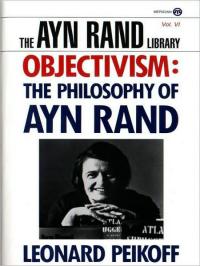
Objectivism: The Philosophy of Ayn Rand by Leonard Peikoff

A more in-depth, book-length overview of Objectivism.

I find it a bit strange that one of the top Google auto-completes I see for “Objectivism” is “Objectivism for dummies,” considering that there is no “For Dummies” book on this topic. But what it indicates is that there is significant interest in a basic, understandable introduction to Objectivism, the philosophy of the novelist and philosopher, Ayn Rand.

If this is what you want, I’d like to recommend my Introduction to Objectivism page. Not only does it have a clear and straightforward presentation of the philosophy of Objectivism, but it also has a large number of links to resources for learning more.

Introduction to Objectivism

I’d also like to recommend reading Ayn Rand’s novels, such as Atlas Shrugged and The Fountainheadif you haven’t recently–to get a fuller feel for the type of person that Objectivism praises, and the type of life that it holds out as an ideal. As I like to caution, however, Rand’s novels are romantic novels, and they feature extraordinary and dramatic situations. The principles her ideal heroes live by are the ones she advocates, but one must be careful about being too literal, (or, in Ayn Rand’s terminology, “concrete-bound” or “anti-conceptual”) in applying those principles to real life.

Happy learning! 🙂

Sword of Apollo

—–

Related Posts:

The Nature of the Morality of Rational Egoism: Short Notes

Other People as Egoistic Values Versus Other People as Objects of Self-Sacrifice in Ayn Rand’s Philosophy

Human Emotions are the Products of Beliefs and Subconscious Value Judgments

Laissez-Faire Capitalism Solves “The Tragedy of the Commons” and Deals With Negative Externalities: A Dialogue

Why Healthcare in the US is So Expensive, and What Can Be Done About It

On This Memorial Day, Let Us Remember, Not “Sacrifice,” But Those Who Have Fought for Freedom

The U.S. Marine Corps Color Guard marches during pass in review during the closing of a Battle Color Detachment ceremony at Eisenhower High School, Rialto, Calif., on March 4, 2012.Every Memorial Day, we hear speeches from government leaders praising what they call the sacrifices of American soldiers. On Memorial Day 2013, President Obama said:

[N]ot all Americans may always see or fully grasp the depth of sacrifice, the profound costs that are made in our name — right now, as we speak, every day.

On Memorial Day 2014, Obama said this:

Early this morning, I returned from Afghanistan. Yesterday, I visited with some of our men and women serving there — 7,000 miles from home. For more than 12 years, men and women like those I met with have borne the burden of our nation’s security. Now, because of their profound sacrifice, because of the progress they have made, we’re at a pivotal moment. Our troops are coming home. By the end of this year, our war in Afghanistan will finally come to end. And yesterday at Bagram, and here today at Arlington, we pay tribute to the nearly 2,200 American patriots who’ve made the ultimate sacrifice in Afghanistan. We will honor them, always.

But is it really “sacrifice” that we properly honor on Memorial Day? Or is it something else that we should be focusing on?

On September 11, 2001, 19 Muslim totalitarians boarded American planes and flew them into the World Trade Center buildings, the Pentagon, and the ground in Pennsylvania. What they did was a sacrifice of their lives for the sake of killing “the enemy” and defending what they saw as the sanctity, purity and salvation of their people against the “corrupting” influences of the “decadent” West. Was this act noble because it was a sacrifice? No?

Then it is not sacrifice per se that we properly honor on Memorial Day, since we do not honor all of those who sacrifice for any cause. Is it then the sacrifice of oneself for the sake of freedom? Is this what we properly honor?

Continue reading

The Meaning of “Necessary” Versus “Contingent” Truth

Billiard balls ready to be brokenThere is a long history in philosophy of distinguishing between truths that are “necessary” and truths that are “contingent.”

A necessary truth is a true statement whose negation must imply a contradiction in reality, such that the negation would be impossible.

So, if “One plus one equals two,” is a necessary truth, then the statement “One plus one does not equal two” will imply a contradiction. Given the meanings of “one” and “two,” we can immediately see that the addition of two “ones” (units) always does yield “two,” yet the statement “One plus one does not equal two,” contradicts this. It’s incomprehensible that one plus one should ever add to anything but two. So “One plus one equals two,” is commonly held to be a necessary truth, with its negation being impossible.

A contingent truth is a true statement whose negation does not imply a contradiction in reality, such that the negation could have been the case.

So, if “John married Jessica last Sunday,” is a contingent truth, then the statement “John did not marry Jessica last Sunday,” could have been true, without implying a contradiction in reality. Since John could have chosen not to marry Jessica, or to have married her on a different day, we can see that this is indeed a contingent truth.

The Objectivist View on the Necessary/Contingent Distinction

Objectivism-The Philosophy of Ayn RandCausality (the Law of Cause and Effect) is the Law of Identity applied to action. This means that an entity’s actions follow from its nature. That is, the nature of the entity (its attributes, properties, etc.) causes the action it will take in any given situation. In any given context, there is only one action open to it: the one in accordance with its nature. Any other action would contradict its nature.

Continue reading

The Basics of Ayn Rand’s Philosophy: Introducing my “Introduction to Objectivism” Page

The happiness of a man whose enlightened mind illuminates the world. Silhouette of Howard Roark with light rays emanating from his head.Hot off the digital press is my “Introduction to Objectivism” page. It conveys the basics of Ayn Rand‘s philosophy in an overview summary. It also explains some of the benefits of learning about her philosophy–called Objectivism–a little about the nature of moral and philosophical principles, and a little about how this rational philosophy fits in with modern science.

Exploring Objectivism is an intellectual adventure that really gives you a greater appreciation for your life, the world around you, and the power of abstract ideas to bring good or evil, success or failure.

So jump on in! 😀

Click here: Introduction to Objectivism

—–

Related Posts:

The Structure of Objectivism

The Nature of the Morality of Rational Egoism: Short Notes

Human Emotions are the Products of Beliefs and Subconscious Value Judgments

Laissez-Faire Capitalism Solves “The Tragedy of the Commons” and Deals With Negative Externalities: A Dialogue

Why Healthcare in the US is So Expensive, and What Can Be Done About It

The Social Justice Warrior’s 9 Theses Against this Blog and Its Author

This blog is racist, because it supports Israel over Islamic totalitarians, and because it posts videos of people speaking in front of Tea Party sympathizers. (You know, those horrible racists!)

This blog is sexist, because it uses “he,” instead of “he/she” or “(s)he” or “he or she” or “she,” when referring to those of unspecified gender.

This blog is ableist, because its author doesn’t believe people should be robbed to support the disabled, (and all the disabled are permanently useless and can never support themselves without the government forcing others to care for them.)

This blog is hateful of poor people, because it doesn’t support the forcible tearing down of rich people for their sake.

This blog is against sound economics, like the Broken Window Theory and “wealth inequality means everyone is poorer.”

This blog dares to peek beyond the Veil of Ignorance, and challenge John Rawls’s view of (social) justice as fairness.

This blog is homophobic, because its author doesn’t support laws forcing private businesses to hire or serve people they don’t want to, such as gays.

This blog is anti-science, because its author doesn’t want government to destroy people’s freedom on the basis of unreliable computer models.

This blog is triggering, because it contains offensively positive references to Ayn Rand.

—–

Related Articles:

Alternet’s Ayn Rand fetish

Salon’s Ayn Rand fetish

Socialism and Welfare vs. Justice: Why Inalienable Private Property Rights are Required for Justice

A farm and a factory: examples of property that requires effort to build.In 1816, Thomas Jefferson wrote:

“To take from one, because it is thought that his own industry and that of his fathers has acquired too much, in order to spare to others, who, or whose fathers have not exercised equal industry and skill, is to violate arbitrarily the first principle of association, “the guarantee to every one of a free exercise of his industry, and the fruits acquired by it.””

Here, Jefferson is affirming the principle of individual rights, especially property rights. But don’t property rights sometimes stand in the way of justice? In any such cases, wouldn’t it be a moral imperative for government to violate property rights?

The purpose of this essay is to show that inalienable private property rights are a necessary condition of justice. That is, any violation of property rights implies injustice, to the extent of the violation. Please note that it is not the purpose of this essay to argue that property rights guarantee justice. Objectivism does not hold that property rights are a sufficient condition for justice, only a necessary condition. There is much injustice that can occur without violations of property rights. But no one, including the government, can rectify such injustices by violating property rights. Anyone attempting to do this is in the wrong, morally.

So, what is an inalienable property right? It is a principle specifying that no one else may take or otherwise use the thing a person has a right to, without that person’s permission. (All things properly called “rights” are inalienable–that is, they cannot morally be taken away; otherwise they are not “rights,” but grants of permission by someone else. Note also that one person’s rights can be waived by him, by the act of violating another person’s rights.)

A property right to a certain, distinct thing–call it “X”–is properly acquired by either 1) engaging in a productive process directly involving X, when it is not already owned by someone else, or 2) consensually trading things or services with another person for X, when that person owns X, or 3) receiving X as a gift from another person, when that person owns X. A “productive process” might be farming to produce food, building a home, building a factory, making shoes, writing software, providing services, like air conditioning repair, radio, television, movies, etc.

Continue reading