It is the official belief of the Southern Baptist Convention that the Bible is the perfect revelation of God and that it is the perfect source of moral instruction. From the SBC website:
The Holy Bible was written by men divinely inspired and is God’s revelation of Himself to man. It is a perfect treasure of divine instruction. It has God for its author, salvation for its end, and truth, without any mixture of error, for its matter. Therefore, all Scripture is totally true and trustworthy. It reveals the principles by which God judges us, and therefore is, and will remain to the end of the world the true center of Christian union, and the supreme standard by which all human conduct, creeds, and religious opinions should be tried. All Scripture is a testimony to Christ, who is Himself the focus of divine revelation.
Here is all the response that that belief needs or deserves:
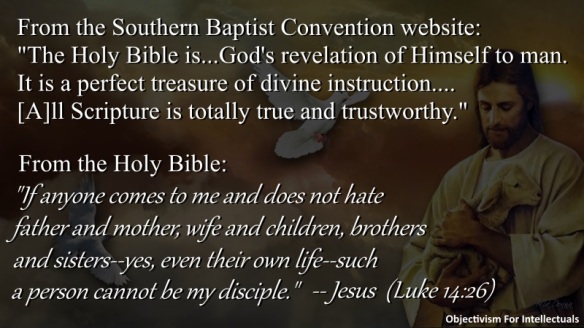
This is one of many details that varies between the four Gospels, causing them to contradict each other in their content and, to an extent, in their message. Biblical inerrancy is clearly an article of dogmatic, blind faith.
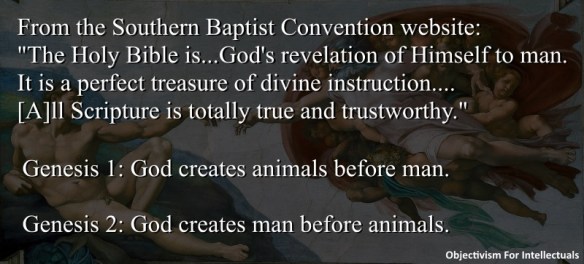
Here’s one more from the Old Testament for good measure:
—–
Related Posts:
The Bible (New Testament) as Evidence
The Wages of Altruism: Domestic Abuse
One Internal Contradiction in the Christian Worldview: God’s Omniscience vs. Free Will
Why the Philosophy of Objectivism is Still Relevant and Needed in the Age of Modern Science
 Whether people like it or not, it is a fact that the production of valuable things requires more than physical labor. (I’m looking at you, Karl Marx, with your Labor Theory of Value and “profit as exploitation.”) This is especially true when it comes to industrial-scale mass production. To successfully deliver products at a reasonable price and quality, a company must be organized in certain ways that are effective; there must be communication and coordination between the various departments; there must be management to make sure things keep running smoothly together and that timetables are kept; there must be wealth invested for buildings, machinery and raw materials in the right amounts; any machinery and facilities must be continually maintained; there must be management of sales and distribution of the product; etc.